Trump, Backed by Republican Turnaround, Plays Hardball With Putin
Visit by Ukraine’s Zelensky to White House comes as Trump seeks to repeat Gaza success in Ukraine.
President Volodymyr Zelensky’s meeting Friday with President Trump at the White House comes as both men are bolstered by a sea change in Republican support for Ukraine. Backed by polls showing Republicans reverting to their traditional hard line on Moscow, Mr. Trump is exerting this week the kind of full court press on the Kremlin that won him the Gaza peace accord.
In a potentially significant blow to Russia’s economy, Mr. Trump announced Wednesday that Prime Minister Narendra Modi of India has promised to stop buying Russian oil. “I was not happy that India was buying oil, and he assured me today that they will not be buying oil from Russia,” Mr. Trump told reporters, referring to the Indian leader. “That’s a big step. Now we’re going to get China to do the same thing.”
Several Indian refiners are preparing to phase out purchases of oil from Russia, Reuters reports from New Delhi. Since Mr. Putin launched his major attack on Ukraine, almost four years ago, Russia has been the largest source of oil for India, accounting for 36 percent of imports. To pressure India to end the imports, Mr. Trump doubled tariffs on imports from India in August. Trade talks with India are underway this week at Washington.
Almost on cue across town, Treasury Secretary Scott Bessent told reporters that the Senate is prepared to grant Mr. Trump the authority to impose 500 percent tariffs on Communist China over its purchases of Russian oil. China and India are the largest importers of Russian oil, the lifeblood of Russia’s economy.

“President Trump has instructed the ambassador and myself to tell our European allies that we would be in favour of whether you would call it a ‘Russian oil tariff’ on China or a ‘Ukrainian victory tariff’ on China,” Mr Bessent said, speaking alongside the American trade representative, Jamieson Greer. “But our Ukrainian or European allies have to be willing to follow. We will respond if our European partners will join us.”
Also yesterday, Mr Bessent posted on X that he told Japan’s finance minister, Katsunobu Kato, of “the Administration’s expectation that Japan stop importing Russian energy.” Japan imports little Russian oil, but gas from Russia’s Sakhalin project accounts for 9 percent of Japan’s imports of liquefied natural gas.
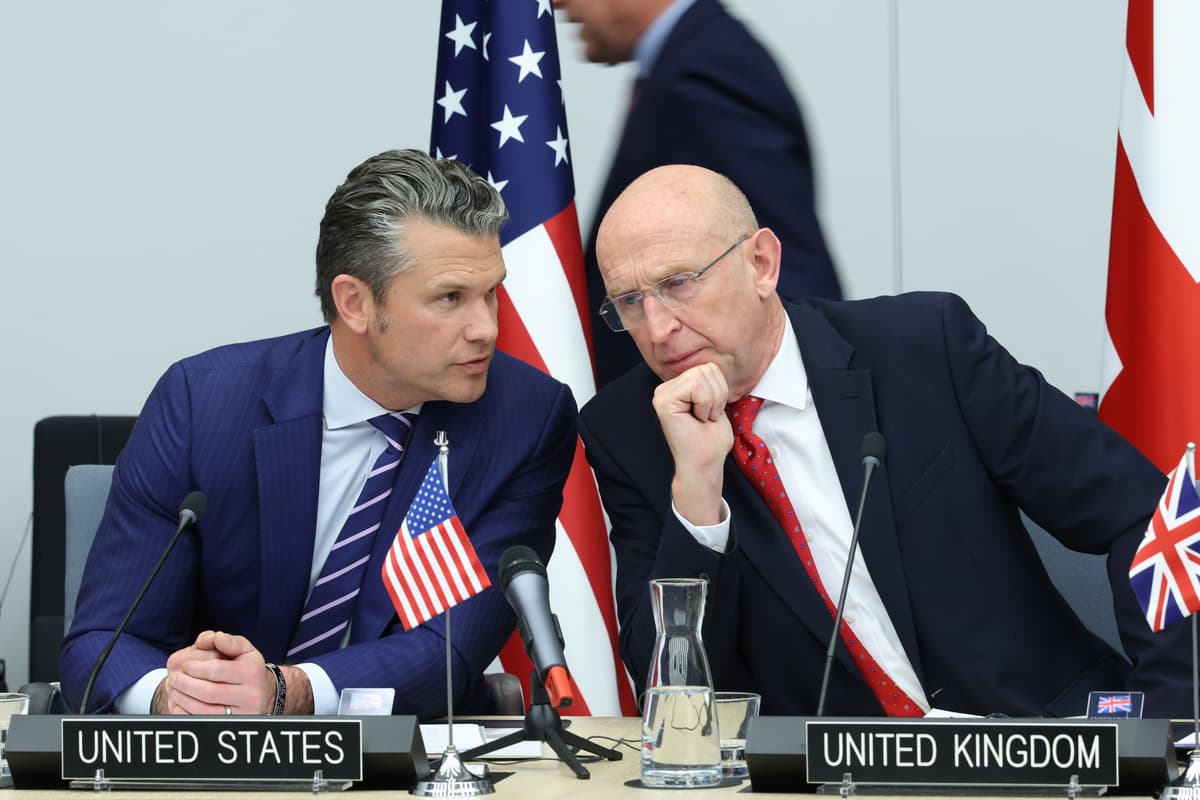
At Brussels, the defense secretary, Pete Hegseth, on Wednesday attended his first meeting of the Ukraine Defense Contact Group, a monthly aid parley he had shunned since February. Using a Reagan-era slogan for dealing with the Soviet Union, Mr. Hegseth urged NATO leaders to adopt a policy of “peace through strength” in respect of Russia. In a clear threat, he said: “If we must take this step, the U.S. War Department stands ready to do our part in ways that only the United States can do.”
In February, Mr. Hegseth had lectured NATO leaders that the Trump Administration had priorities other than Europe. This time, he said:“If there is no path to peace in the short term then the United States, along with our allies, will take steps necessary to impose costs on Russia for its continued aggression.”

All week long, Mr. Trump has dangled before the Kremlin the threat of supplying Ukraine with Tomahawks. This fall, Ukraine is firing its own long range missile, the Flamingo. The Tomahawk cruise missiles have a similar range and warhead, but the American missile is battle tested, is more accurate and is better at evading interceptor missiles. Even if only several dozen are delivered to Kyiv, Tomahawks could devastate Russia’s drone factories and oil refineries.
Reports on the Tomahawks coincides with leaked reports that America is giving targeting information to Ukraine. The Kremlin reacted with anger to the proposals.
“The delivery of these missiles could end badly for everyone. And first of all — for Trump himself,” the former Russian president, Dmitry Medvedev, posted Sunday on Telegram. “One can only hope that this is another empty threat.” Currently the deputy chairman of Russia’s Security Council, Mr. Medvedev often makes incendiary comments that have the quiet approval of the Kremlin’s inner circle.
Then came Monday’s Gaza peace agreement. As TV cameras whirred, Mr. Trump turned to special envoy Steve Witkoff and said: “We have to get Russia done. We gotta get that one done. If you don’t mind, Steve, let’s focus on Russia first.” In response, the Kremlin turned conciliatory.
“We welcome the confirmation of the political will to do everything possible to promote the search for peaceful solutions,” Kremlin spokesman Dmitry Peskov said Tuesday. “We are already well acquainted with Mr. Witkoff. He is effective, has proven his effectiveness now in the Middle East, and we hope that his talents will continue to contribute to work already underway in Ukraine.”

Mr. Trump can play hardball with Russia because his Republican base has migrated toward a hardline position against Russia from skepticism about Ukraine.
Republican attitudes are shaped by Mr. Putin’s failure to act on Mr. Trump’s peace proposals in the spring, his stepped-up attacks on Ukraine after the Anchorage summit in August, and his dispatch of drones and war jets into NATO territory over the last month. The American president also sends out messages that move his base.
“Russia has been fighting aimlessly for three and a half years a War that should have taken a Real Military Power less than a week to win,” Mr. Trump posted September 23 on Truth Social. “It is very much making them look like ‘a paper tiger.’” Mr. Trump, who always wants to be on the side of a winner, increasingly paints Russia as the loser in the war.
“I don’t know why he continues with this war,” Mr. Trump said Tuesday. “He lost 1.5 million soldiers,..they have long lines waiting for gasoline in Russia right now…His economy is going to collapse. He just doesn’t want to end that war. It’s making him look very bad.”
Kyiv-based analyst Peter Dickinson agrees, writing for the Atlantic Council: “Trump’s ‘paper tiger’ barb was meant as an insult, but it may be closer to the truth than Putin’s pretensions to great power status.”

One week after the paper tiger jibe, Harris pollsters asked 2,413 registered voters if America should place more sanctions on Russia. Of Republicans, 87 percent said yes, compared to 71 percent of Democrats. Should Washington pressure Europe to buy less Russian oil? Eighty-six percent of Republicans said yes, and 76 percent of Democrats agreed.
On the question of providing more arms to Ukraine, Republicans have moved beyond calling it “Biden’s war.” Seventy-three percent of Republicans supported arming Ukraine, slightly more than the 72 percent of Democrats who did.
It is unclear if Mr. Trump will come through with the Tomahawks. He seems to see the missiles as a strong negotiating card, one that would lose value after it is played. Yet the White House meeting Friday is expected to be a far cry from the contentious meeting in February meeting when the American leader said Mr. Zelensky “doesn’t have the cards.”
In recognition of Ukraine’s drone warfare prowess, Mr. Trump is expected to announce a major joint venture production deal. Mr Zelensky has said it could be a five-year, $50 billion deal to produce 10 million drones annually.