Trump Might Need To Take on the Civil Service
Laws protecting the deep state may be ripe for review by the Supreme Court.
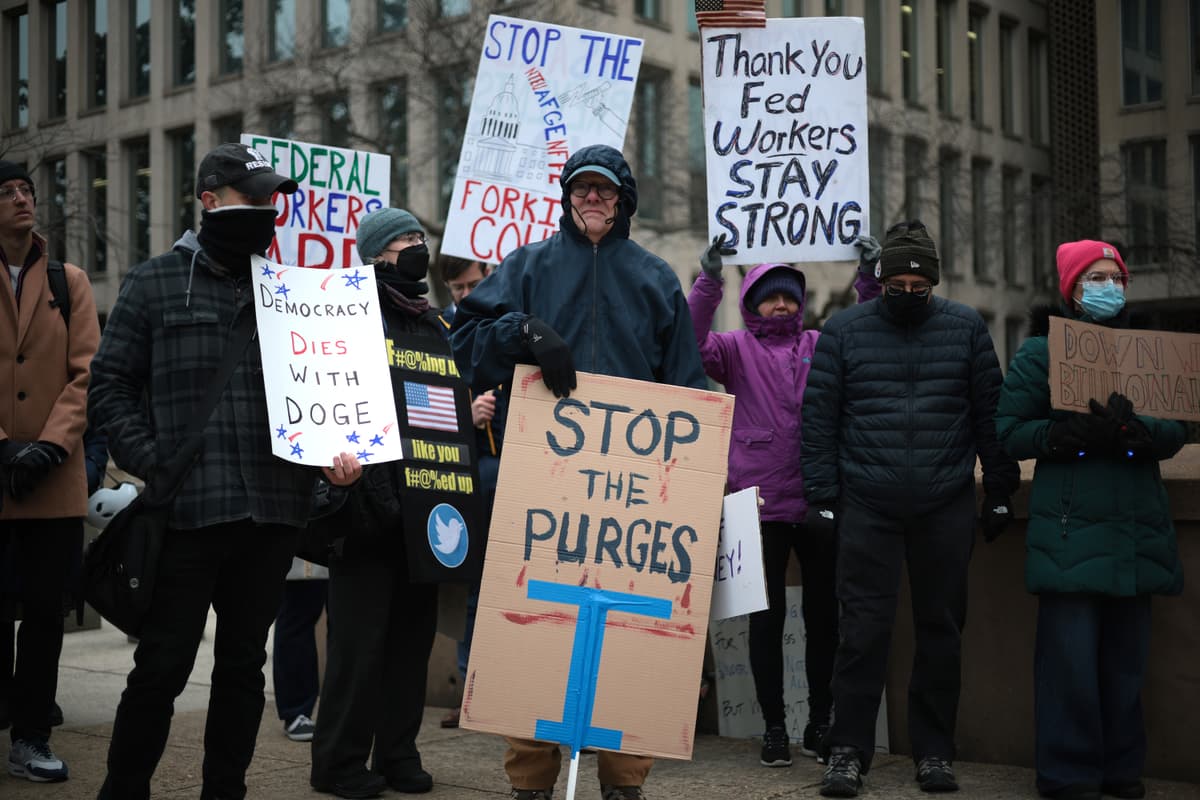
What do you call 300,000 fired federal bureaucrats? A good start. The news that there will be merely 2.1 million federal executive branch employees by year-end, as opposed to 2.4 million when the year began, is good news for America’s taxpayers. It’s a signal of progress, too, on President Trump’s vow to clean up the Beltway bureaucracy. A question to watch, though, is whether Mr. Trump’s job cuts will pass muster at the Supreme Court.
The declining federal payroll — amounting to roughly one in eight federales — is the “largest single-year reduction since World War II,” per the Times, which gleaned the data from the director of the Office of Personnel Management, Scott Kupor. He points to most of the layoffs arising under Elon Musk’s DOGE initiative, and notes that most of the staffing cuts will be official by the end of September.
The cuts suggest “the extent of Mr. Trump’s downsizing,” the Times reports, in an effort centered on “eliminating waste, saving money and making the government run more efficiently.” Departments like Health and Human Services and Education are being reorganized. In Mr. Trump’s view, the layoffs are “a reduction of a bureaucracy that he believes has tried to thwart him,” the Times reports. There seems to be ample justification for that view.
It’s not our intention to overlook the human element in these layoffs. It would be churlish to revel in anyone losing his job. Yet laying off a federal employee, whose salary is paid by the taxpayers, is a different proposition than, say, shutting down a steel mill and throwing the staff out of work. Plus, too, many federal staff took voluntary buyouts. One wishes, in any event, all the ex-bureaucrats well in their search for gainful employment in the private sector.
Yet for too long, these columns have reported that Beltway bureaucrats have come to exercise a kind of independent authority, derided by critics as the Deep State. This is especially so since the rise of civil service and the unionization of the federal workforce. These officials, who serve regardless of who occupies the White House, tend to tilt left. They have spun a web of regulations and rules that can give them more power than elected officials.
These columns have long doubted the merit of civil service protections that shield federal employees from presidents cleaning house upon a change of administration, a traditional practice in the republic’s first century. Cossetting civil servants with job protections, these columns noted, were a “bolstering of bureaucracy at the president’s expense.” Congress’s power to put these limits on the president struck us as ripe for Supreme Court review.
After all, if the president, a single individual, is the sole repository of the Constitution’s grant of executive branch power, that suggests he needs authority to manage the personnel working under the president — including power to fire unwanted staff. Yet the Supreme Court has, as recently as 2020 in Seila Law v. Consumer Financial Protection Bureau, suggested that Congress can protect lower-level federal employees from summary firing.
That power by Congress, in the high court’s reasoning, is in contrast with the president’s nearly unchecked power to fire policy-making officials in the executive branch. This principle has recently been underscored in a series of preliminary rulings by the Nine over Mr. Trump’s firing of, say, members of the Merit Systems Protection Board or the National Labor Relations Board, even if the Federal Reserve Board might, for now, be marked safe.
The high court has yet to tackle head-on a president’s ability to fire low-level federal employees even when Congress has given them security. That could require, say, a look at a precedent from 1886, United States v. Perkins, that limited the president’s power to fire a naval engineer. Mr. Trump won office on promises to reform the executive branch. Extending his effort to reduce the federal payroll could hinge on the high court protecting presidential power.