Trump Moves To Back Peacekeepers for Ukraine
This would be a step closer yesterday to the kind of Western military guarantees that have allowed South Korea to flourish for nearly eight decades.

Ukraine moved a step closer yesterday to getting the kind of Western military guarantees that have allowed South Korea to flourish since the Armistice of 1953. While respecting the “no boots on the ground” desires of many MAGA voters, President Trump said America could play a “coordinating” role for a European peacekeeping force.
“We discussed Security Guarantees for Ukraine, which Guarantees would be provided by the various European Countries, with a coordination with the United States of America,” Mr. Trump posted on Truth Social. President Volodymyr Zelensky later predicted that the details will be “formalized on paper within the next week to 10 days.” The explosive issue of land swaps — trading land for peace — apparently was not discussed at yesterday’s meetings
Prime Minister Keir Starmer and President Emmanuel Macron are to be co-chairmen of a meeting of the “Coalition of the Willing,” to discuss details of security guarantees. Members of this group of 31 Western countries have discussed supplying a rotating force of 50,000 soldiers to monitor a Russia-Ukraine demilitarized zone. Under this scenario, America would provide air logistics and satellite intelligence to detect Russia troop movements toward a cease-fire line.

Sensing that this plan was in the works, Russia’s foreign ministry announced hours before the Western leaders met at Washington that Moscow would not accept NATO troops in Ukraine. The Kremlin also did not confirm Mr. Trump’s announcement that President Vladimir Putin agreed to meet his Ukrainian counterpart in coming days.
“I called President Putin, and began the arrangements for a meeting, at a location to be determined, between President Putin and President Zelenskyy,” Mr. Trump posted. “After that meeting takes place, we will have a Trilat, which would be the two Presidents, plus myself.” Minutes later a Kremlin aide, Yuri Ushakov, said on Telegram that the two leaders discussed only “the possibility of raising the level of representatives from the Ukrainian and Russian sides.”
In contrast, Chancellor Friedrich Merz told reporters at Washington that the Putin-Zelensky meeting will take place within the next two weeks. He said the sword of sanctions should continue to hang over the Russian leader’s head: “We don’t know whether the Russian president will have the courage to attend such a summit. Therefore, persuasion is needed.”
Separately, President Emmanuel Macron said: “We must prepare a list of additional sanctions and regional pressures on Russia if no agreement is reached. … The biggest deterrent for Russia will be hundreds of thousands of well-equipped Ukrainian soldiers. The main guarantee of security for Ukraine is a strong army.”

The presidents of Russia and Ukraine last met six years ago. Since then, Mr. Putin has refused to meet his Ukrainian counterpart. Last night, “a senior U.S. administration official” told Reuters that a meeting could take place in Hungary. Although a member of the North Atlantic Treaty, Hungary has taken a pro-Kremlin stance under Prime Minister Viktor Orban.
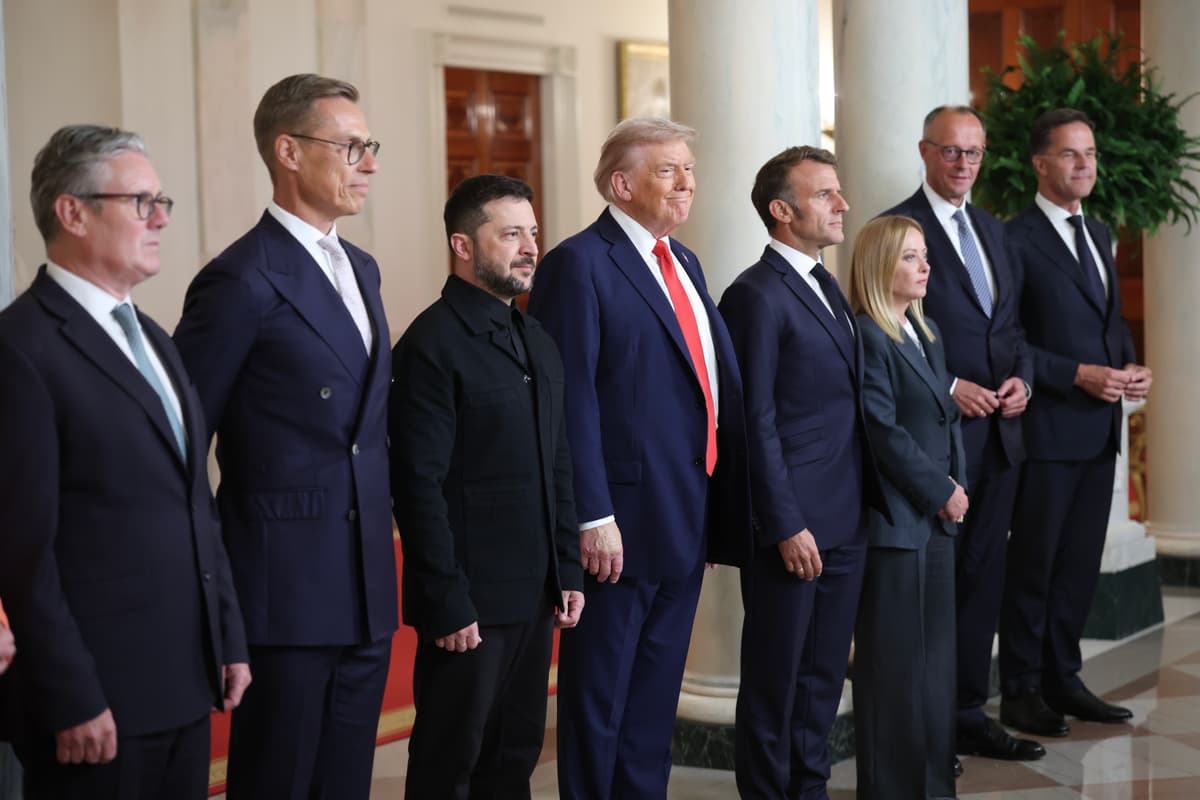
Yesterday’s meetings at Washington illustrated the enduring power of the White House. On short notice, seven of the most powerful leaders of Europe scrapped their weekend plans and flew to Washington to meet Mr. Trump and to support Mr. Zelensky. During yesterday evening’s meeting, Mr. Trump paused talks with the European seven to call Mr. Putin at about midnight Moscow time. The pair talked for 40 minutes.
Six months ago, Mr. Zelensky had a disastrous meeting at the White House. Vice President JD Vance turned on him, asking: “Have you said ‘thank you’ once?” Yesterday, the Ukrainian leader thanked Mr. Trump eight times in two minutes. At the end of the meeting, Mr. Trump presented the visiting Ukrainian with symbolic keys to the White House.

Adding urgency to the meetings was the Trump-Russia summit of last Friday at Anchorage. Although a bilateral lunch was canceled and talks ended earlier than expected, friends of Ukraine worried that a secret deal had been cooked up behind closed doors. Mr. Trump bridled to some press coverage that portrayed Friday’s summit as a win for the Russian president. He posted: “I know exactly what I’m doing, and I don’t need the advice of people who have been working on all of these conflicts for years, and were never able to do a thing to stop them.”
European fears that American support of Ukraine was hanging in the balance sparked European limo lock yesterday afternoon at the White House. Converging on Pennsylvania Avenue were the leaders of Europe’s “Big Four” — Britain, France, Germany, and Italy. Joining them were the secretary-general of NATO and the president of the European Commission. The one outlier was the president of Finland. Alexander Stubb said he was there because Finland is the North Atlantic Treaty nation with the longest land border with Russia — 833 miles.

This show of unity and solidarity with Ukraine seemed to have had an impact on Mr. Trump. “When it comes to security, there’s going to be a lot of help,” he told reporters, stressing that European countries will shoulder the major burden. “They are a first line of defense because they’re there, but we’ll help them out.”
The North Atlantic Treaty Organization’s secretary general, Mark Rutte, ruled out Ukraine joining the 32-nation defensive alliance. Although he said America and several other nations oppose Ukraine’s entry, he said that strong security guarantees can be fashioned outside of NATO. “What we are discussing here is not NATO membership, what we are discussing here is Article 5 type of security guarantees for Ukraine,” he said, referring to the all for one and one for all clause in NATO’s founding document. “What exactly they will entail will now be more specifically discussed.”

Setting off this intensive diplomacy, Mr. Trump’s special envoy to Russia met with Mr. Putin at Moscow on August 6. “We were able to win the following concession: That the United States could offer Article 5-like protection,” he told CNN’s “State of the Union” program on Sunday. This “was the first time we had ever heard the Russians agree to that.”
Other American allies — notably South Korea, Taiwan, Japan, and Israel — have varying levels of American security guarantees, all provided outside the framework of the North American Treaty Organization.
As a sweetener to Mr. Trump’s commercial instincts, Mr. Zelensky told reporters at Washington that Ukraine would use European financing to buy $90 billion of American-made military equipment. In addition, Ukraine will produce $50 billion worth of drones for the Pentagon. Ukraine is considered to be the leading practitioner of drone warfare in the Western world.
Secretary Marco Rubio last night told Fox after the meetings: “We no longer supply Ukraine with weapons for free. We no longer give Ukraine money. Now we sell weapons to them, and European countries pay for it through NATO.”