Trump Offers Europe Tough Love: Defend Yourself Within Two Years

‘The days of the United States propping up the entire world order like Atlas are over,’ the president’s new Security Strategy says.
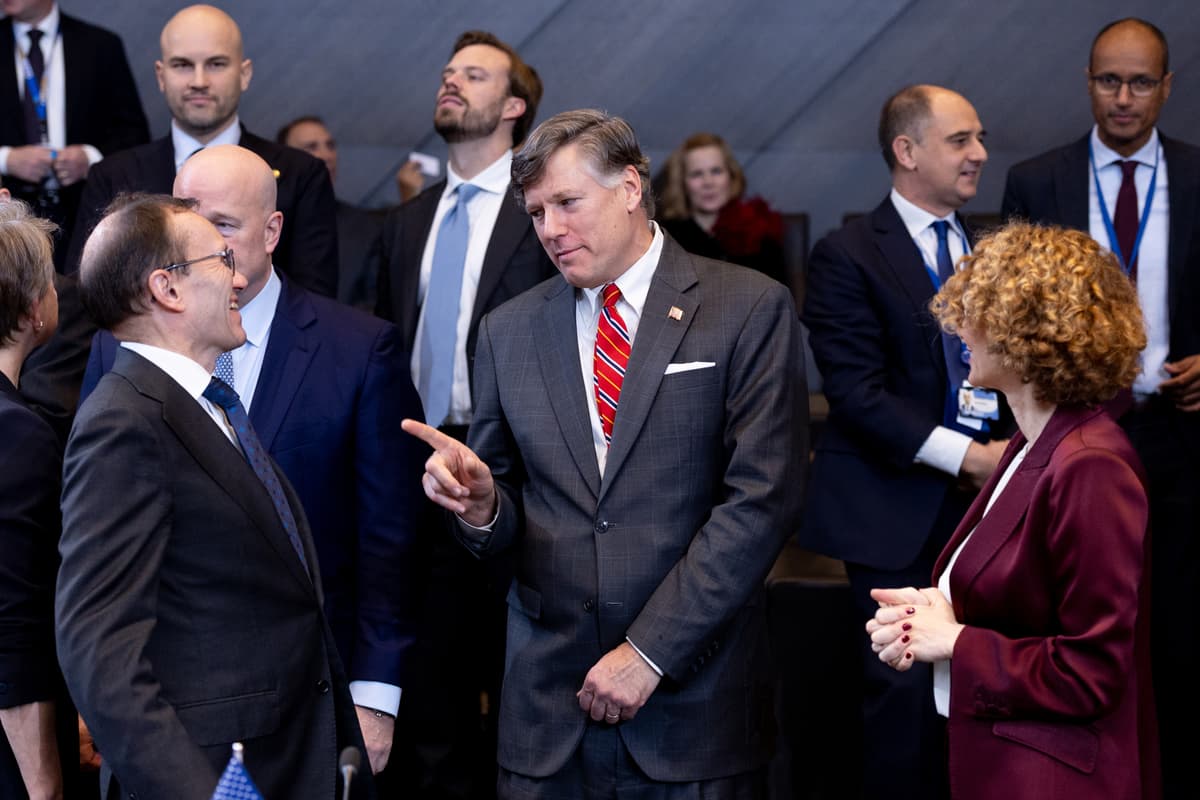

Omar Havana/Getty Images
America's deputy secretary of state, Christopher Landau, center, at NATO headquarters, Brussels, on December 3, 2025. Omar Havana/Getty Images

Europe should have the soldiers and equipment to defend itself two years from now, by the end of 2027. That is the gist of President Trump’s Security Strategy, released yesterday.

“The days of the United States propping up the entire world order like Atlas are over,” reads the strategy document that sets the parameters for the second Trump term. Earlier this year, in face of Trump Administration impatience with Europe, the European Union set a target of making the continent ready to defend itself by 2030. With major shortfalls in air defense, cyber warfare, intelligence and drones, many analysts warned  the goal was over ambitious.

Now Mr. Trump appears to want to wean Europe off dependence on American military aid well before his term ends in January 2029. This would radically reshape the trans-Atlantic alliance of living memory. On April 4, 2029, NATO will mark the 80th anniversary of its founding.

“Europe must take primary responsibility for its own security,” the deputy secretary of state, Christopher Landau, posted Wednesday on X. “Successive US Administrations have been saying this in one form or another pretty much my whole life — look up the 1969 ‘Nixon doctrine’ — but our Administration means what it says.”

President Donald Trump speaks during a Cabinet meeting at the White House, Tuesday, Dec. 2, 2025, in Washington, as Secretary of State Marco Rubio, left, and Defense Secretary Pete Hegseth, right, look on.
President Trump at a Cabinet meeting at the White House, December 2, 2025, flanked by Secretary of State Marco Rubio, left, and Defense Secretary Pete Hegseth, right. AP/Julia Demaree Nikhinson

Mr. Landau posted hours after the annual meeting at Brussels of the foreign ministers of the North Atlantic Treaty. It was the first time in more than 20 years that America was not represented by a secretary of state.

“The United States wants Europe to take over the majority of NATO’s conventional defense capabilities, from intelligence to missiles, by 2027,” Reuters reports from Washington, citing Pentagon briefings for European diplomats. This “would dramatically change how the United States, a founding member of the post-war alliance, works with its most important military partners.”

The 33-page strategy report comes with a dollop of criticism of European leaders for allowing vast Muslim and African immigration. Raising the alarm about the “stark prospect of civilizational erasure,” the Trump Administration report blames “cratering birthrates” and “migration policies that are transforming the continent.” It says: “We want Europe to remain European, to regain its civilizational self-confidence.”

“Should present trends continue, the continent will be unrecognisable in 20 years or less,” the report warns. “Over the long term, it is more than plausible that within a few decades at the latest, certain NATO members will become majority non-European. As such, it is an open question whether they will view their place in the world, or their alliance with the United States, in the same way as those who signed the NATO charter.” 

With anti-immigration parties leading public opinion polls in Britain, France, Germany, and Italy, centrist politicians complained that the report interferes in their domestic politics. “It’s language that one otherwise only finds coming out of some bizarre minds of the Kremlin,” the former Swedish prime minister, Carl Bildt, posted on X. He described the document as “to the right of the extreme right in Europe.”

THE HAGUE, NETHERLANDS - JUNE 25: US President Donald Trump (L) during a news conference with Marco Rubio, US secretary of state on the second day of the 2025 NATO Summit on June 25, 2025 in The Hague, Netherlands. Among other matters, members are to approve a new defense investment plan that raises the target for defense spending to 5% of GDP. (Photo by
President Trump during a news conference at the 2025 NATO Summit at The Hague. Omar Havana/Getty Images

Germany’s foreign minister, Johann Wadephul, told reporters at Berlin yesterday that the United States is “ our most important ally.” Addressing criticism by the Trump administration of freedom of speech in Europe, he said that Germany does not “believe that we need to get advice here from any country or party.”

From the hard right, an Alternative for Germany Bundestag member, Markus Frohnmaier, hailed the U.S. strategy as “a foreign policy reality check for Europe and particularly for Germany.” In an apparent allusion to the AfD and other hard right parties, the American document says “the growing influence of patriotic European parties” gives “cause for great optimism.”

In retort, Representative Jason Crow of Colorado, a Democrat who sits on House committees overseeing intelligence and the armed forces, called the strategy “catastrophic to America’s standing in the world and a retreat from our alliances and partnerships.”

On Russia, the central security issue facing Europe, the strategy report calls for an end to expansion of the North Atlantic Treaty. It blames censorship of public opinion in Europe for “unrealistic expectations” of European leaders for settling the war in Ukraine.  It asserts: “A large European majority wants peace, yet that desire is not translated into policy, in large measure because of” what it calls European governments’ “subversion of democratic processes.”

President Putin shakes hands with President Trump's special envoy Steve Witkoff, during their meeting at the Kremlin in Moscow on Aug. 6, 2025. Gavriil Grigorov/Sputnik via AP
President Vladimir Putin shakes hands with President Trump’s special envoy, Steve Witkoff, during their meeting at the Kremlin on August 6, 2025. Gavriil Grigorov/Sputnik via AP

The document called for a quick settlement in Ukraine in order to reestablish “strategic stability” with Russia. The document came out as Mr. Trump’s special envoy, Steve Witkoff engages this week in shuttle diplomacy between the Kremlin and Miami, where he meets with Ukrainian officials.

“Trump wants a peace in Ukraine at any cost — a giveaway to Putin — which would have devastating consequences for European peace, stability and prosperity,” a London-based financial analyst, Timothy Ash, wrote yesterday to clients. “That peace would likely leave Ukraine unstable and subject to further attack by Russia.”

An Italian geopolitical analyst, Nathalie Tocci, wrote yesterday on the Foreign Policy website: “It is long past time for Europe to realize that, when it comes to the Russia-Ukraine war and the continent’s security, it is, at best, alone.”


The New York Sun

© 2025 The New York Sun Company, LLC. All rights reserved.

Use of this site constitutes acceptance of our Terms of Use and Privacy Policy. The material on this site is protected by copyright law and may not be reproduced, distributed, transmitted, cached or otherwise used.

The New York Sun

Sign in or  create a free account

or
By continuing you agree to our Privacy Policy and Terms of Use