Trump Prepares To Talk Peace, but Did Putin Get the Message?

It may be difficult for the Kremlin to turn off its verbal aggression against Russia’s neighbors.
AP/Alexander Zemlianichenko, pool, Mark Schiefelbein
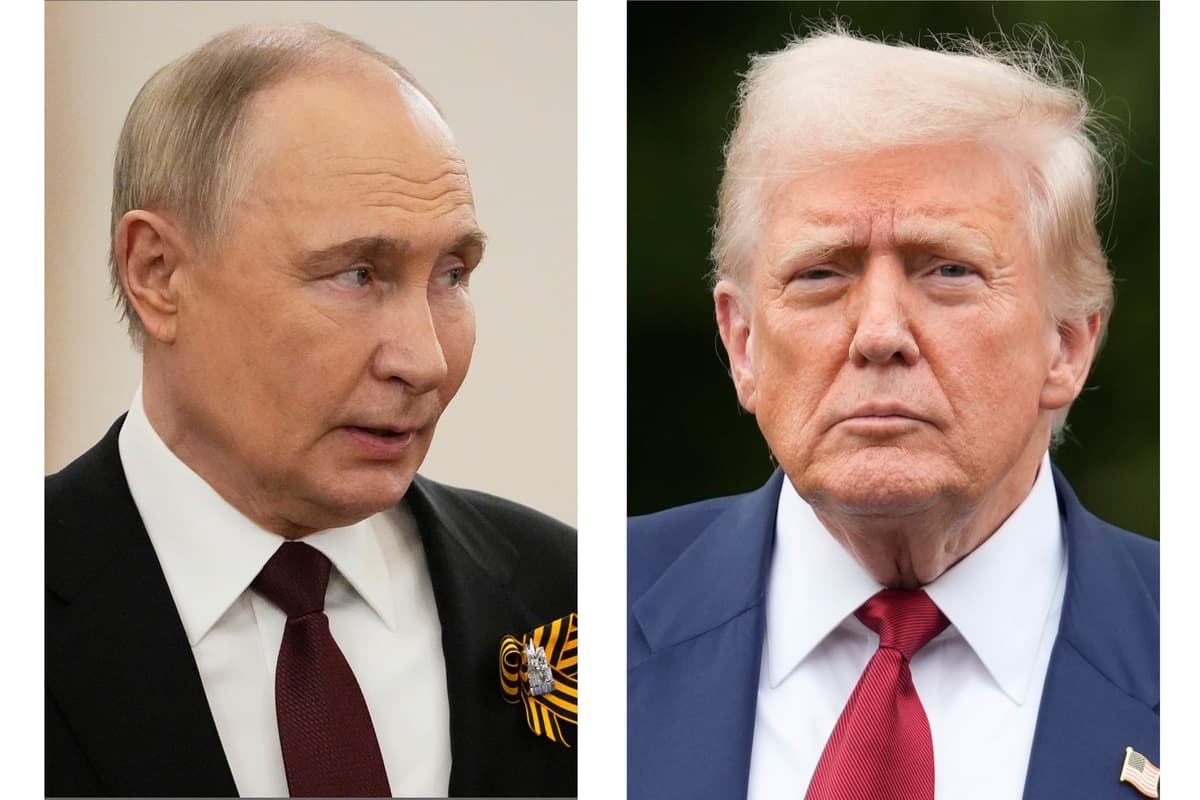
President Vladimir Putin at Moscow on May 9, 2025, and President Trump at Washington on August 1, 2025. AP/Alexander Zemlianichenko, pool, Mark Schiefelbein

As President Trump prepares to fly to Alaska to talk peace with President Vladimir Putin, the Kremlin leader’s entourage does not seem to have gotten the memo. Firing in all directions, verbal salvoes went out in the last 48 hours against Azerbaijan, the Baltics, and Moldova. Ukraine, the subject of Friday’s peace parley, is still numb from a major bout of genocidal rhetoric from Moscow.

While it may be difficult for the Kremlin to turn off this verbal aggression against Russia’s neighbors, analysts wonder if Mr. Putin is really interested in making a deal on Ukraine. The fireworks started Sunday night on Vladimir Solovyov’s talk show on state-run Russia 1 TV.

“The Baltics just can’t seem to understand that they are a geopolitical mistake,” Mr. Solovyov, one of the Kremlin’s top propagandists, said on a popular show watched by millions. Referring to Latvia, Lithuania, and Estonia, all former Soviet republics, he continued: “NATO is not going to stick their necks out for them. Who wants to burn in a nuclear Armageddon for the Baltics? Well, who?”

Turning to Azerbaijan, one of the wealthiest former Soviet republics, Mr. Sovolyov and a Russian state duma member, Andrey Gurulev, separately said Moscow should launch a Ukraine-style “Special Military Operation” against the oil-rich nation. Azerbaijan’s sins are supplying pipeline gas to Ukraine and then complaining when Russia bombed their energy facilities in Ukraine.

On Sunday, the Azeri president, Ilham Aliyev, talked on the phone with President Volodymyr Zelensky. Yesterday, Mr. Aliyev announced that Azerbaijan will send $2 million in humanitarian aid to Ukraine. This prompted immediate war threats from the Kremlin nomenklatura. In response, Baku news site Caliber.az reported yesterday that Azerbaijan is considering lifting its ban on shipping arms to Ukraine.

Relatives and soldiers of the Azov Regiment pay last respect near the coffin of their comrade, Georgian volunteer Mykhailo Kovaliv, during a farewell ceremony on Independence Square in Kyiv, Ukraine, Saturday, Aug. 9, 2025.
Relatives and soldiers of the Azov Regiment near the coffin of their comrade, Georgian volunteer Mykhailo Kovaliv, during a farewell ceremony on Independence Square at Kyiv, August 9, 2025. AP/Dan Bashakov

Yesterday, another former Soviet republic, Moldova, came within the sights of Russia’s former defense minister, Sergei Shoigu, now secretary of the security council. In a lengthy article for state-run Ria Novosti news service, he warned Moldovans to vote for pro-Moscow candidates in the September 28 parliamentary elections. Otherwise, he warned: “Practice shows that rapprochement with NATO inevitably leads to the loss of sovereignty.”

Overlooked in the international press, these attacks on five former Soviet republics may give clues as to how serious Mr. Putin is about negotiating peace with a sixth former Soviet republic — Ukraine. 

Although Russia has suffered an estimated 1 million killed and wounded and the battle lines have been largely frozen for the last two years, Mr. Putin apparently believes he is winning. Publicly, he has shown no interest in stopping the war.

“The Russian and Ukrainian people are one people, [so] in this sense, all of Ukraine is ours,” he said June 20 in the keynote speech to the St. Petersburg International Economic Forum. “Wherever a Russian soldier’s foot steps, that’s ours.”

In July, there were more than 2,600 battles in Ukraine, the highest monthly tally since independent monitor Armed Conflict Location and Event Data started tracking the conflict in February 2022.  For its part, Ukraine increased its drone, missile, and artillery attacks on Russia by one fifth in July, to 1,400. This includes a 75 percent increase in strikes occurring outside of Russia’s border regions.

“Russia is dragging out the war, and therefore it deserves stronger global pressure. Russia refuses to stop the killings, and therefore must not receive any rewards or benefits,” Mr. Zelensky posted yesterday on X. “Concessions do not persuade a killer.”

President Zelenskyy at a news conference at the chancellery in Berlin, Germany.
President Zelensky at a news conference at the chancellery at Berlin. AP/Markus Schreiber

To American historian Anne Applebaum, land swaps will not divert Mr. Putin from his crusade to reconstitute the Russian empire. “This is not a war for territory,” Ms. Applebaum, a Ukraine analyst, wrote Friday on her Substack. “Putin doesn’t need another hundred square kilometers of Donetsk province. His goals are ideological. He wants to destroy all of Ukraine, to make Ukraine part of a new Russian empire or sphere of influence and to use that victory to undermine NATO and the European Union.”

Regarding Ukraine, Russian state press and politicians increasingly use language that Westerners call “maximalist,” a euphemism for genocidal.

“There is no other option: no one should remain alive in Ukraine,” a headline said over a July 30 opinion piece in Ria, the state news agency. 

The same day, Ria ran another oped, this one headlined: “Noted: Ukraine will end very soon.”

One week ago, a Russian state duma deputy, Anatoly Wasserman, originally from Odessa, told Azerbaijani news outlet Minval that the stated goals of Russia’s invasion of Ukraine are “incompatible with the continued existence of Ukraine” as a sovereign state. He said Russia alone will determine the end date for its war.

This morning, major European leaders plan a Zoom call with Mr. Zelensky. This is to be followed by a group call later today with Mr. Trump.

The Kremlin’s investment envoy, Kirill Dmitriev, worried in a post on Telegram: “Certainly, a number of countries interested in continuing the conflict will make titanic efforts (provocations and disinformation) to disrupt the planned meeting between President Putin and President Trump.” 

Lowering expectations for Friday’s summit, Mr. Trump told reporters yesterday at the White House: “This is really a feel-out meeting.” He said he would know “probably in the first two minutes” whether progress is possible.


The New York Sun

© 2025 The New York Sun Company, LLC. All rights reserved.

Use of this site constitutes acceptance of our Terms of Use and Privacy Policy. The material on this site is protected by copyright law and may not be reproduced, distributed, transmitted, cached or otherwise used.

The New York Sun

Sign in or  create a free account

or
By continuing you agree to our Privacy Policy and Terms of Use