
Ukrainian Nuclear Plant Faces Risk of Chernobyl-Like Meltdown Unless Power Is Restored in Days

Europe’s largest nuclear facility is on the brink as a result of clashes between Russian and Ukrainian forces in the area.

AP/file
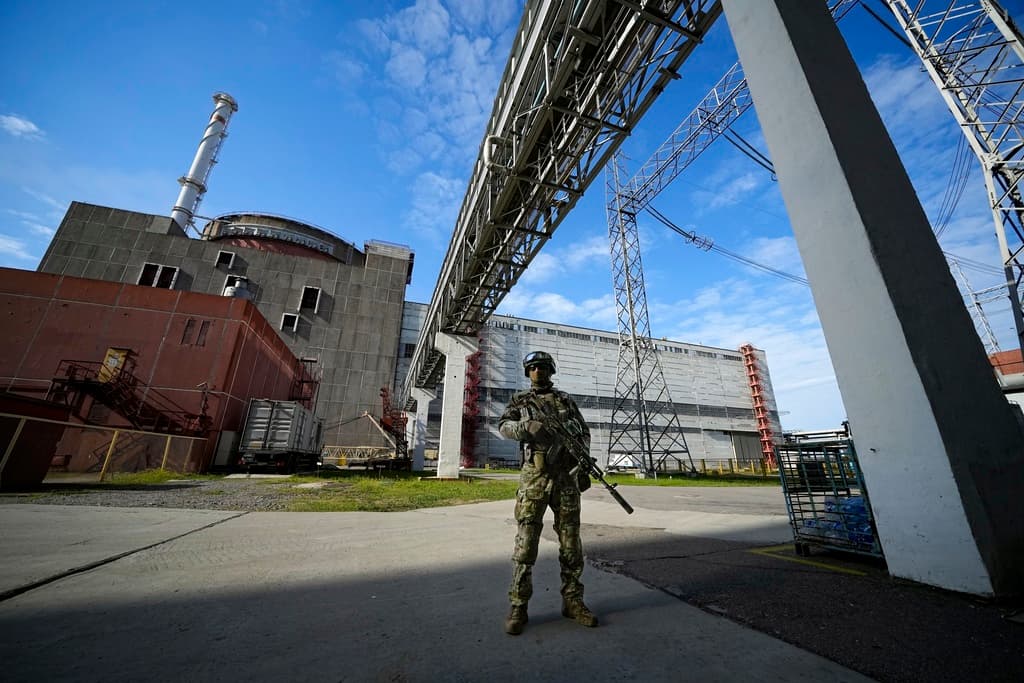
A Russian serviceman guards the Zaporizhzhia Nuclear Power Station in Ukraine. AP/file

Europe’s largest nuclear power plant, currently located in Ukraine and controlled by Russian forces, is facing the prospect of a Chernobyl-style meltdown if it is not reconnected to the power grid in the coming days, according to the head of the International Atomic Energy Agency.

The Zaporizhzhia nuclear power plant is currently in the middle of its longest power outage since the war began, with heavy military activity in the area preventing its repair and reconnection to power lines.

The facility has been reliant on emergency generators running on diesel fuel to keep operating essential safety and security functions, including  the cooling of its six shutdown reactors, according to European Union officials. They say it is vital that control of the plant be returned to Ukraine.

“Returning the ZNPP to the full control of the competent and legitimate Ukrainian authorities is the only lasting solution to minimise the risk of a nuclear accident with global implications,” the EU official say.

The International Atomic Energy Agency is working with military officials from both Russia and Ukraine in an attempt to get offsite power restored to the plant as soon as possible.

“While the plant is currently coping thanks to its emergency diesel generators — the last line of defense — and there is no immediate danger as long as they keep working, it is clearly not a sustainable situation in terms of nuclear safety,” the IAEA’s director general, Rafael Mariano Grossi, said in a statement. “Neither side would benefit from a nuclear accident.” 

The reactors at ZNPP have been shut down for more than three years and the nuclear fuel inside it has cooled, reducing the amount of radioactive material, but it could still suffer a meltdown if off-site power is not restored in the near term.

“The current status of the reactor units and spent fuel is stable as long as the emergency diesel generators are able to provide sufficient power to maintain essential safety related functions and cooling,” Mr. Grossi said. “Nevertheless, it is extremely important that offsite power is restored. I strongly encourage both sides to work with us and enable these essential repairs to take place.”

A meltdown at a similar nuclear reactor in Pripyat, Ukraine in 1986 was the worst accident in the history of the nuclear power industry. A failure of power systems at the Chernobyl plant caused a nuclear chain reaction and subsequent steam explosion that spewed radioactive waste across vast swaths of Europe and what was then the Soviet Union.

In the immediate aftermath of the accident, 30 workers and firemen died from acute radiation syndrome and thermal burns. Authorities evacuated approximately 115,000 people from the surrounding areas, and later relocated hundreds of thousands more. The long-term consequences included widespread contamination, significant economic losses, and a marked increase in thyroid cancer among those exposed to radioactive iodine as children. 


The New York Sun

© 2025 The New York Sun Company, LLC. All rights reserved.

Use of this site constitutes acceptance of our Terms of Use and Privacy Policy. The material on this site is protected by copyright law and may not be reproduced, distributed, transmitted, cached or otherwise used.

The New York Sun

Sign in or  create a free account

or
By continuing you agree to our Privacy Policy and Terms of Use