With His Tight Grip on Druglords, Politicians, and the Military, This Man Pulls the Strings in Venezuela

America has made Diosdado Cabello, the minister for interior, justice and peace, the second most-wanted man in his country after President Nicolás Maduro.
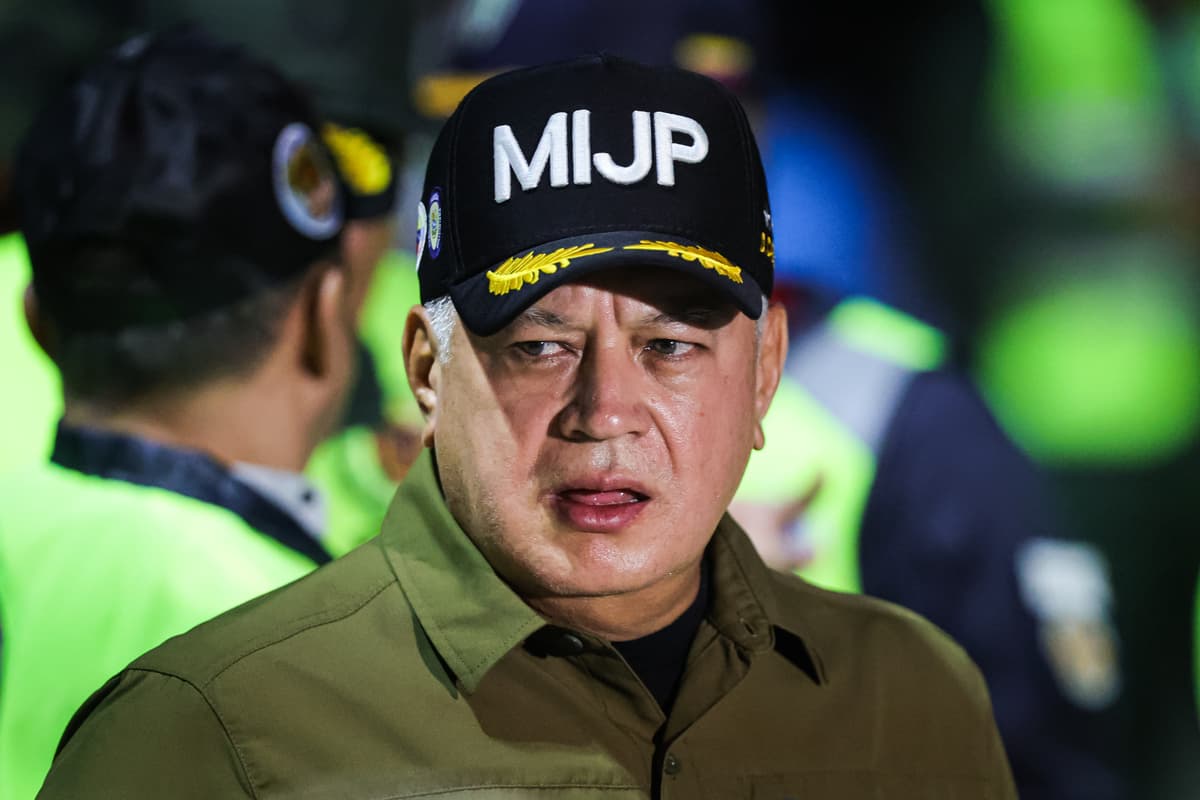

Jesus Vargas/Getty Images
Venezuela’s minister of interior, justice and peace, Diosdado Cabello, looks on during the arrival of Venezuelans who had been detained in El Salvador at Caracas on July 18, 2025. Jesus Vargas/Getty Images

When the Department of State raised the reward for Diosdado Cabello Rondón to $25 million earlier this year, it sent a clear message: Washington considers Venezuela’s second-most-powerful man one of the Western Hemisphere’s most dangerous criminals.

The bounty, part of the Narcotics Rewards Program, is one of the largest ever placed on a sitting government official — eclipsed only by that on the dictator Nicolás Maduro himself.

For the Trump administration and many Venezuela observers, Mr. Cabello is not simply a corrupt politician. He is, they allege, a key architect of a state-sponsored drug enterprise that has turned Venezuela into a hub of cocaine smuggling, money laundering, and regional instability.

“Diosdado Cabello is not simply a figure within the Maduro regime — he is its enforcer, its architect of internal cohesion, and the custodian of the regime’s survival mechanisms,” the president of the Global Organization for Security and Intelligence, Johan Obdola, tells The New York Sun. 

“While Nicolás Maduro represents the façade of political authority, Cabello controls the infrastructure that truly sustains power: the military hierarchy, the intelligence apparatus, and the extensive web of illicit economies that finance the state.”

From Soldier to Revolutionary Power Broker

Born in 1963 in Monagas state, Mr. Cabello trained as a military engineer and joined Hugo Chávez in a failed 1992 coup attempt that launched the Bolivarian movement. When Chávez rose to power, Mr. Cabello followed, a trusted loyalist who blended ideological conviction with a soldier’s discipline.

He served in multiple posts over two decades: vice president, governor of Miranda, head of the National Assembly, and, most recently, minister of popular power for interior, justice and peace.

On his official Instagram page, Mr. Cabello describes himself as a “Venezuelan politician committed to the construction of socialism, the defense of the rights of the people, and the legacy of Comandante Chávez.” His tone — half revolutionary sermon, half command briefing — captures how he sees himself as the custodian of Chavismo’s militant core.

His influence extends well beyond ideology. Analysts describe him as the regime’s enforcer — the man who ensures discipline within the ruling United Socialist Party of Venezuela, or PSUV, and the armed forces.

“Cabello has a long history within the dictatorial regime established by the late Hugo Chávez,” a professor of sociology at Palm Beach State College, Luis Fleischman, tells the Sun. 

“He was part of the 1992 coup attempt led by Chávez and has remained loyal ever since,” says Mr. Fleishchman, who also serves as co-president of the Palm Beach Center for Democracy and Policy Research. “His current post gives him control over the country’s intelligence and police agencies — effectively making him the regime’s czar of political repression.”

Through decades of political maneuvering, Mr. Cabello built networks across the military and security services, controlling key appointments and the flow of patronage. His grip on the intelligence apparatus — and on PSUV’s communications networks — allows him to shape internal narratives and manage the party’s most sensitive operations.

The U.S. Indictments: From Corruption to Narco-Terrorism

Mr. Cabello’s transformation from revolutionary icon to U.S. fugitive began in earnest in March 2020, when federal prosecutors in New York unsealed an indictment charging him, Mr. Maduro, and a dozen others with narco-terrorism, drug trafficking, and weapons offenses. 

The Justice Department accused him of helping run the “Cartel de los Soles” — a network allegedly embedded within the Venezuelan armed forces that facilitated the shipment of hundreds of tons of cocaine to the United States and Europe.

According to court filings, Mr. Cabello and other senior officials used military airfields, shipping routes, and diplomatic channels to move narcotics in coordination with the Revolutionary Armed Forces of Colombia (FARC), a Marxist guerrilla group. The alleged aim: to “flood the United States with cocaine” while enriching the regime’s elite.

“Cabello operates where politics, military, and narco-trafficking converge,” retired Drug Enforcement Administration Special Agent in Charge Wesley Tabor tells the Sun. “That mix breeds chaos far beyond Venezuela’s borders.”

A 2024 InSight Crime analysis found that elements of the armed forces acted as both law enforcers and traffickers — seizing cocaine from rivals, then reselling it under military protection.

Inside Venezuela: The Politics of Fear and Control

Mr. Cabello’s portfolio today — Interior, Justice, and Peace — places him at the nerve center of Venezuela’s domestic security system. Through that office, he oversees policing, intelligence, and the surveillance infrastructure that sustains Mr. Maduro’s rule.

“In an illegitimate regime, heavy repression serves to compensate for the absence of legitimacy,” said Mr. Fleischman. “For that reason, Cabello remains a central figure in Venezuela’s authoritarian power structure.”

In October 2025, the government rolled out a new “citizen security” app allowing Venezuelans to report anything they “see or hear,” a move critics likened to digital informant networks used in authoritarian states. The initiative, announced by Mr. Maduro but implemented under Mr. Cabello’s ministry, deepens public monitoring while extending the state’s reach into daily life.

Mr. Cabello also hosts the weekly television program Con el Mazo Dando, translated as “Hitting with the Hammer,” where he names and mocks perceived enemies of the revolution — journalists, activists, and ex-military officers. Human rights groups describe the show as a tool of intimidation, part of a broader apparatus that fuses propaganda with surveillance.

His critics say this blend of media power and ministry control allows him to run the most sophisticated political policing operation in Latin America. For supporters, it is the mechanism that preserves Venezuela’s “Bolivarian order” against external sabotage.

The Shadow Networks: Crime, Migration, and Regional Reach

Mr. Cabello’s reach extends beyond Venezuela’s borders. Investigations have traced connections between Venezuelan security officials and the Tren de Aragua, a gang born inside Venezuela’s prisons that has grown into a transnational criminal organization. The gang now operates in Colombia, Chile, and Peru, trafficking migrants, weapons, and narcotics — blurring the line between regime repression and organized crime.

“Cabello has built and coordinated one of the most sophisticated transnational criminal architectures in the Western Hemisphere,” said Mr. Obdola. “He serves as the central node connecting the Venezuelan regime to the Cartel de los Soles, Mexican cartels such as Sinaloa and CJNG, and Colombian insurgent remnants like the ELN and FARC dissidents.”

He said Cabello’s networks have also expanded into crypto-based money laundering operations “with connections traced to actors in South Korea, Turkey, and parts of Eastern Europe,” enabling the regime to move billions in illicit revenues through digital channels.

“Cabello embodies the criminalization of governance — the point where political authority, organized crime, and military loyalty fuse into a single, unaccountable power structure,” Mr. Obdola said. “In that sense, while Maduro governs the spectacle, it is Cabello who governs the system.”

A White House–connected insider focused on Venezuelan policy tells the Sun on background that Cabello is “the logistics guy for the narco network.”

“Most of the production is in Colombia, but the distribution routes go through Venezuela. Cabello oversees the trafficking corridors, works with Mexican cartels, and manages who operates where,” the source said. “He’s smarter and more calculating than Maduro, which makes him even more dangerous.”

Washington’s Dilemma

The United States has tried nearly every instrument short of force to weaken Mr. Cabello’s grip: indictments, asset freezes, visa bans, and the now-record $25 million reward for his capture. But the practical obstacles are enormous. He rarely travels abroad, moves under heavy guard, and enjoys near-total impunity inside Venezuela.

“Sanctions have not weakened Diosdado Cabello — they have entrenched him,” Mr. Obdola said. “Every new indictment or restriction imposed by the United States reinforces the regime’s siege mentality, legitimizing Cabello’s hardline posture within the power structure.”

Mr. Tabor echoed that view, saying U.S. actions “sting symbolically but not structurally. Sanctions isolate him internationally, yet inside Venezuela they reinforce his narrative of defiance — and tighten his grip.”

The insider added that Washington’s strategy has shifted toward treating Venezuela “less as a political conflict and more as a criminal takedown. These are indicted narco-traffickers. Law enforcement views it as dismantling a transnational syndicate, not negotiating with a government.”

Still, Mr. Cabello has mocked the bounty. On his X account, he called the U.S. reward “a medal of honor from imperialism” and dismissed the charges as a smear campaign against Venezuelan sovereignty.

The Man Behind the Power

For all the accusations, Mr. Cabello is a deeply disciplined political operator. Those who know him describe a man who wakes before dawn, reviews intelligence briefings personally, and maintains military decorum even in private meetings. He rarely drinks, avoids ostentatious displays of wealth, and projects the image of a soldier-patriot rather than a playboy oligarch.

Yet his power base — the overlapping circles of party, military, and criminal influence — has made him indispensable to Mr. Maduro and untouchable to outsiders.

“Cabello is the regime’s enforcer — the spine behind Maduro’s survival,” Mr. Tabor said. “Maduro holds the presidency; Cabello holds the power. He controls the levers that keep the system loyal and silent through his military hold.”

Mr. Obdola summed it up bluntly: “Diosdado Cabello is the embodiment of the hybrid threat Venezuela has become — a fusion of state power, organized crime, and ideological manipulation operating under the banner of sovereignty. He has converted the institutions of a nation into instruments of corruption, repression, and survival.”


The New York Sun

© 2025 The New York Sun Company, LLC. All rights reserved.

Use of this site constitutes acceptance of our Terms of Use and Privacy Policy. The material on this site is protected by copyright law and may not be reproduced, distributed, transmitted, cached or otherwise used.

The New York Sun

Sign in or  create a free account

or
By continuing you agree to our Privacy Policy and Terms of Use