

Zelensky, Ahead of Meeting With Trump at UN, Imposes His Own Sanctions on Russia’s Oil Exports
New numbers show that drone attacks on Russia’s oil industry are slashing export earnings.
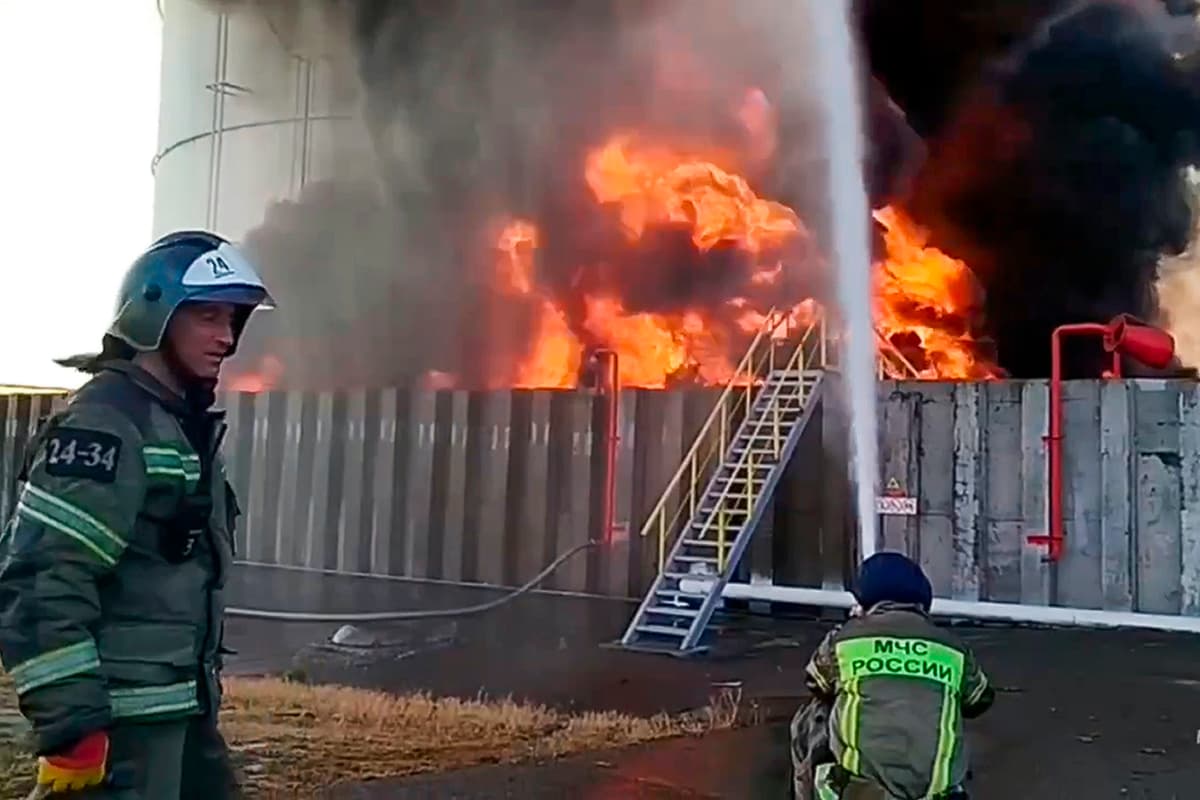
When President Trump meets with President Volodymyr Zelensky this week at New York on the sidelines of the United Nations General Assembly, the Ukrainian leader is expected to once again lobby Mr. Trump to impose sanctions on Russia. Mr. Zelensky may not mention that, without waiting for Washington, he is imposing his own sanctions on Russia. By bombing Russian oil pipelines, pumping stations, refineries, and export terminals, Ukraine is cutting into the muscle of Russia’s economy.
Until recently, Ukrainian drone attacks on Russian oil and gas facilities were dismissed as pretty fireworks for internet videos. Now new numbers show that the bombing campaign is having an impact. After Ukrainian drones bombed the three largest oil exporting ports in western Russia — Primorsk, Ust-Luga, and Novorossisysk — Russia’s oil exports and revenues dropped by 23 percent during the second week in September compared to the prior week, according to Bloomberg calculations.
The American and the Ukrainian leaders see eye to eye on the point that Russia’s oil and gas sales are the nation’s economic Achilles heel. “The Russian war machine will only stop when it runs out of fuel,” Mr. Zelensky recently told the annual Yalta European Strategy Meeting at Kyiv. “And Putin will begin to stop it himself when he himself truly feels that the resources for war are running out.”
While Mr. Trump has proved reluctant to impose new sanctions on Russia during his second term so far, Mr. Zelensky’s drone blitz is taking its toll on Russia’s exports. Oil and gas sales account for about one-third of Russia’s budget.
“Russia’s oil export revenues remain near five-year lows, reducing tax revenues and exacerbating Russia’s economic slowdown,” the Paris-based International Energy Agency reports. In August, Russia’s oil and gas export revenues were down almost $1 billion compared to July, this intergovernmental agency says.
On Saturday, Ukraine bombed two more big refineries — Saratov and Novokuybyshevsk. With these attacks, Ukraine recorded more strikes on Russian energy facilities through September 20 than during all of August. As much as a quarter of Russia’s refining capacity is knocked out. This is forcing Russia’s biggest pipeline operator, Transneft, to warn oil producers to cut output for lack of storage capacity, Reuters reports. Transneft dismisses the report as “fake news.”
“The most effective sanctions — the ones that work the fastest — are the fires at Russia’s oil refineries, its terminals, oil depots,” Mr. Zelensky told the nation in a TV fireside chat last week. “We have significantly restricted Russia’s oil industry, and this significantly restricts the war. Russia’s war is essentially a function of oil, of gas, of all its other energy resources.”
Over the last year, America and Europe debated allowing Ukraine to use Western-made missiles to hit targets 200 miles into Russia. Meanwhile, Ukraine was quietly developing its own missiles capable of carrying one-ton warheads 1,000 miles into Russia. Now in mass production, these missiles place within range a far-flung archipelago of high-value, virtually indefensible targets.
Saturday’s bombing of the Saratov refinery, 450 miles east of Ukraine, was the second Ukrainian attack on Saratov in five days. Also on Saturday, Ukraine bombed two pumping stations that supply oil to Novorossiysk, Russia’s largest Black Sea oil exporting terminal.
Largely out of sight of the Western press, two Aframax tankers — Kusto and Cai Yun — hit during Ukrainian strikes — remain anchored near Primorsk, Russia’s highest volume oil export terminal in the Baltic. Flows from the second largest Baltic port, Ust-Luga, dropped in half after strikes on three pumping stations that feed the terminal.
Ukraine is “on its path toward becoming the most capable missile power in Europe,” a German missile analyst, Fabian Hoffman, writes in his Substack post: “What Ukraine’s 3,000-Kilometer Cruise Missile Means for the War and the Future of Europe.”
By contrast, Ukraine’s “brains and grains” economy does not offer Russia similar high-value targets. Grain silos can be replaced. IT employees are dispersed. As a result, Russia’s strategy is to bomb apartment buildings in Ukrainian cities, hoping to break civilian morale. As evidenced by Germany’s blitz against London, the Allies’ fire-bombing of Dresden, and the American bombing of Hanoi, this strategy often fails.
Ukraine’s bombing campaign is having its own impact on Russian morale. Last week, Russia’s state-controlled news site Izvestiya reported that fuel shortages have spread to 10 Russian republics and regions. Responsible for almost 10 percent of the world’s oil production, Russians have long taken cheap and plentiful gasoline as their birthright. Now, with the Russian internet filling with dashcam videos of long gas lines, authorities have asked citizens to stop posting videos of gas lines and of refinery fires.
Judging by internet videos, some of the severest fuel shortages are in Russia-occupied areas of Ukraine. Here, Ukraine’s strategy is to cripple Russia’s army, a leviathan that runs on diesel.
There is no sign that Mr. Zelensky launched the bombing campaign in order to impress Mr. Trump prior to their meeting at New York. On the contrary, the targeted attacks on Russia’s energy industry are expected to continue — and possibly accelerate — this fall.
“We will continue to do that as long as Russia is not showing any meaningful signs of readiness to sit down and negotiate,” Ukraine’s first deputy foreign minister, Sergiy Kyslytsya, told Reuters Friday. “I don’t believe that Russia will collapse economically in the foreseeable future. But I think that the pain for the regime should increase.”