
168,000 Persons Flee to Safety Amid Fighting Between Cambodia and Thailand

American made F16 war planes may spell the difference in favor of Thai forces.
AP/Heng Sinith
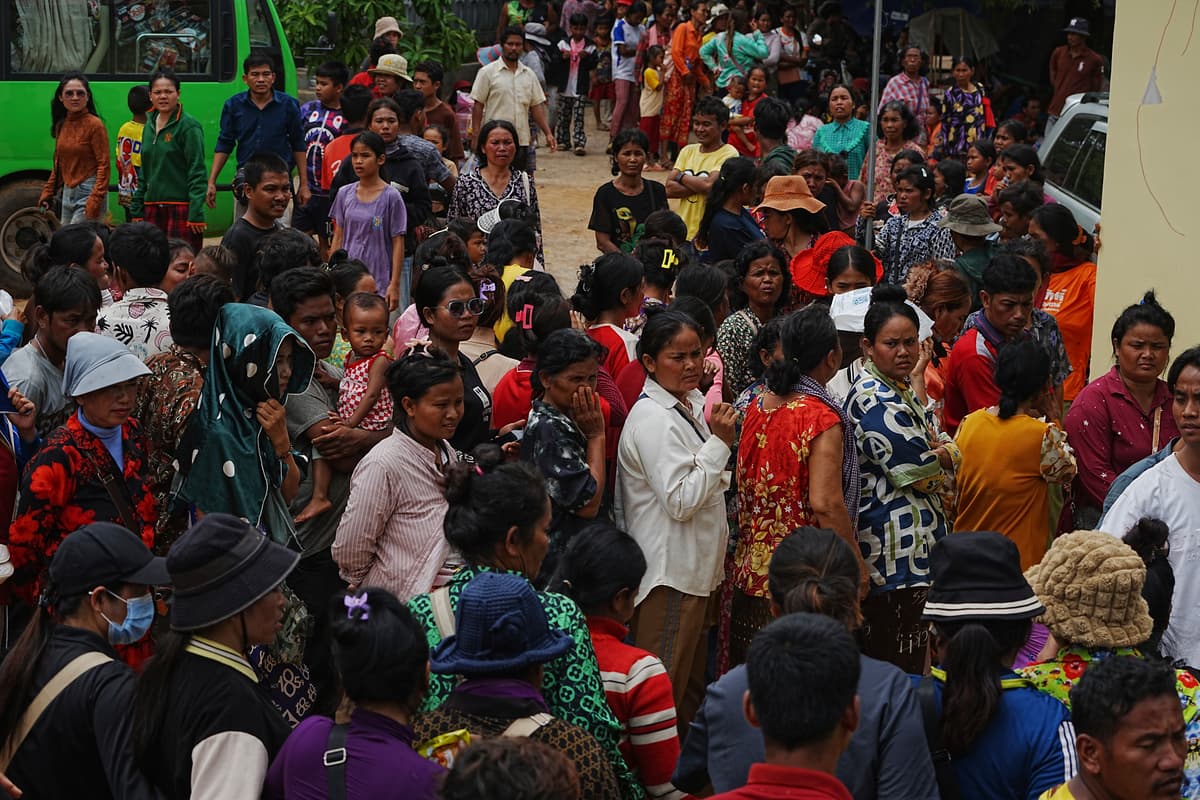
Local villagers wait to receive supplies donated by a charity, in Wat Phnom Kamboar, Cambodia, Sunday. AP/Heng Sinith

In a contest between two ancient Southeast Asian foes, modern arms provided by their super-power benefactors may spell the difference between victory and defeat.

Thailand, bound to America by a treaty from 1954, appears so far to have the upper hand against Cambodia after air strikes by American-made F16 fighters. Undaunted, however,  the Cambodians, armed with Chinese-made rifles, machineguns and rocket-propelled grenades, have killed more than 30 people.

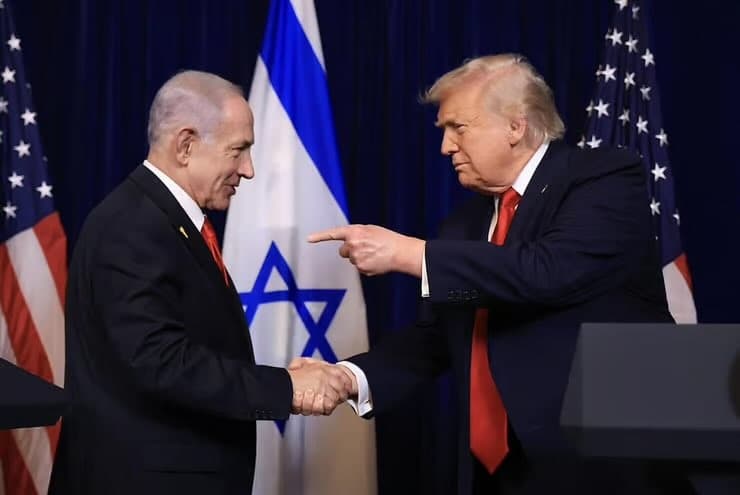
Leaders of both sides, however, appear to have listened to calls from President Trump either to stop fighting or forget about trade agreements.  Malaysia’s prime minister, Anwar Ibrahim, is hosting talks Monday between Thailand’s acting prime minister, Phumtham Wechayachai, and Cambodia’s prime minister, Hun Manet, son of the country’s long-ruling Hun Sen.

Communist China, acknowledging the dispute involves “complex historical issues,” has also called for “dialogue,” but China’s interests lie squarely with Cambodia against Thailand.

After having supported the Khmer Rouge throughout their bloody rule over Cambodia from 1975 to 1979, Communist China has fully aligned with the regime that drove out the Khmer Rouge with the strong support of Vietnam after Hanoi’s victory over South Vietnam in 1975. Hun Sen, having defected from the Khmer Rouge before fighting them, easily switched his loyalty to China in the interests of a steady flow of arms and aid.

“Cambodia’s alignment with China,” writes a Chinese scholar in Japan, Chhay Lim, in the Asia Times, “should be seen not as a simplistic allegiance but as a strategic move — at times driven by necessity — to ensure its survival and prosperity in an increasingly complex geopolitical environment.”

The Thai military accused Cambodian forces of firing “heavy weapons, field artillery, and BM-21 rocket systems,” according to the Bangkok Post. Thai forces, it said, “responded with appropriate supporting fire” while upwards of 168,000 people fled for safety. Thailand reported 20 killed, almost all civilians, while Cambodia reported 13 deaths.

The fighting is breaking out at half a dozen points along the 500-mile-long Thai-Cambodian border as each side accuses the other of infringing on its territory. Conflict extends from a temple on a cliff 260 miles north of the Cambodian capital of Phnom Penh to an island in the Gulf of Thailand.

Cambodia holds both, but Thailand claims the treaty with France that placed Cambodia under French control in 1907 did not really clarify who owned them. The Thai claim to Cambodia, moreover, goes much deeper into history, to its right to rule much of Cambodia, including the Angkor Wat temple complex at Siem Reap, 200 miles north of Phnom Penh.

The Cambodians accuse the Thai of having instigated the conflict by placing barbed wire around a temple. Both sides charged the other with deploying drones, after which the Cambodians opened rifle and artillery fire and Thailand ordered two F16s to bomb Cambodian positions.

In a conflict in which blame will probably never be fixed, the stakes go far beyond the borders that Thai and Cambodian forces promise to defend as the war escalates.

China’s support of Cambodia reflects its drive for power and influence in Southeast Asia. The legacy of the Vietnam War and then Khmer Rouge rule, in which 2 million people died, hangs heavy over a region in which the Americans contest Chinese claims to the South China Sea, which converges with the Gulf of Thailand south of Vietnam.

The Americans support Thailand with more than $100 million a year in military aid but have problems dealing with a Thai regime that’s constantly in a state of flux.The prime minister of Thailand, Paetongtarn Shinawatra, formed a tight relationship with Hun Sen before he handed leadership of Cambodia to son Hun Manet. Ms. Shinawara was then suspended after supposedly communicating by phone with Cambodian contacts, but she’s been quoted as condemning the Cambodian attacks.


The New York Sun

© 2025 The New York Sun Company, LLC. All rights reserved.

Use of this site constitutes acceptance of our Terms of Use and Privacy Policy. The material on this site is protected by copyright law and may not be reproduced, distributed, transmitted, cached or otherwise used.

The New York Sun

Sign in or  create a free account

or
By continuing you agree to our Privacy Policy and Terms of Use