
A Chronicle of Condé Nast Is a Lament for Lost Glossy Glory

A new leader at Vogue comes as the transformations of the digital age shows no sign of relenting.
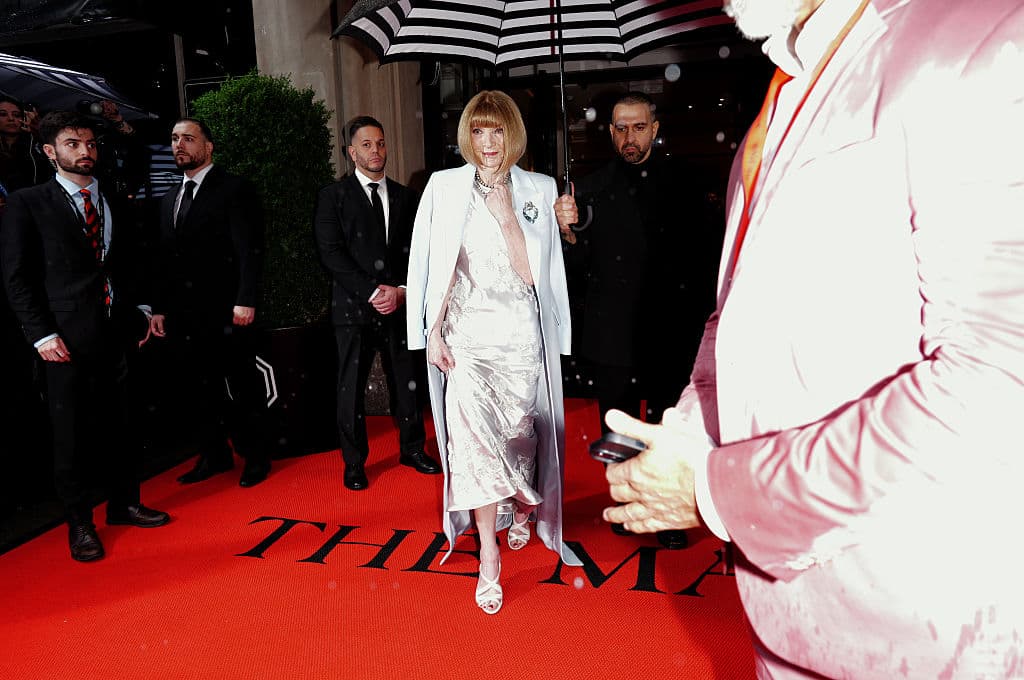
Craig Barritt/Getty Images for The Mark Hotel
Anna Wintour attends The Mark Hotel Met Gala departures at The Mark Hotel on May 05, 2025 at New York City. Craig Barritt/Getty Images for The Mark Hotel

‘Empire of the Elite: Inside the Media Dynasty That Reshaped America’
By Michael Grynbaum
Simon and Schuster, 368 Pages

The shuttering of the “Vogue Club,”  following on the heels of Anna Wintour’s announcement that she would step down as the editor in chief of Vogue — she’ll still serve as the magazine’s “global editorial director” and as the chief content officer of its parent company, Condé Nast — underscores that the times are changing  at brands that once stood at the epicenter of America’s dreams of glitz and glamor and now are struggling to stay afloat.

The selection of Chloe Malle to succeed Ms. Wintour at Vogue comes on the heels of a changing of the guard at another Condé crown jewel, Vanity Fair. The top editor there, Radhika Jones, announced in April that she would resign. In June, Vogue’s erstwhile creative editorial director, Mark Giuducci, 38, succeeded her. A family friend of Ms. Wintour, he tells the Times that the zeitgeist “feels like a co-production between Marcel Proust and Michael Bay.”

Condé was once the best party in town. That, at least, is the dish from “Empire of the Elite,” by Michael Grynbaum of the Times. Mr. Grynbaum contends that Condé is the “media dynasty that reshaped America,” and his book argues that the company of Vogue, Vanity Fair, the New Yorker, GQ, Architectural Digest, Glamour, and more functioned like a Hollywood of the printed page, eliciting desire and manufacturing dreams unattainable enough to bewitch.

Mr. Grynbaum, whose beat is the press, writes with the satisfying snap of good magazine prose — of the kind that, say, Tina Brown commissioned when she was editor in chief of Vanity Fair. He describes Anna Wintour’s early photographic shoots as “fresh, edgy, even kinky at times, with a feel for the avant-garde styles then sweeping New York.” At Condé , Mr. Grynbaum notes, top editors sliced “the gradations of caste gossamer-thin.”

Mr. Grynbaum is hardly shy in his claim that “for decades, one company in Manhattan told the world what to buy, what to value, what to wear, what to eat, even what to think. Before Instagram, before TikTok, there was Condé Nast Publications, merchant of fantasies and supreme arbiter of sophistication.” Never before, Mr. Grynbaum reckons, “had so much cultural influence been concentrated under one roof — and it will never happen again.”

Before Condé was the coolest kid on the block he was an upwardly mobile hustler, the grandson of a preacher and the son of a deadbeat father. A rich friend provided an access to the Manhattan elite, and Nast quickly set about reversing the fortunes of two sleepy magazines gathering dust in Upper East Side salons — Vanity Fair and Vogue. Nast zhuzhed up these publications for the Jazz Age, but the 1929 crash put them into eclipse. 

A different kind of upstart comes onto the scene in 1959, when a shtetl-born real estate baron, Samuel Newhouse, bought Condé Nast for some $5 million and folded it into his Staten Island-based newspaper empire, Advance Publications. Mr. Grynbaum’s account of the rise of the Newhouses captures something of the vertigo of these upwardly mobile Jews who moved within a generation to Park Avenue from the Lower East Side.

A New Yorker writer, A.J. Liebling, himself a patrician “Our Crowd” Jew, called Newhouse a chiffonier, or ragpicker, for buying newspapers in distress and making them profitable. Newhouse’s wife was the formidable Mitzi, who as a Time profile described her in 1959 was a “delicate wisp of a woman (5 ft., 76 Ibs.) who likes to wear originals by Dior and Givenchy.” The magazine reported that Newhouse bought Vogue as a “prize present” for Mitzi.

Sam was a serious man with little time for the pretty precincts of his empire. He handed Condé  to his somewhat schlemiel of a son, Samuel, or Si. It was bashert. Si, who died in 2017, had a genius for hiring. The dust jacket for “Empire of the Elite” features three of the editors he brought on — Ms. Wintour of Vogue, Ms. Brown of Vanity Fair and then the New Yorker, and Graydon Carter of Vanity Fair. Forget ink-stained wretches — these were stars.

Mr. Grynbaum explains how Newhouse transformed Condé from “a clubby little business to the imperious steward” of cool. Newhouse himself molted from a “feckless scion” to an “esteemed patron,” in the process amassing an art collection that would rival a Medici. This book is especially sharp on the not-insignificant role played by a Manhattan real estate developer, Donald Trump, in the galaxy of celebrities that Newhouse sent spinning in the firmament.

A 1994 Vogue quiz for prospective assistants that Mr. Grynbaum scoops in these pages required identifying 178 cultural totems — in writing, and on the spot. The list includes Manolo Blahnik, Molly Bloom, Leonardo DiCaprio, Mrs. Dalloway, “The Magic Mountain,” and Kate Moss. A famed editorial director, Alex Liberman, an émigré from the Bolsheviks, ruminated: “I believe that money should be used to facilitate a creative life.”

Mr. Grynbaum is unsparing in detailing the iceberg that wreaked havoc on this ocean liner of luxury — the internet. Like Odysseus gripping the mast with plugged-up ears, Condé clung to print even as it became clear that the future was digital. Still, this book argues that “we continue to live in the culture” that its great magazines made. The possibility of first lady Melania Trump on the cover of Vanity Fair is still, after all, a talker.     


The New York Sun

© 2025 The New York Sun Company, LLC. All rights reserved.

Use of this site constitutes acceptance of our Terms of Use and Privacy Policy. The material on this site is protected by copyright law and may not be reproduced, distributed, transmitted, cached or otherwise used.

The New York Sun

Sign in or  create a free account

or
By continuing you agree to our Privacy Policy and Terms of Use