

A Critical Favorite and a Popular Hit in Europe, ‘There’s Still Tomorrow’ Comes to America Two Years After Its Release
Paola Cortellesi has done a significant amount of heavy lifting for this project, being not only the director and lead actress but writing the script alongside Furio Andreoti and Giulia Calenda.
Paola Cortellesi’s “There’s Still Tomorrow” is making its United States premiere two years after it was released in Italy. Since that time, the film has garnered a brow-raising accumulation of kudos and awards.
Not only did it rack up six David di Donatello Awards — the Italian equivalent of the Oscars — but the picture has garnered notice outside of its home country: Film festivals in Norway, Australia and Sweden have seen fit to shower it with praise. The Academy of Motion Picture Arts and Sciences? For reasons known only to its members, Hollywood took a pass.
“There’s Still Tomorrow” wasn’t only a critical favorite, but a popular hit. In Italy, Ms. Cortellesi’s movie trounced “Barbie” and “Oppenheimer” at the box office. The hometown crowd took a shine to the story of Delia (Ms. Cortellesi), a housewife of modest means and increasingly stern resolution in post-World War II Rome. The picture “stemmed from my desire to tell the post-war stories I heard from my family elders … the joy and sorrow of the people they had crossed paths with.”
Ms. Cortellesi has done a significant amount of heavy lifting for this project, being not only the director and lead actress but writing the script alongside Furio Andreoti and Giulia Calenda. She’s clearly absorbed a tremendous amount of Italian cinema. The tenets of neorealismo have been hewed to — this is very much about people toward the bottom of the economic ladder — as are those pertaining to vintage Italian comedies. You almost expect Albert Sordi to poke his head into the proceedings at a given moment.

Via Greenwich Entertainment
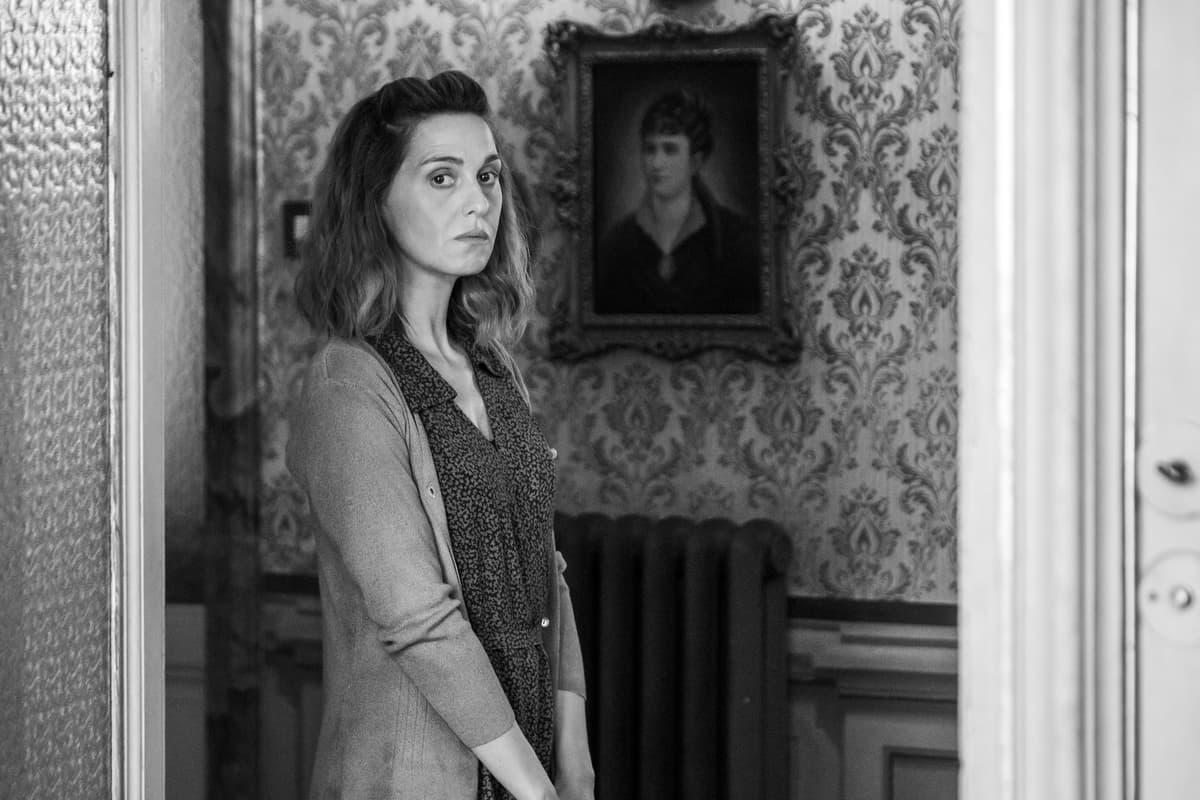
“There’s Still Tomorrow” is an old-fashioned film with a new-fangled gloss. It’s been filmed in black-and-white — eternal grazie to Davide Leone for his sumptuous cinematography — and the opening scene employs an old-school 4:3 aspect ratio. The latter is subsequently shucked for a wide-screen format and other markers of contemporary taste: an achronological soundtrack for one, as well as a self-conscious flouting of tone and staging.
The latter is intermittent, but it does some damage to the movie’s narrative and emotional integrity. In the opening scene, we see Delia in bed with her husband, the older Ivano (Valerio Mastandrea). It’s early morning and as the couple wakes, Ivano slaps his wife upside the head as if this were the natural state of things. An upsetting harbinger, for sure, but Ms. Cortellesi stages it as if it were a cartoon. Later she transforms sustained physical abuse into a parody of a Fred and Ginger dance routine.
Ms. Cortellesi makes a point of stylistic grandstanding, but to what purpose, exactly? Later we hear an excerpt of a track by Outkast, “B.O.B.-Bombs Over Baghdad,” superimposed on a setting that predates the advent, let alone the international ubiquity, of rap music by decades. Surely, our director might have paid better homage to her family, not to mention an important moment in Italian history, by evoking the past rather than subjecting it to post-modernist caprice?
What event transpired in 1946 Italy? To state as much would be to spoil the story as the film’s denouement is truly surprising and, notwithstanding a good dollop of corn, genuinely effective. As it is, Ms. Cortelles’s directorial dodging-and-feinting is more convincing than her run of reliable ethnic archetypes, though the actors — particularly, Emanuela Fanelli and Romana Maggiora Vergano — are gratifyingly invested in their parts.
How well does “There’s Still Tomorrow” live up to its hype? Pretty well, I guess. Here is a beautifully crafted and sporadically amusing picture that is, in the end, a mite too pleased with itself.