
A Defiant Alina Habba Resigns in Face of Implacable Judicial Opposition but Warns ‘Do Not Mistake Compliance for Surrender’

Multiple courts ruled that her continued service as New Jersey’s top prosecutor was unlawful.
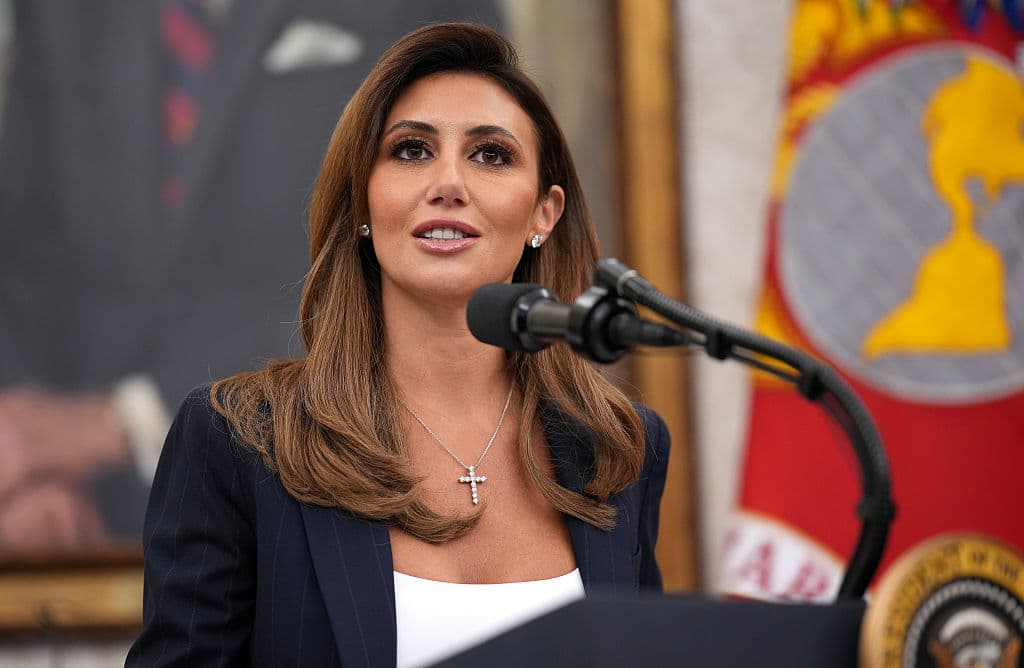
Andrew Harnik/ Getty Images
Alina Habba delivers remarks before being sworn in as the interim United States Attorney for New Jersey in the Oval Office, March 28, 2025 at Washington. Andrew Harnik/ Getty Images

The resignation of the acting United States attorney for New Jersey, Alina Habba, is a concession from the Trump administration that her position as the Garden State’s top prosecutor was at a dead end. 

Ms. Habba’s resignation was announced on X by Attorney General Pam Bondi. The general colored herself “saddened” by the departure but acknowledged that a string of courtroom losses had made it “untenable” for Ms. Habba to “effectively run her office.” Ms. Bondi called the resignation “especially unfortunate” given what she called Ms. Habba’s “strong record of achievement.”

In a statement Ms. Habba declared “As a result of the Third Circuit’s ruling, and to protect the stability and integrity of the office which I love, I have decided to step down. But do not mistake compliance for surrender. This decision will not weaken the Justice Department and it will not weaken me.”

Ms. Bondi disclosed that Ms. Habba will stay on at the Department of Justice as “Senior Adviser to the Attorney General for U.S. Attorneys, helping drive the fight against violent crime nationwide.” Ms. Bondi also insists that Ms. Habba “intends to return to lead the “U.S. Attorney’s Office for the District of New Jersey” if the government’s appeal on behalf of Ms. Habba prospers. 

Ms. Habba, who was a defense lawyer for Mr. Trump before she was appointed to the prestigious prosecutorial post, had never prosecuted a felony before. In August, Judge Matthew Brann —a Republican appointed to the bench by President Obama — ruled that Ms. Habba’s appointment was unlawful. Last week a three-judge panel of the Third United States Circuit upheld that decision. Ms. Bondi writes that the DOJ will “seek further review of this decision, and we are confident it will be reversed.”

President Trump appointed Ms. Habba as interim United States attorney in March, a designation that lasts for 120 days. In June, Mr. Trump nominated her for a permanent role, but her path to confirmation by the Senate was blocked by the Senate custom known as “blue slipping,” whereby both of a state’s senators need to greenlight a nominee for a Senate vote. 

New Jersey’s Democratic senators, Andy Kim and Cory Booker, both staunch opponents of Mr. Trump, blocked Ms. Habba’s path. Mr. Trump has railed against the blue-slipping convention, calling on the Senate majority leader, John Thune, to scrap it,  but Mr. Thune has so far demurred from demolishing this custom of the Senate. 

That opposition of Messrs. Booker and Kim was galvanized by Ms. Habba’s prosecution of two prominent Democrats —  the mayor of Newark, Ras Baraka, as well as Congresswoman LaMonica McIver —following a melee outside of a Newark ICE facility. The case against Mr. Baraka was dropped, but the one against Ms. McIver is ongoing and could result in prison time if she is convicted. This has become a sticking point for the Democratic caucus in the House.

 Two black women members of the House, Ms. McIver and Congresswoman Sheila Cherfilus-McCormick, are both facing felony charges from the Trump Justice Department. Ms. Cherfilus-McCormick is charged with stealing from FEMA. It’s not clear how Ms. Habba’s exit will affect the prosecution of Ms. McIver..

After Ms. Habba’s 120-day interim term expired, the federal judges of New Jersey — 15 of 17 of whom were named to the bench by Democratic presidents — rejected her bid for further service and appointed another attorney, Desiree Leigh Grace, to lead the office. Ms. Bondi fired Ms. Grace and appointed Ms. Habba as acting United States attorney. The Third Circuit, though, reasoned that “under the Government’s … theory, Habba may avoid the gauntlet of presidential appointment and Senate confirmation and serve as the de facto U.S. Attorney indefinitely.”

The DOJ argued to both Judge Brann and the Third Circuit that the president possesses “substantial authority to decide who is executing the criminal laws of the United States.” By resigning, though, Ms. Bondi avoids the possibility of an appellate precedent that could complicate the administration’s appointment strategies elsewhere. In Virginia, prosecutor Lindsey Halligan has been disqualified, a blow to the prosecutions of the criminal cases against the former FBI director, James Comey, and New York’s attorney general, Letitia James.  

Ms. James is also challenging the appointment of the chief prosecutor in upstate New York, John Sarcone. In an apparently unrelated incident to Ms. Habba’s appointment challenges, her office was last month attacked by an assailant wielding a baseball bat. The suspect, Keith Michael Lisa, has been arrested and is in custody.         


The New York Sun

© 2025 The New York Sun Company, LLC. All rights reserved.

Use of this site constitutes acceptance of our Terms of Use and Privacy Policy. The material on this site is protected by copyright law and may not be reproduced, distributed, transmitted, cached or otherwise used.

The New York Sun

Sign in or  create a free account

or
By continuing you agree to our Privacy Policy and Terms of Use