


A Movie That Rewards Revisiting, ‘Five Easy Pieces,’ Is Revived at Film Forum
Jack Nicholson’s turn as a rootless scion of the privileged classes, for which he earned an Oscar nomination, retains its nervy unpredictability.
Movie makers have provided many cautions about picking up hitchhikers on the open road. The earliest likely example was in Frank Capra’s “It Happened One Night” (1934), which, admittedly, cast a positive light by accentuating the leggy charms of Claudette Colbert. But from Edward G. Ulmer’s “Detour” (1946) and Ida Lupino’s “The Hitch-Hiker” (1953) to any number of Grade-Z exploitation movies, thumbing a ride is typically presented as a charitable driver’s worst decision.
Among the memorable hitchhikers in cinema history is Palm Apodaca (Hellena Kallianiotes), a raven-haired woman who is picked up by Robert Dupea (Jack Nicholson) in Bob Rafelson’s “Five Easy Pieces” (1970). Palm is traveling with a friend in tow, Terry Grouse (Toni Basil), and the post-’60s gestalt of these two women is set in direct contrast to Bob’s girlfriend in the shotgun seat, a truckstop waitress of downhome mien, Rayette (Karen Black).
A good-hearted attempt on Rayette’s part to be sociable with the passengers takes a wild and darkly comedic turn. If not necessarily an environmentalist, Palm is someone who has adopted the movement’s concerns to an extreme. “Those [road] signs everywhere,” she snarls, “they should be erased. All those signs selling you crap and more crap and more crap.” Palm’s frustration in discussing the subject — “I don’t even want to talk about it” — doesn’t stop her from talking at length about the follies of humankind. The word “crap” is the go-to descriptor, and it is used in abundance.
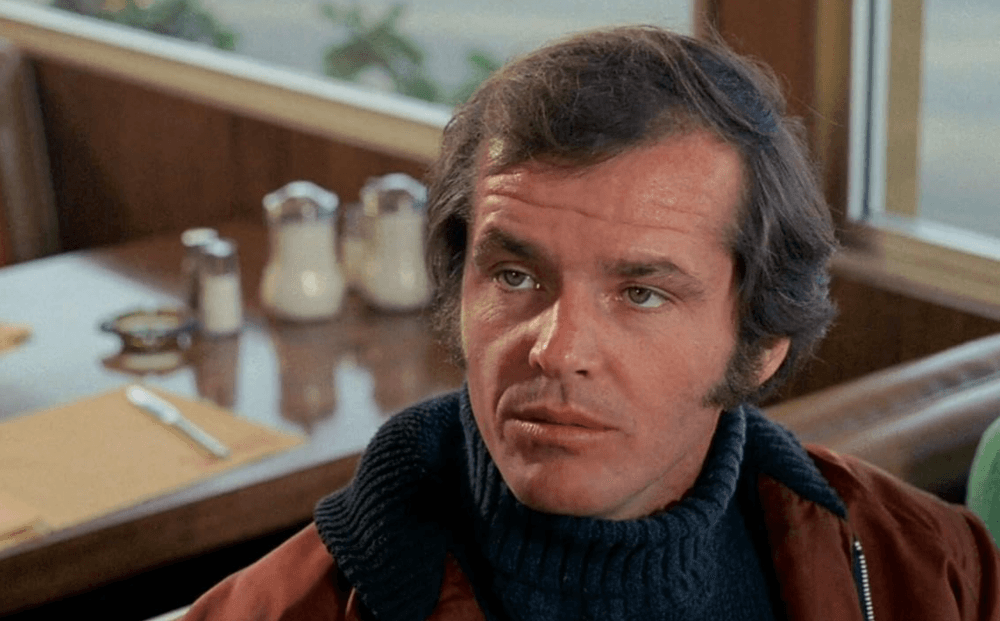
Re-watching “Five Easy Pieces” on the occasion of its upcoming revival at Film Forum offers a splendid opportunity to gauge just how well this signal achievement of 1970s cinema has held up over 50-plus years. The screenplay by Carole Eastman, from a story on which she collaborated with Rafelson, is rife with dialogue as distinctive as the hitchhiking scene, and only rarely does it hint at literary artifice. Even the famous moment when Mr. Nicholson orders a chicken salad sandwich at a highway diner retains its sting. There are few frustrations as eternal as having to deal with an inflexible bureaucrat.

Mr. Nicholson’s performance earned an Oscar nomination for Best Actor, following up on his Best Supporting Actor nomination the previous year for his turn as a lawyer who succumbs to the “yeah, man” zeitgeist in Dennis Hopper’s “Easy Rider” (1969). It’s been some time since Mr. Nicholson has appeared on screen — that would be in James L. Brooks’s “How Do You Know” (2010). While absence may or may not make the heart grow fonder, it does allow for a degree of distance for which in-your-face stardom doesn’t necessarily allow. Mr. Nicholson’s having been out of the limelight allows the rest of us to take in his performance as an actor and less as a celebrity.
His turn as a rootless scion of the privileged classes retains its nervy unpredictability. A temperament forever at odds with its own despair, Bob scuttles through life in a state of resolute irritability that is mitigated, if only just, by the love of a sister, Partita (an indelible Lois Smith), and the sexual ministrations of a future sister-in-law, Catherine Van Oost (Susan Anspach).
As for Rayette: The sense of duty Bob extends toward her is marked by both condescension and custodianship. When a guest at a dinner party attempts to take Rayette down a peg or two, Bob’s invective is as much about showing up intellectual snobbery as it is a mark for any fondness he may have for his girlfriend.
Bob’s travels are peppered with characters whose eccentricities, failings, and fleeting kindnesses are embodied with a rare and marked groundedness — whether it be a good-time girl (Sally Struthers before her “All In the Family” days), a galumphing bumpkin (Billy “Green” Bush), or a recording engineer who’s seen it all (Richard Stahl).
Before landing in Hollywood, Rafelson did a number of odd jobs that took him away from his native Manhattan, and his travels show in the credence by which he treats ordinary Americans. “Five Easy Pieces” rewards revisiting.