A Skeptical Supreme Court Challenges Trump Administration’s Authority To Unilaterally Levy Tariffs at Will

‘Maybe the most important case this court has heard in 100 years,’ says a lawyer for one of the plaintiffs in the case.
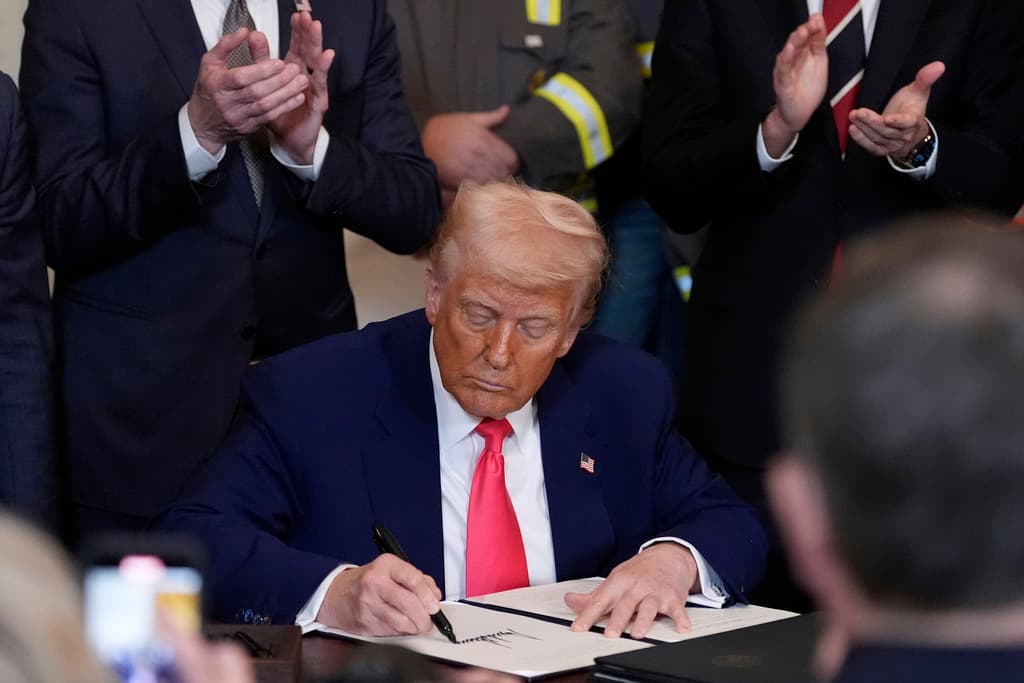
AP/Alex Brandon
President Trump signs an executive order during an event in the East Room of the White House, April 8, 2025. AP/Alex Brandon
LUKE FUNK
LUKE FUNK

Several conservative Supreme Court justices seemed skeptical of the Trump administration’s rationale for levying his “Liberation Day” tariffs during an hours-long, high-stakes hearing on Wednesday.

The court heard oral arguments in Learning Resources, Inc. V. Trump, a lawsuit challenging a key pillar of the president’s economic policy.

The petitioners, a group of small businesses, claim President Trump’s use of reciprocal tariffs is an overstep of his powers and should be struck down. The United States Court of International Trade and the United States Court of Appeals for the Federal Circuit have both ruled against the administration.

Mr. Trump levied the worldwide reciprocal tariffs as part of his “Liberation Day” executive order, relying on the 1977 International Emergency Economic Powers Act. Opponents say the import duties are a use of the law that lawmakers never intended and one that has never been claimed by the president.

In his argument, the Trump administrator’s solicitor general, D. John Sauer, tried to paint the tariffs as regulatory rather than revenue-based. Mr. Sauer argued that Mr. Trump is using his authority to regulate foreign powers and claimed that the revenue they are generating is an ancillary effect of the policy.

The justices peppered Mr. Sauer with questions on how the act grants Mr. Trump the power to impose tariffs when the law makes no mention of them.

Chief Justice Roberts noted that the case may hinge on the major questions doctrine, which requires Congress to speak clearly on issues of “vast economic and political significance.”

The court used that doctrine to strike down several Biden administration domestic programs, but Mr. Sauer said that the doctrine should not be applied to the tariffs because they are being used in connection to foreign policy, which is part of the president’s authority.

Justice Neil M. Gorsuch questioned whether, if Congress did in fact hand over its authority to the president, it would ever reclaim that power. He was referring to the nondelegation doctrine, which the court used decades ago to strike down parts of President Roosevelt’s New Deal. The doctrine says that Congress can’t hand over its legislative powers to other branches of government. The current court has not cited the doctrine in any of its recent decisions.

The lawyer for the companies fighting the tariffs, Neal Katyal, also faced sharp questioning about limiting the president’s powers.

Justice Samuel Alito expressed concerns about limiting a president’s ability to address an emergency if the economic powers act is ruled to not include tariffs. Justice Alito also asked Mr. Katyal if he thought all tariffs were revenue-raising. Mr. Katyal responded “obviously.”

In answering a question from Justice Amy Coney Barrett, Mr. Katyal acknowledged that it could be messy and difficult for the tariff money to be refunded if the court ruled against the Trump administration. Mr. Katyal added that is not a reason to keep the tariffs in place.

The solicitor general of Oregon, Benjamin Gutman, also argued on behalf of a group of Democratic-led states that are part of the case against the president. Mr. Gutman was only questioned for a short period before Chief Justice Roberts closed the hearing after about two-and-a-half hours.

Treasury Secretary Scott Bessent, Commerce Secretary Howard Lutnick, and United States Trade Representative Jamison Greer were all in the court for the arguments.

“The justices asked tough questions but fair questions and very thoughtful ones,” Mr. Katyal said outside the court after the hearing. He said the message he gave was simple — that only Congress has the power to levy tariffs and they are nothing more than taxes on the American people.

“We feel really good about the arguments today and the questions that were asked by the justices,” the attorney general of Arizona, Kris Mays, said. “Maybe the most important case this court has heard in 100 years, especially to our economy and our consumers and businesses large and small.”

The executive editor of SCOTUSblog, Zachary Shemtob, said on C-SPAN after the hearing that the questioning led him to believe that a majority of the justices would rule against the president. Mr. Shemtob said that while justices could wait until June to issue a decision, he thinks they will act much faster due to the importance of the issue and he would not be shocked if a decision was released before Christmas.


The New York Sun

© 2025 The New York Sun Company, LLC. All rights reserved.

Use of this site constitutes acceptance of our Terms of Use and Privacy Policy. The material on this site is protected by copyright law and may not be reproduced, distributed, transmitted, cached or otherwise used.

The New York Sun

Sign in or  create a free account

or
By continuing you agree to our Privacy Policy and Terms of Use