

A Survivor Who Was Taken Hostage on October 7, 81-Year-Old Gadi Moses, Aims To Raise His Kibbutz, Nir Oz, From the Ashes
When Gadi Moses was released from captivity in Gasa, the entire country of Israel was impressed with his defiant demeanor.
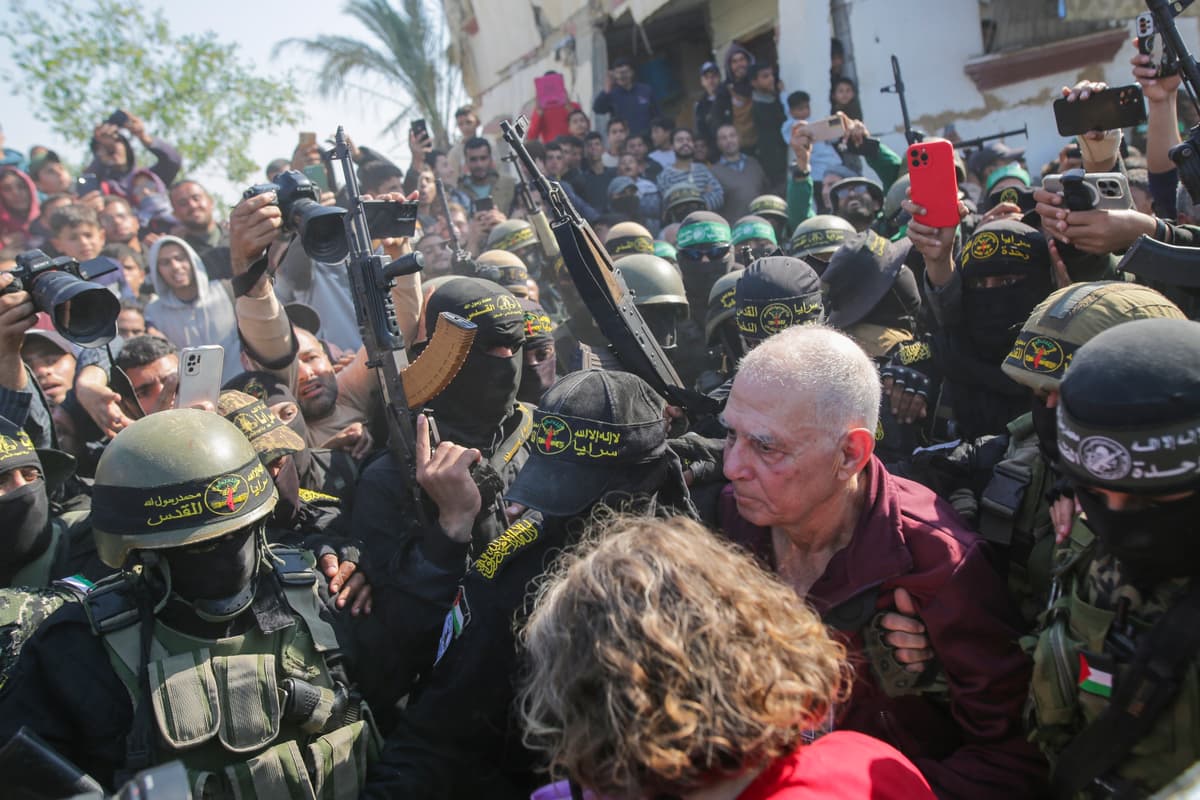
For some Israelis, it may be difficult to find inspiration since the October 7, 2023, massacre, but those seeking rejuvenation and hoping to once again enjoy the good life, including a sip or two of fine homemade wine, Gadi Moses is one way to go.
“We have Merlot, Syrah, Malbec,” Mr. Moses says during this reporter’s recent visit to his home Kibbutz, Nir Oz. As we stand atop a watchtower he’s pointing to a soon-to-be harvested grape patch below. We can easily see the Gaza border less than a mile away. Constant explosions can be heard as the war goes on.
“There were four of us,” the 81-year-old kibbutznik says, referring to the enthusiasts who grew the wine grapes in the kibbutz for private consumption. He is the group’s only survivor, the others having perished on October 7. He was taken to Gaza, where he was held hostage by the Palestinian Islamic Jihad, a terrorist group allied with the Strip-ruling Hamas, for 481 days.
The only time he was really afraid, he says, was in January, hours before he was released as part of a deal orchestrated by President Trump. His captors took him to what looked like an open grave that he thought would be his last spot on earth. “As I was waiting to hear the machine gun tarararam, I was thinking of dead grapevines,” he says. The episode turned out to be the last act of the psychological torture that characterized his entire time in captivity.

When he was released, the entire country of Israel was impressed with his defiant demeanor. “I decided not to show them any sign of fear,” he says. Then he made his first wish: to rebuild Nir Oz and revive it as the beacon it was before the massacre. “People will come,” he vows.
Walking the kibbutz’s paths in August, destruction was ever present. Ruined and burnt homes were everywhere, remnants of the massacre of two years ago. For now, Mr. Moses says more people want to join the kibbutz, especially young ones, than it can accommodate. He is on a campaign, including during a recent America tour, to raise funds for the project that he leads after a harrowing experience as an octogenarian hostage: Revive Nir Oz.
The kibbutz is one of the communities that suffered the worst destruction on October 7. The residents’ mailboxes carry banners that say “murdered,” “kidnapped,” or “released,” the latter just a few. A quarter of the community’s 400 residents were slain or abducted that morning.
Survivors, who were evacuated back then to a town nearby, gathered at Nir Oz on Monday to mark the two-year anniversary of the invasion from Gaza that devastated their lives.
Nearly a third of the 240 Israeli hostages that were taken into the Strip that morning were from this tiny kibbutz. They include Shiri and Yarden Bibas and their two red-headed toddlers, Ariel and Kfir. The youngest abductees became a worldwide symbol of the hostage crisis, and were murdered with their mother.
In captivity Mr. Moses was mostly held in a tiny room inside a residential apartment, where “to pass the time, I walked 10 miles a day around that 14-foot room,” he says. While he tolerated the beating, starvation, and other forms of physical abuse, the psychological torture was more difficult.
The captors told him that his partner, Efrat Katz, was held hostage nearby and that a meeting could perhaps be arranged. Every once in a while, though, he was allowed to listen to a radio in his room for a short time. In one broadcast from Israel, he heard how Efrat was in fact killed on the war’s first day. “You’re a liar,” Mr. Moses defiantly yelled at his armed captor. “What do you gain by lying like this?”
In another lie, the captors told him that his daughter, Moran, and grandchildren, Noam and Ronnie, were killed on October 7. “They had tickets to Bruno Mars, he’s a singer, for that night,” he says.
In reality, when Mr. Moses was released, he was surprised and delighted to learn that the three miraculously survived. Before they were finally rescued long hours after the attack commenced, the mother and children had hidden silently and unnoticed in their safe-room. The terrorists rummaged through the rest of the house, stealing every valuable and making noise.
During the Sun’s visit, Mr. Moses recounted to Israel Defense Force soldiers, who were on a break from weeks of intensive fighting inside Gaza, his stories of fear, courage, defiance, and hope of rebuilding the place he’d lived in for 62 years.
The troops, mostly in their 20s, admire him and stand in line for selfies with him. For them, Mr. Moses represents a man who left Gaza captivity with his head held high, someone who despite everything vows to reclaim the lives that he and his friends, dead and alive, once had. “You are the future of this country,” he tells the soldiers while bidding them farewell. They would soon return to battle.
Before leaving, we go to see the recently dug grave of his partner, Efrat Katz. She was a beloved classmate of this reporter. She will never see how her man now symbolizes a country’s comeback from the worst disaster since its founding. Or how her Nir Oz will rise from the ashes.