A Triumph for Trump as Fani Willis Loses Bid To Reverse Her Disqualification for Affair With Special Prosecutor

The Georgia supreme court denies the district attorney’s bid to reverse her suspension from the racketeering case against the 47th president.
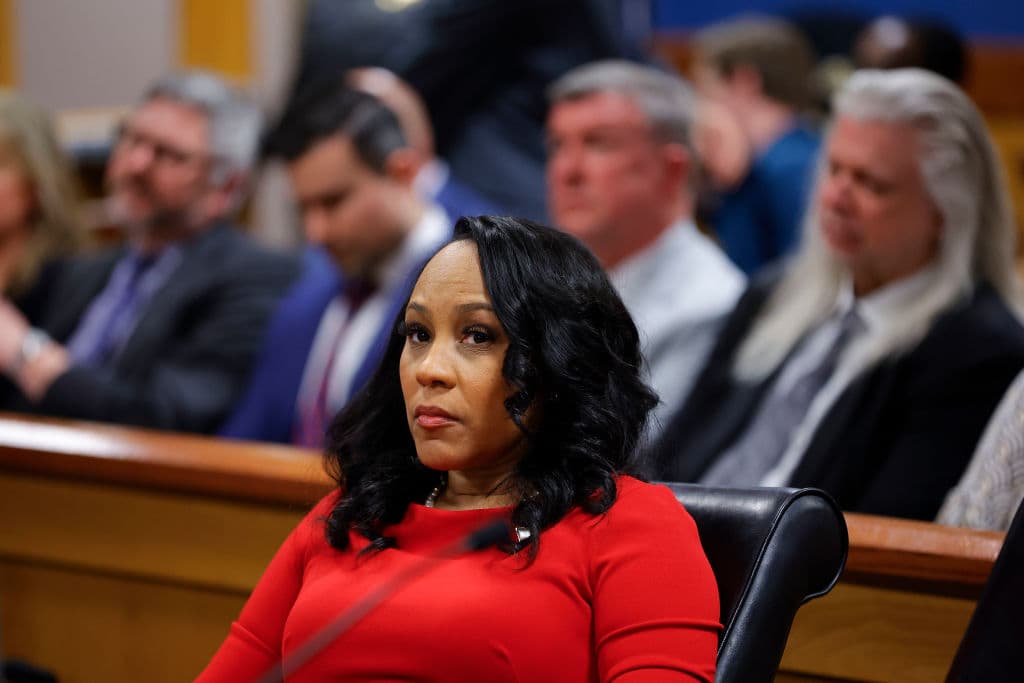

Photo by Alex Slitz-Pool/Getty Images
The Fulton County district attorney, Fani Willis, during a hearing at the Fulton County Courthouse on March 1, 2024, at Atlanta. Photo by Alex Slitz-Pool/Getty Images

The four-to-three decision by the Georgia supreme court to deny the appeal by Fulton County’s district attorney, Fani Willis, of her disqualification is a stunning victory for President Trump — and could end the prosecutor’s push to convict the 47th president.

Georgia’s high court held that “even if one believes that the Court of Appeals erred in reaching that decision granting review to answer that question would be mere error correction, and this Court generally does not exercise our certiorari jurisdiction merely to correct errors that do not have some broader impact on Georgia law.”

Under Georgia law, the supreme court can only grant review if the legal principle at stake extends beyond the facts of the case under consideration. The Peach State’s highest court held here that the “circumstances of this case are unique” and that it was “not convinced that the parties will rely on it for anything broader than the Court of Appeals’ stated conclusion that, based on the specific findings in this case, the trial court chose the wrong remedy.”

Mr. Trump’s lawyer, Steven Sadow, says in a statement that Ms. Willis’s “misconduct during the investigation and prosecution of President Trump was egregious and she deserved nothing less than disqualification. This proper decision should bring an end to the wrongful political, lawfare persecutions of the President.” 

Georgia’s highest court was not compelled to review the Georgia court of appeals’s ruling that “this is the rare case in which disqualification is mandated and no other remedy will suffice to restore public confidence in the integrity of these proceedings.” The appellate court determined that Ms. Willis’s secret romance with her special prosecutor, Nathan Wade, mandated disqualification.

The decision by the Peach State’s highest tribunal to deny certiorari is a stunning repudiation of Ms. Willis, who won re-election in November in a rout. An independent panel will now appoint a new prosecutor with the discretion to either pursue the racketeering case concocted by Ms. Willis and Mr. Wade or drop the charges altogether.

The two-to-one decision by the court of appeals to disqualify Ms. Willis for what it called a “significant appearance of impropriety” amounted to a reversal of the ruling by the trial judge, Scott McAfee. He decided that while the behavior of Ms. Willis and Mr. Wade emitted an “odor of mendacity” and was “legally improper,” the remedy to the due process interests of the defendants — including Mr. Trump — could be remedied if Mr. Wade departed from the case, which he did post haste. Ms. Willis has vowed to stay on.

The sprawling election interference case, though, has been stuck in amber since Ms. Willis was disqualified. The court of appeals declined to dismiss the charges altogether, which preserves the possibility that if Ms. Willis can claw back onto the case she could revive the prosecution. Ms. Willis has defended her hiring of Mr. Wade, who has never prosecuted a felony, for this complex case. She asserts that his credentials are “impeccable.”

Mr. Wade, who is suing AT&T over data that the telecommunications giant shared with the defendants seeking to disqualify Ms. Willis, was paid more than $700,000 by Fulton County taxpayers for his services. He and Ms. Willis took vacations together to destinations like Aruba, Belize, and Napa Valley. Ms. Willis testified that Mr. Wade paid for the trips with his credit card, and she reimbursed him with cash.

Mr. Wade and Ms. Willis testified that their romance began only after he was hired, but cellular telephone data discloses that the pair exchanged thousands of calls and text messages before he was hired. The data also showed that Mr. Wade visited Ms. Willis’s neighborhood some 35 times before he was hired. Mr. Wade has alleged that workplace affairs are as “American as apple pie.”

The final ruling of a state supreme court can only reach the United States Supreme Court if the decision involves a “substantial question” of federal or constitutional law. It is not immediately clear what a question would be with respect to the disqualification of Ms. Willis under Georgia law.


The New York Sun

© 2025 The New York Sun Company, LLC. All rights reserved.

Use of this site constitutes acceptance of our Terms of Use and Privacy Policy. The material on this site is protected by copyright law and may not be reproduced, distributed, transmitted, cached or otherwise used.

The New York Sun

Sign in or  create a free account

or
By continuing you agree to our Privacy Policy and Terms of Use