Actor Michael Caine’s Impressively Varied Career on Display at the Museum of Modern Art
‘Michael Caine: A Shock of Recognition’ is intended to honor ‘one of British and American postwar cinema’s most endearing and enduring actors.’
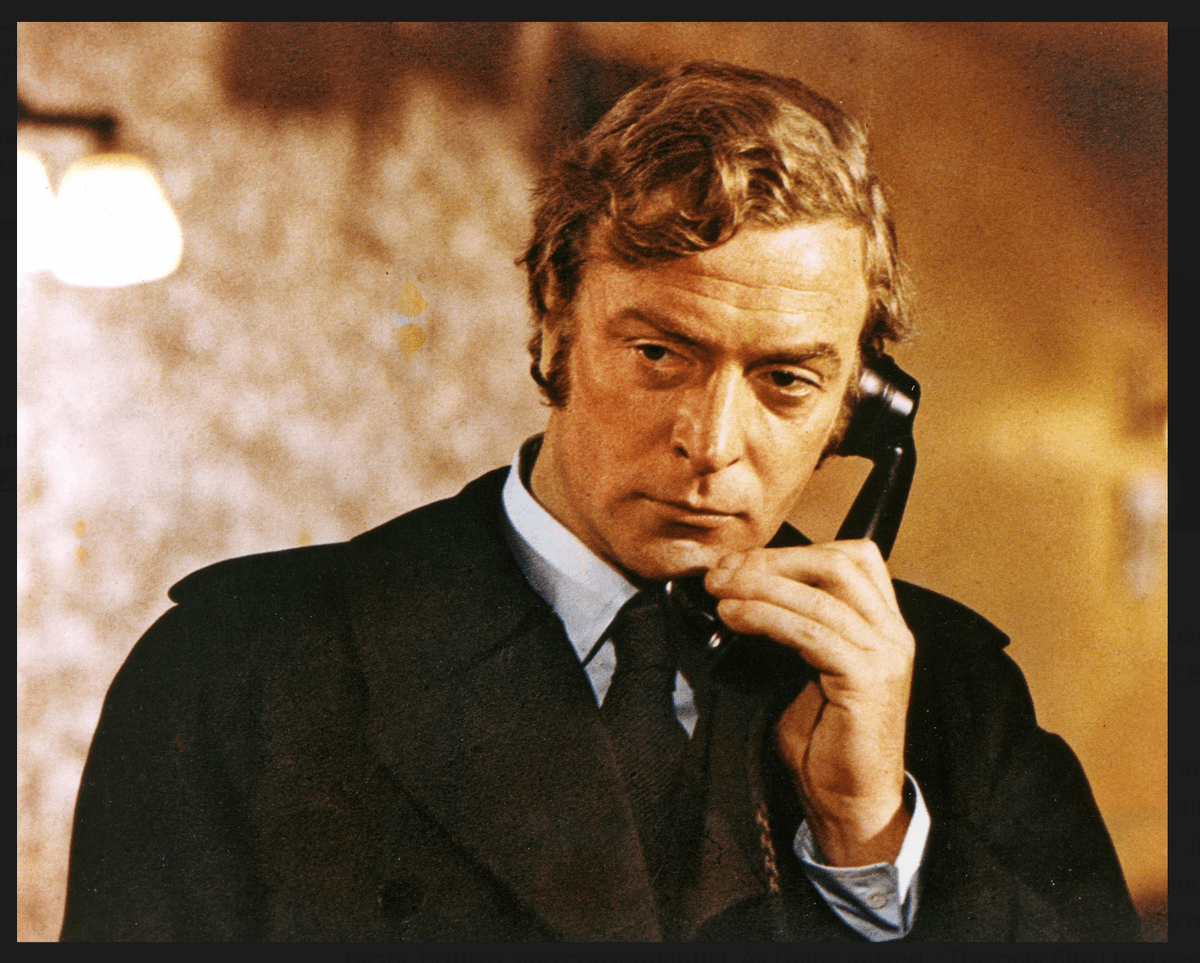
What is your favorite bad movie starring Sir Michael Caine? There are many to choose from.
The 92-year-old actor — he announced his retirement two years ago come October — is sanguine about the choices he’s made in a seven-decade career. Sir Michael admits to not having watched his starring performance in Joseph Sargent’s “Jaws: The Revenge” (1987), “however I have seen the house that it built, and it is terrific.” You have to wonder if he made it through the entirety of “Blame It On Rio” (1984): Although directed by Stanley Donen, this leering sex farce is a far cry from “Singin’ in the Rain” (1952).
Allow me the indulgence to reminisce over Irwin Allen’s “The Swarm” (1978), a picture that couples two genres held dear by fans of 1970s popular cinema: the all-star disaster epic and the revenge-of-nature morality tale. Allen’s apocalyptic bee movie doesn’t merit a sit-through, but it’s worth puzzling over those who lent their estimable talents to it, including Olivia de Havilland, Fred MacMurray, Henry Fonda, the unjustly neglected Bradford Dillman, and, yes, Sir Michael.
Curator Joshua Siegel exhibits admirable circumspection by not inviting these pictures within the Museum of Modern Art for the upcoming series, “Michael Caine: A Shock of Recognition,” a program intended to honor “one of British and American postwar cinema’s most endearing and enduring actors.”
An abiding sense of commonality has been a part-and-parcel of Sir Michael’s appeal, what with his understated physicality, off-hand naturalism, and sly sense of understatement. He’s established himself very much as an old-school movie star. Like John Wayne, Michael Caine is invariably himself in the movie at hand. Can it be a coincidence that Sir Michael has long paid homage to the Duke for a pivotal bit of advice? “Talk low, talk slow, and don’t say too f—ing much.”

The title for the MoMA retrospective stems from a literary critic, Edmund Wilson, and his elaboration on Herman Melville’s notion of how art, roughly stated, has the ability to break free of provincialism and achieve a commonality of purpose. “I want people to see me on the screen,” Sir Michael has averred, “and say, ‘I am him.’” Movie-goers may have a difficult time getting on-the-one with a commander of the British Empire, but Maurice Joseph Micklewhite had roots that were modest.
Born at London, Sir Michael was the scion of a scrubwoman and a fish market delivery man. After World War II, the Micklewhites were shuttled to the south of the city and lived in what was supposed to be temporary housing. “We ended up living there for eighteen years,” the actor wrote in a 2011 memoir, “and for us, after a cramped flat with an outside toilet, it was luxury.” After years spent knocking about the theater, Sir Michael gained toeholds in the cinema and on the telly, breaking through as an upper class twit, Lieutenant Gonville Bromhead, in Cy Endfield’s historical saga “Zulu” (1964).
Sir Michael earned an Oscar nomination as Best Actor for his turn as a licentious Cockney roundabout in Lewis Gilbert’s “Alfie” (1966). He starred in a James Bond knock-off, Sidney J. Furie’s “The Ipcress File” (1962), and the picture did well enough at the box office to garner two sequels.
The latter were later spoofed by the comedian Mike Meyers for his run of Austin Powers pictures, and Sir Michael did him the favor of guest-starring as the super spy’s Dutch-hating father in the last of the series, Jay Roach’s “Goldmember” (2002). A scene in which the two actors trade in British slang — with subtitles, of course — is very funny. “If you don’t go over the top,” Sir Michael told CNN upon the release of the movie, “you look like a ninny.”
There are no worries about ninnyhood in Mike Hodges’s thriller “Get Carter” (1971). As a take on the criminal underclass, the picture is unrelenting in its grottiness. Hodges’s script, based on a novel by Ted Lewis, “Jack’s Return Home,” tells the story of Jack Carter (Sir Michael), a London gangster who returns to his hometown in order to avenge the murder of his brother. Low-rent characters are the rule; cut-rate eroticism endows it with an unseemly cast. Sir Michael predominates, but the supporting cast holds its own, especially Rosemarie Dunham, John Osborne, and Geraldine Moffet.
The picture’s ending is as ruthless as the life chosen by its protagonist: there are Caine films with happier endings to be seen at MoMA. “Get Carter” is of a piece with a wildly uneven and impressively varied career.