After Trump’s Early Exit From APEC, Asia’s Top Powers Seek Alignment on Trade and Security
In separate meetings with China’s Xi Jinping on Friday and Saturday, the leaders of Japan and South Korea sought to tamp down military tensions while boosting economic cooperation.
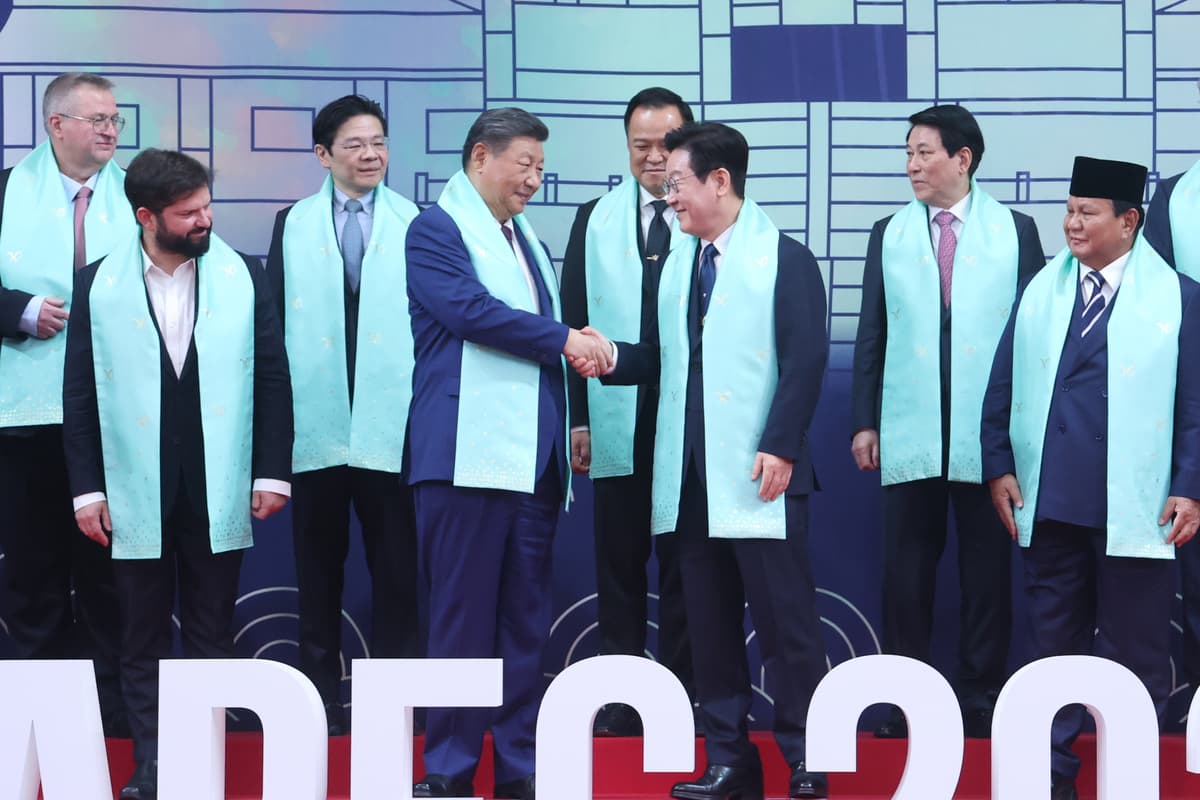

GYEONGJU, South Korea – While President Trump was tucking into Halloween festivities at the White House, leaders of the three richest East Asia nations were talking together about cementing commercial ties and easing military confrontation.
Communist China’s president, Xi Jinping, did not leave South Korea until Saturday evening after summits with the leaders of China’s two most formidable regional rivals, Prime Minister Sanae Takaichi of Japan and President Lee Jae-myung of South Korea.
Ms. Takaichi, alone among the leaders Mr. Xi met on the sidelines of the Asia-Pacific Economic Cooperation group summit, confronted him directly over the Free Chinese island province of Taiwan, which Japan will likely join in defending if China ever tries to make good on threats to take it over.
Voicing subtle expressions of “concern,” she told Mr. Xi that “favorable cross-Strait relations” between the Chinese mainland and Taiwan are “important for the region’s safety and security,” according to Nikkei Asia, an English-language offshoot of Japan’s financial daily, Nihon Keizai Shimbun.
The reference to “cross-Strait relations” concerned persistent intimidation of Taiwan by Chinese air and naval forces based on the mainland, just 90 miles away across the Taiwan Strait.
Ms. Takaichi, whose right-wing outlook was influenced by Japan’s long-ruling Shinzo Abe, also warned against “China’s activity in the South China Sea,” where Beijing is buttressing its territorial claims by building air and naval bases on islands and atolls. Abe was assassinated in 2022, two years after he resigned as prime minister.
Reputed to be an ultra-rightist hawk, Ms. Takaichi hinted at rising Chinese military power when she said she hoped that she and Mr. Xi would “actively engage in dialogue” to resolve “various issues and challenges.”
Although both Japan and South Korea are bound to Washington by historic defense treaties, Mr. Lee played on China’s role as a peacemaker rather than as a military threat in his summit with Mr. Xi.
Most importantly, Mr. Lee asked Mr. Xi to exercise his influence to bring about dialogue between North and South Korea. Rebuffed in repeated attempts to get through to North Korea’s leader, Kim Jong-un, Mr. Lee sees China as the only channel through which to communicate with the unpredictable leader who has declared South Korea an “enemy.”
Mr. Xi responded that China is willing to “jointly address challenges” via “the bilateral strategic relationship.” China exercises huge influence over North Korea – to which it supplies oil and food – while South Korea counts China as its biggest trading partner.
Mr. Xi described South Korea and China as “close neighbors who cannot move apart and inseparable partners in cooperation.” He said the two “have achieved co-prosperity through sustained exchanges and collaboration.”
One-on-one conversations between national leaders here this week were far more important than the waffling final “consensus” reached amid differing views on the meaning of “free trade” and how much to support it.
“In recent years, the focus has been much about finding common ground on free trade amid uncertainties driven by a growing tide of protectionism,” South Korea’s Yonhap News noted.
This year, said Yonhap, “the leaders reaffirmed that ‘robust’ trade and investment are vital to the growth and prosperity of the Asia-Pacific region,” – a statement that could be interpreted any way the delegates wanted.
But what if Mr. Trump had stayed for the summit after meeting with Mr. Xi before it opened? Nikkei Asia reflected Asian views of Mr. Trump’s absence in a commentary headlined, “Trump’s early exit handed Xi the starring role at APEC.”