

Appeals Court Reverses Ruling That Forced Christian Organization To Employ Lesbian Customer Service Representative

‘This decision will protect religious entities who rely on hiring like-minded employees to carry out their core missions,’ a conservative lawyer says.
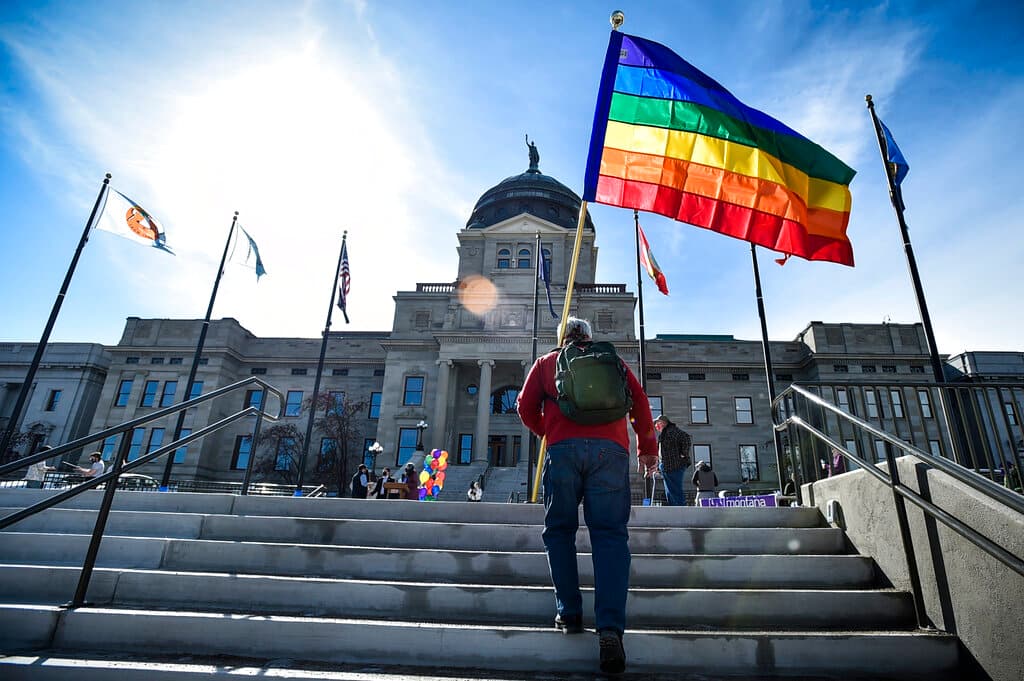
Thom Bridge/Independent Record via AP, file
Demonstrators for LGBT rights at a state capitol. Thom Bridge/Independent Record via AP, file

A federal appeals court says a faith-based humanitarian organization, World Vision, did not violate anti-discrimination laws when it rescinded a job offer to a female applicant after it learned she was married to a woman.

The liberal U.S. Court of Appeals for the Ninth Circuit has overturned a Washington district court’s decision to grant summary judgment for the woman, Aubry McMahon, whose job offer as a customer service representative position was rescinded. A lower court found that the decision violated Title VII and the Washington Law Against Discrimination. 

A three-judge panel on the appeals court agreed with World Vision’s argument that customer service representatives perform “vital religious functions” at the organization and thus qualify for a ministerial exception to employment discrimination laws. 

The ruling comes as the Supreme Court has recognized ministerial exceptions, but has not clarified who qualifies as a “minister” — whether they have to have “minister” in their title or specific training, for example — and what cases can be dismissed under that doctrine, which has left it up to lower courts to decide. The decision might add to pressure for the high court to clarify who qualifies for the exception, and which discrimination cases can be dismissed under the doctrine.

The appellate court’s opinion, written by Judge Richard Tallman, says that customer service representatives at World Vision qualify for the position because they act as the organization’s “voice, face, and heart.” 

The judges reversed the district court’s decision and remanded the case back to the court for a summary judgment in World Vision’s favor. 

In January 2021, World Vision offered Ms. McMahon, who is Christian, a job as a customer service representative. However, after she received the job offer, she sent an email that first tipped off the company to her marriage to another woman, stating that “my wife and I are expecting our first baby” in March, and asked if she would qualify for time off since she would be a new employee. 

World Vision had a discussion about the “application of its Biblical marriage policy … to Ms. McMahon’s situation,” and days later rescinded the offer because of her “inability” to comply with its standards of conduct that prohibit sexual activity outside of a marriage between a man and a woman. 

A district court in Washington initially granted summary judgment to World Vision, citing the church autonomy doctrine. However, Ms. McMahon moved for reconsideration, and the court reversed itself and found that World Vision had acted under a “facially discriminatory hiring practice.”

In an amicus brief, the ACLU argued that a ruling in favor of World Vision would allow religious organizations to discriminate against people based on other characteristics, such as race. 

Judge Tallman highlighted Supreme Court decisions, such as Hosanna-Tabor Evangelical Lutheran Church & School v. Equal Employment Opportunity Commission, that affirmed the ministerial exception and said that the job duties of a customer service representative had to be viewed in light of World Vision’s religious mission. The Supreme Court’s Our Lady of Guadalupe School v. Morrissey-Berru decision stated that employees do not need to meet a certain checklist to qualify for the ministerial exception, such as having “minister” in their title. Instead, the court said, “What matters, at bottom, is what an employee does.”

Judge Tallman said, “On this critical step, the district court erred by viewing the [customer service representative’s] responsibilities in the abstract, isolated from World Vision’s central mission.”

A conservative legal firm, First Liberty, which wrote in an amicus brief supporting World Vision, celebrated the appellate court’s ruling.

A senior counsel for First Liberty, Becky Dummermuth, said, “The Ninth Circuit recognized that the Religion Clauses of the First Amendment protect the right of a religious organization to require that employees with important religious functions agree with its religious beliefs.”

“Forcing religious organizations to hire employees who may openly disagree with their religious beliefs violates both Title VII and the constitutional doctrine of church autonomy. This decision will protect religious entities who rely on hiring like-minded employees to carry out their core missions,” she said. 

The Ninth Circuit’s decision comes as the Supreme Court has left open questions about who qualifies as a minister and what kind of cases can be dismissed because of the exception. 

In 2021, the Massachusetts supreme judicial court ruled that a tenured associate professor, Margaret DeWeese-Boyd, could sue the Christian college she worked for, Gordon College, after she was denied a promotion to be a full professor. She later sued and alleged she was denied the promotion due to her views on same-sex marriage. While the college described professors as ministers, the Massachusetts high court rejected the college’s argument that its employees are “ministers” and qualify for the ministerial exception. 

The Supreme Court declined to hear the case, citing the “preliminary posture of the litigation,” and the parties later settled, leaving open questions about who qualifies as a “minister.”


The New York Sun

© 2025 The New York Sun Company, LLC. All rights reserved.

Use of this site constitutes acceptance of our Terms of Use and Privacy Policy. The material on this site is protected by copyright law and may not be reproduced, distributed, transmitted, cached or otherwise used.

The New York Sun

Sign in or  create a free account

or
By continuing you agree to our Privacy Policy and Terms of Use