
Arguments Loom in ‘Liberation Day’ Tariff Case That Could Crimp Trump’s Power To Set Import Levies

He claims unbounded discretion in wielding a power that is neither granted to him by the Constitution nor delegable by Congress.
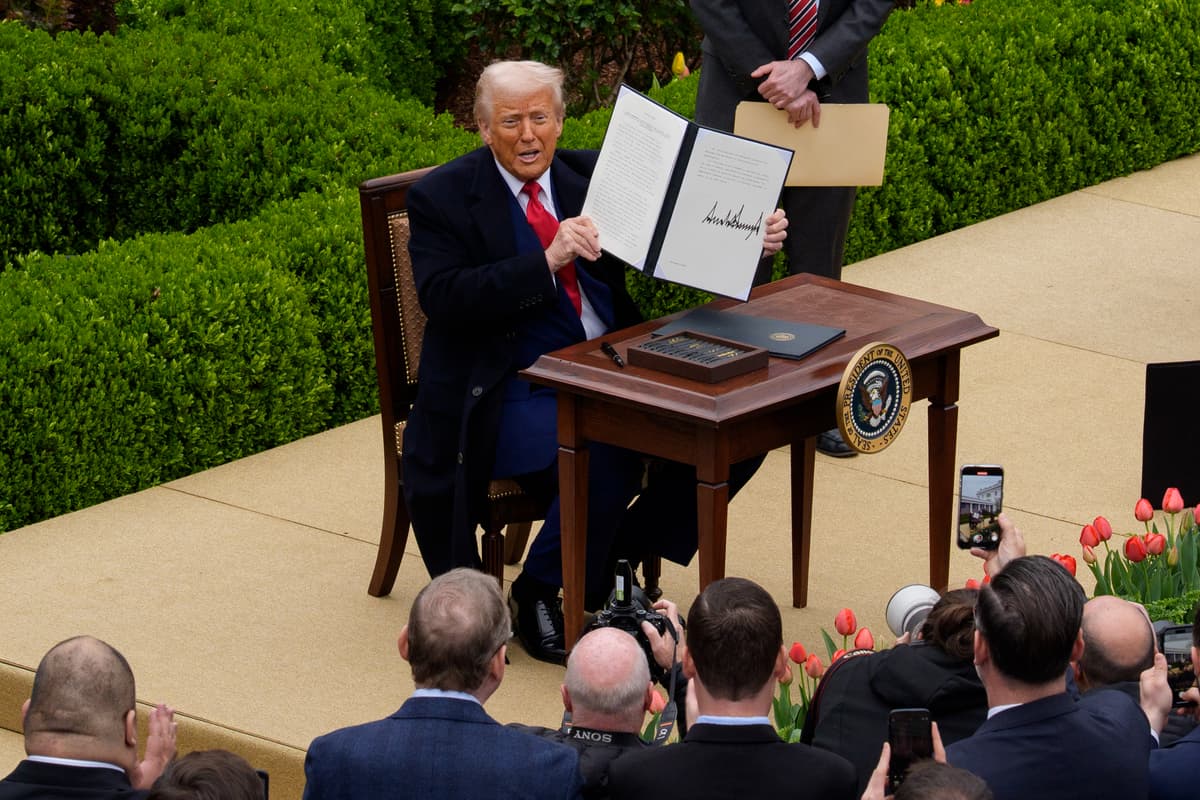
Andrew Harnik/Getty Images
President Trump signs an executive order imposing tariffs on imported goods at the White House, April 2, 2025. Andrew Harnik/Getty Images

President Trump’s destructive “Liberation Day” tariffs, announced April 2, should result in a constructive judicial ruling that significantly sedates today’s hyperactive presidency. Next Thursday, a federal appeals court will hear oral arguments about this: May the president, by making a declaration (that he claims is exempt from judicial review) of a national “emergency” and “an unusual and extraordinary threat,” impose tariffs (taxes paid by American consumers) whenever he wants, at whatever level he wants, against whatever country he wants, on whatever products he wants, for as long as he wants?

A unanimous lower court has said, essentially: Of course not. Eighteen organizations, spanning the jurisprudential spectrum, have filed amicus briefs opposing the president. They demonstrate the following:

After the preamble, the Constitution’s first word is “all”: “All legislative Powers” are vested in Congress. And the power to tax is listed first among Congress’s enumerated powers. Because the Constitution vests in Congress the power to “lay and collect” duties and imposts, presidential authority to impose them must derive from a statute.

Mr. Trump relies on the International Emergency Economic Powers Act of 1977. Yet it nowhere includes the term “tariff” or any of its synonyms, and no previous president has claimed that it authorizes tariffs. Today’s president argues that the act’s conferred power to “regulate” trade implies the presidential power to tax it. This is an astonishingly radical claim because hundreds of statutes authorize innumerable agencies to “regulate,” but not to tax. Congress has often authorized tariffs, but always with specific substantive, temporal and procedural limitations on presidential discretion.

The act’s authority can be exercised only in an emergency involving “an unusual and extraordinary threat,” which trade deficits — the president’s obsession — are not. Unusual? He says they have been “persistent” for half a century.

Recently, the Supreme Court said the Federal Communications Commission’s “regulation” of communications carriers could include an FCC-imposed tax on them but only because Congress explicitly authorized this. Otherwise, the FCC tax would violate two related rules, the major questions doctrine and the nondelegation doctrine.

The former stipulates that for courts to construe statutes to grant the executive broad powers, Congress must “speak clearly” about authorizing executive “decisions of vast economic and political significance.” Congress did no such thing in 1977 with the economic powers act.

The Supreme Court says the nondelegation doctrine, which undergirds the separation of powers, “bars Congress from transferring its legislative power to another branch of Government” without providing “an intelligible principle to guide the delegee’s use of discretion.” Today’s president insists that the act grants presidents unbounded discretion in wielding a power that is neither granted to him by the Constitution nor delegable by Congress.

A constitutional scholar, Philip Hamburger, says the Constitution’s Framers thought “the natural dividing line between legislative and nonlegislative power was between rules that bound subjects and those that did not.” Tariffs bind Americans seeking to purchase imports.

The second law enacted by the first Congress established detailed tariff rates (e.g., 1 cent per pound of brown sugars). Tariff changes were largely Congress’s domain until the 1930s, when Congress began empowering presidents to negotiate — subject to congressional approval — tariff reductions. 

In 1974, Congress authorized the president to impose surcharges of limited amount (15 percent) and duration (five months). And an appellate court stressed in 1975 that a declaration of national emergency “is not a talisman enabling the president to rewrite the tariff schedules” because this would unconstitutionally authorize “the exercise of an unlimited power.”

The 1974 law authorized the president to impose tariffs only to address “balance-of-payments deficits.” Mr. Trump’s idiosyncratic tariffs punish Brazil, with which there is an American trade surplus, because he objects to Brazil’s internal politics.

States of emergency (51 are extant) tempt presidential abuses (the pandemic emergency was President Biden’s pretext for trying to cancel $430 billion in student debt) and are difficult to end: Congress cannot easily reclaim power delegated to the president, who can veto Congress’s retrieval attempts. Given the two-thirds vote requirement for veto overrides, delegation tends to be a ratchet clicking to the president’s advantage.

The president claims his declaration of an “emergency” is unreviewable because it involves foreign relations. Yet tariffs, which have domestic consequences and purposes, properly are congressional exercises of a constitutionally enumerated power and must come from statutes.

Today’s president is a hare, darting here and there. The judiciary is generally a tortoise, slow because it is deliberative. You know the fable, though. And here is a fact: This tariff case could markedly restrain this rampant presidency.

The Washington Post


The New York Sun

© 2025 The New York Sun Company, LLC. All rights reserved.

Use of this site constitutes acceptance of our Terms of Use and Privacy Policy. The material on this site is protected by copyright law and may not be reproduced, distributed, transmitted, cached or otherwise used.

The New York Sun

Sign in or  create a free account

or
By continuing you agree to our Privacy Policy and Terms of Use