Scissorhands in Suburbia

This article is from the archive of The New York Sun before the launch of its new website in 2022. The Sun has neither altered nor updated such articles but will seek to correct any errors, mis-categorizations or other problems introduced during transfer.

The New York Sun

You might remember the name Matthew Bourne from 1998. That was the year his mostly male “Swan Lake” arrived on Broadway, where it ruffled some feathers, generated enormous buzz, and earned him two Tony Awards (for choreography and direction). It also sold an astonishing number of tickets: The show ran for four months on Broadway.

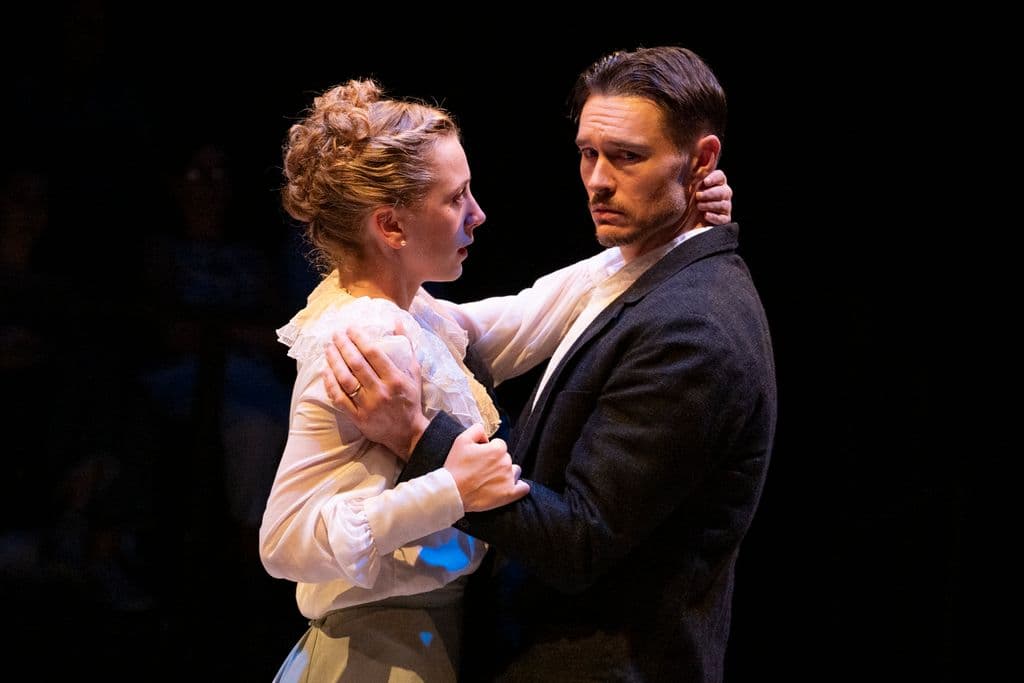
Alternately, you might know Mr. Bourne as the inventor of the wildly original “Play Without Words,” which transferred to New York for three brief but acclaimed weeks in 2005, or as the co-director and choreographer of the Broadway hit “Mary Poppins.” But after this week, you will likely know him as the creator of “Edward Scissorhands,” the dance musical without words, based on the 1990 Tim Burton film, that debuted in London in December 2005. “Edward Scissorhands,” which is stopping in New York in the midst of an immensely popular American tour, opens a two-week engagement at the Brooklyn Academy of Music on Wednesday.

The very existence of an “Edward Scissorhands” national tour is something of a surprise in an era when mainstream audiences seem skeptical of concert dance. That Mr. Bourne is able to tour America successfully with a wordless popular ballet — and draw nontraditional audiences along the way — is a remarkable feat.

But Mr. Bourne, now 47, is a stubborn and determined populist. In a field largely populated by choreographers who — by choice or necessity — pitch their creations to a moneyed elite, he aims to draw large, diverse crowds.

Reached by telephone last month during a tour stop in Washington, D.C., Mr. Bourne said he tries to break through a feeling of intimidation that audiences may bring to a ballet. “What I’ve tried to do over the years is make dance accessible to a wider, younger audience,” he said. “In the U.K., ‘Edward’ played for 12 weeks in London to packed houses. That number of people goes way beyond the dance audience. Way, way beyond.”

Mr. Bourne makes his shows with the uninitiated in mind. He casts performers who “look like real people,” rather than the gorgeous, “godlike people” so commonly found in dance companies. And he provides all the fairy-tale stage magic an audience accustomed to films and Cirque du Soleil could ever want. (The set design for “Edward Scissorhands” (by Lez Brotherston, who also designed the pitch-perfect costumes) is a veritable feast for the eyes, replete with dancing topiaries, picket fences, gleaming blades, and inky blue night skies.

The storyline (developed by Mr. Bourne in collaboration with the film’s screenwriter, Caroline Thompson) diverges markedly from that of the beloved cult film. The central character is still an endearing teenaged misfit, a Goth boy with shears where his hands ought to be. (Richard Winsor and Sam Archer play the role on alternating nights, performing with 18-inch blades attached to their fingers; the hands weigh seven pounds each.) He still falls in love with the daughter of the suburban family that takes him in. But the story has been transplanted from a contemporary American suburbia to that of the 1950s, and few of its original scenes survive. Mr. Bourne says it’s up to him to make the new storyline crystal clear.

To that end, he does his homework. During shows, he sits not backstage but in the dark house, elbow to elbow with the ticketbuyers, gauging their reactions. At intermissions, he chats with people in the lobby.

“I ask them to tell me the story of what they just saw, and then I learn what got across and what didn’t,” Mr. Bourne said. “I’ll give notes the next day to the performers. Of course, it varies from town to town. So I’m constantly reviewing it to make the show work better for each audience.”

Despite his best efforts, there is one aspect of “Edward Scissorhands” that continues to puzzle some audiences. Though “Edward” is performed to a musical score by Terry Davies (based on themes from the original film score by Danny Elfman), it has no singing. “I do think that a lot of people who have come to see it have kind of been waiting for Edward to burst into song,” Mr. Bourne said with a wry laugh. “In the first 10 minutes, I can feel them thinking, ‘Surely someone’s going to talk.’ Then I think that what happens is that in the interval, people talk it over and decide that it’s all right. And when they come back for the second half, the response is straightaway much more enthusiastic.”

Stagecraft has always been a passion for Mr. Bourne. Growing up in London’s East End, “a genuine Cockney,” he loved putting on amateur shows. He says he felt decidedly out of place at his school, “a sort of rough boys’ schools where you didn’t talk about musicals and old movies,” which were his passions. Coming from a working class background, it wasn’t an obvious idea to study ballet — in fact, he was 22 before he took a serious dance class.

Throughout his career, he has always identified as an outsider — a major reason, he says, for his decision to invest years of his life in getting “Edward Scissorhands” to the stage. “My shows are quite spectacular design-wise, but that’s never the reason for doing them,” Mr. Bourne said. “The things I get excited about more than anything else are stories and characters. You’ve got to really love the piece to live with the characters so long. And the sort of stories I like to tell are really about outsider characters who have something to prove, or something to get beyond in their lives.”

After 20 years of creating dance theater pieces, Mr. Bourne has become the outsider who makes other outsiders feel comfortable in the theater. He recalled sitting in the theater one recent night during the “Edward Scissorhands” stop in Charlotte, North Carolina, as the crowd — initially uncertain — warmed to lonely, lovable Edward and made peace with the absence of words. By the second half, the audience was demonstrably affectionate, and by the time snow started falling on a beautiful ice sculpture — carved by Edward with his flashing scissors — there were sighs. By the time the show’s unusual curtain call came around, the crowd was on its feet.

“What I want is a story that captures people and makes them laugh and makes them cry,” Mr. Bourne said. “All those really wonderful, old-fashioned things about entertainment that dance people can sometimes forget.”

Begins March 14 (30 Lafayette Ave., Brooklyn, 718-636-4100).


The New York Sun

© 2025 The New York Sun Company, LLC. All rights reserved.

Use of this site constitutes acceptance of our Terms of Use and Privacy Policy. The material on this site is protected by copyright law and may not be reproduced, distributed, transmitted, cached or otherwise used.

The New York Sun

Sign in or  create a free account

or
By continuing you agree to our Privacy Policy and Terms of Use