
As America Bolsters Ties With Pakistan, Islamabad’s Army Chief Tightens Grip on Power 

The backslide toward full military control raises fears about Pakistan’s support for Islamic terrorism.
Via Inter Services Public Relations Directorate of Pakistan
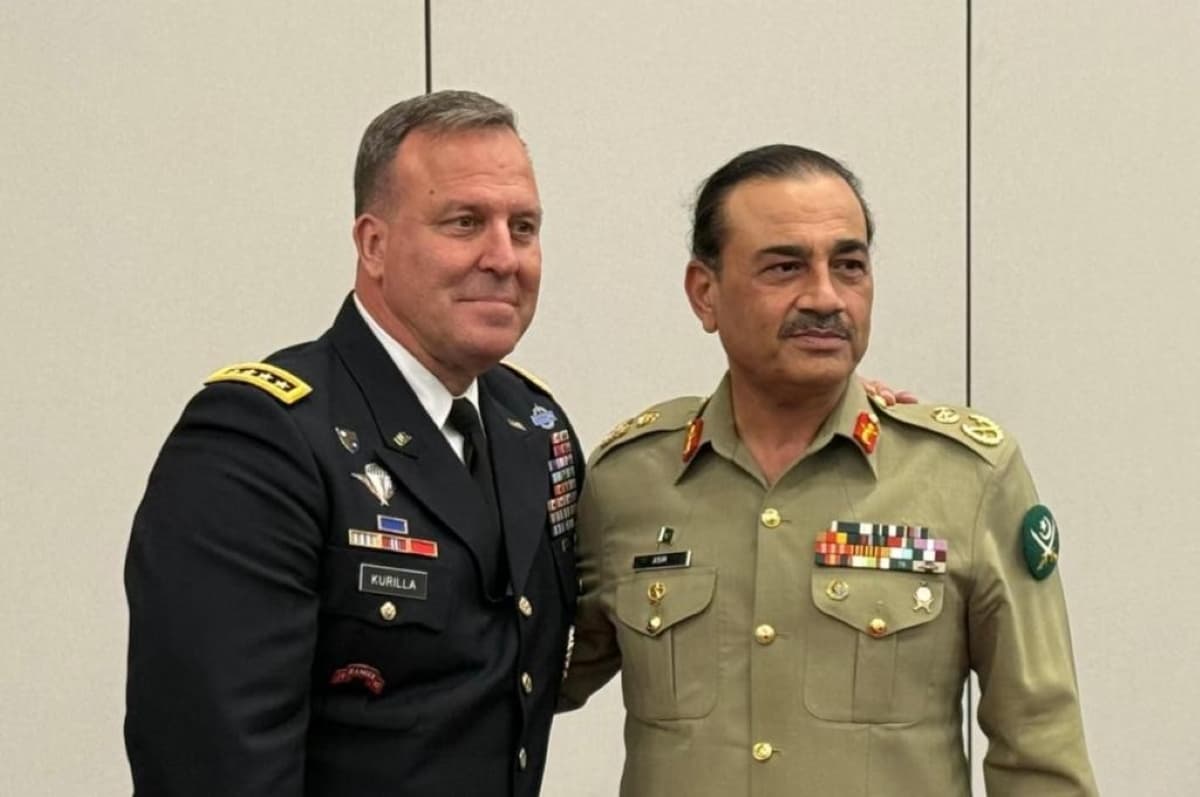
Field Marshal Asim Munir of Pakistan at the retirement ceremony of the outgoing commander of the United States Central Command, General Michael Kurilla, at Tampa, Florida, August 10, 2025. Via Inter Services Public Relations Directorate of Pakistan

At a time when America is pursuing closer ties with Pakistan to the detriment of its relationship with India, Islamabad’s military chief, Field Marshal Asim Munir, is tightening his grip on power in a country already known as an army with a state. The backslide toward full military control raises fears, too, about Pakistan’s support for Islamic terrorism. 

Parliament has passed a sweeping constitutional amendment that expands Field Marshal Munir’s authority, grants him lifetime immunity from arrest and prosecution. The move, signed into law last Thursday, further entrenches the military’s influence over the country’s political and judicial institutions.

Washington, meanwhile, is stepping up its engagement with Field Marshal Munir. He has visited the White House twice in recent months, and in August American officials invited him to attend the retirement ceremony of the former Central Command chief, General Michael E. Kurilla. After years of friction over counterterrorism policy, America appears intent on rebuilding and strengthening military and economic ties with Pakistan.

Under the America First framework, Washington is no longer trying to democratize other countries, and many American officials do not see an all-powerful Field Marshal Munir — and the prospect of creeping dictatorship in Pakistan — as an American problem. Yet if the United States believes it has found a reliable partner in the fight against terrorism, that assessment is misguided.

In May, India launched Operation Sindoor to destroy the terror bases in Pakistan and in Pakistan-Occupied Kashmir behind the attack in Pahalgam, Jammu and Kashmir, that targeted Hindu male tourists. Yet, after India’s military operation, media and intelligence reports say that Islamabad helped Pakistan-based terror groups rebuild—providing them with compensation, repairing sites, and relocating them to safer areas. 

According to those sources, Pakistan supported the move of Jaish-e-Mohammed and other groups to shift their operations from Pakistan-Occupied Kashmir into Khyber Pakhtunkhwa, a region they view as more defensible following Indian cross-border strikes. 

These reports allege that the Jaish-e-Mohammed terror outfit held public rallies in Khyber Pakhtunkhwa under police protection. Furthermore, on September 14, Jaish-e-Mohammed conducted a recruitment rally, addressed by Maulana Mufti Masood Ilyas Kashmiri, Amir for Khyber Pakhtunkhwa and Kashmir. 

Observers report that he claimed that then-Army Chief — and now Field Marshal — Munir had ordered the Pakistan Army and Air Force to pay tribute and provide protection at funerals of terrorists killed by India during Operation Sindoor. It is worth noting that Indian authorities now link a Jaish-e-Mohammed terror module to the November 10 car-bomb explosion near Delhi’s Red Fort, which killed 13 people and wounded many more.

Another element that Washington should take into consideration is that Pakistan can no longer be considered a key geostrategic ally, as its influence in the region has weakened significantly. Its strategic depth doctrine — the cornerstone of Islamabad’s Afghanistan policy for nearly two decades — has failed. The doctrine aimed to install a compliant regime at Kabul that would prevent among others encirclement by India. Today, however, the Taliban no longer act as Pakistan’s client.

On October 9, Pakistani aircraft struck targets at Kabul, focusing on alleged positions of the jihadi group Tehreek-e-Taliban Pakistan. Yet, the strikes coincided with the first official visit to India by the Afghan foreign minister, Amir Khan Muttaqi, and New Delhi’s announcement to reopen its Kabul embassy, underscoring Islamabad’s growing concern over Taliban–India relations.

Pakistan historically viewed the Taliban as a controllable proxy that would defer to its military and intelligence agencies. But as the Taliban are becoming more nationalists and pursue economic autonomy, particularly regarding independent development of Afghanistan’s mineral resources, Pakistan’s leverage has declined. The country can no longer rely on Afghan dependence—financial, logistical, or political—to enforce alignment, effectively dismantling the strategic depth doctrine that once defined its foreign policy approach.

Furthermore, the collapse of Pakistan’s strategic depth policy has brought the country closer to potential territorial fragmentation. Pashtun populations are increasingly resisting Punjabi political dominance, and if Pashtun separatism accelerates, Balochistan — where independence movements already enjoy substantial support — could follow, potentially fracturing Pakistan along ancestry lines. 

The Taliban, as a predominantly Pashtun movement, no longer act as Pakistan’s compliant proxy, removing a key lever Islamabad historically used to influence Pashtun communities across the border and within Pakistan. In this context, the October strikes in Afghanistan and the consolidation of power in Field Marshal Munir’s hands signal not so much strength, but rather deep insecurity within Pakistan’s ruling elite.

By contrast, India is the rising power in the subcontinent. As the world’s largest democracy, India is on track to become a major technological superpower by 2035. Already a global hub for IT services, it is expected to move beyond back-end support and emerge as a leader in innovation. 

India commands influence across the region through its demographic weight, economic strength, technological leadership, and active diplomatic engagement, giving it a decisive role in shaping South Asian (and not only) politics, security, and development agendas. 

The failure of Pakistan’s strategic depth policy, coupled with its retreat into authoritarianism, has constrained Islamabad’s economic development and weakened its influence across the region. At the same time, Pakistan continues to view India as its principal adversary, a mindset that drives its support for proxy groups and aggressive posturing. 

In this context, for America to prioritize Pakistan at the expense of its relationship with India would be strategically shortsighted and counterproductive, as Islamabad’s influence wanes — reducing it to little more than a regional dwarf — and its ability to shape outcomes steadily erodes, while New Delhi’s influence steadily grows. Ultimately, the United States must recalibrate its South Asia strategy to safeguard long-term regional security and American interests.


The New York Sun

© 2025 The New York Sun Company, LLC. All rights reserved.

Use of this site constitutes acceptance of our Terms of Use and Privacy Policy. The material on this site is protected by copyright law and may not be reproduced, distributed, transmitted, cached or otherwise used.

The New York Sun

Sign in or  create a free account

or
By continuing you agree to our Privacy Policy and Terms of Use