
As America’s Navy Shrinks, Time Is Running Out To Prevent Communist China From Seizing Control of the Pacific
To regain deterrence by 2027 will require doubling down on conventional naval investments in warships and shipyards, while rapidly getting firepower to sea in novel ways.
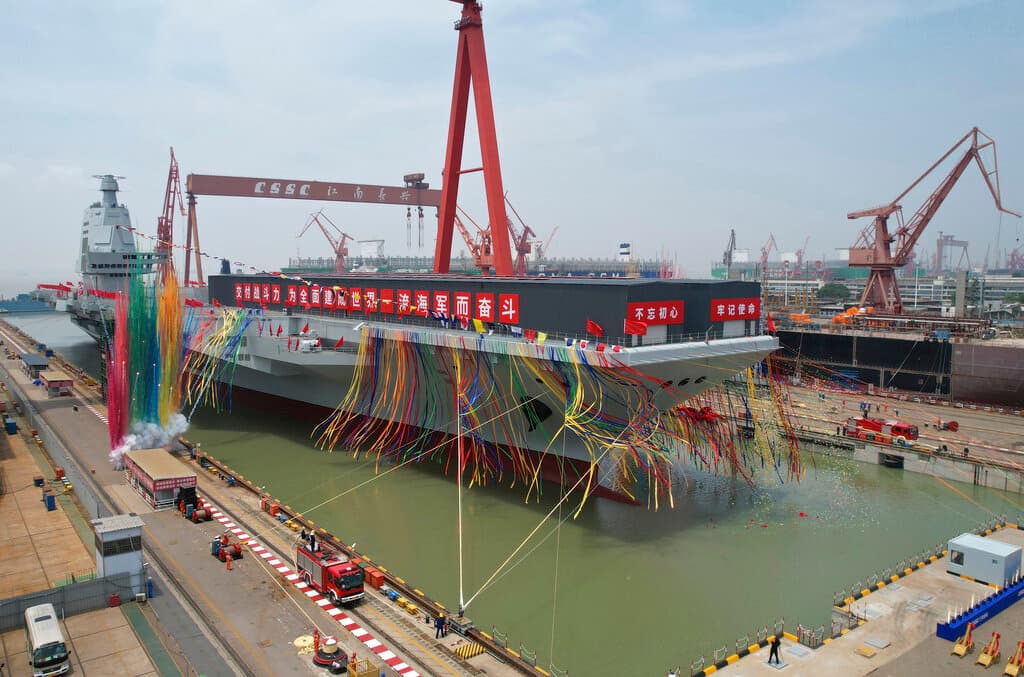

After more than a decade of apathy and false starts, the United States Navy will shrink to a nadir of 280 warships by 2027 — the same time that Communist Chinese leaders have made clear their military is to be ready to wage and win a war with America.
It is increasingly clear that our Navy is inadequate to deter a Pacific war, cannot be sustained for such a war with existing ports and shipyards, and has an armory of munitions that is too thin.
Yet there is still time to regain deterrence by 2027, and to begin to ensure that any war of China’s choosing in the Pacific can be quickly decided in our favor. This requires doubling down on conventional naval investments in warships and shipyards, while rapidly getting firepower to sea in novel ways.
One way is to begin serial production of already proven large unmanned ships that have demonstrated capability to launch weapons like the SM-6 and have deployed to the Western Pacific, like the Unmanned Surface Vehicle Ranger.
There’s no time to lose. As the American fleet dwindles, China’s is growing at an alarming rate and shows no signs of abating. China is outbuilding the United States Navy and is on track to add more than 20 new warships this year, compared to maybe five for America.
Moreover, China’s fleet is rehearsing joint fire campaigns and blockades of the Republic of China on Taiwan at a tempo and complexity to ensure it can persevere over America and its allies. All told, by year’s end the Chinese Communist Party’s navy is expected to number 400 warships.
At such a rate of modernization and growth, and mismatch of military capacity, China’s leaders have been increasingly brazen. Consider the harassment of a treaty ally, the Philippines, in the South China Sea, the use of lasers to blind pilots on a German military aircraft in the Red Sea, and of course the almost routine occurrence of unprofessional intercepts of American aircraft and ships in international airspace in East Asia.
With 2027 as the target date, what is left that can be done?
Building conventional warships — submarines, destroyers, and aircraft carriers — takes three or more years. Munitions like the highly effective SM-3 can take more than a year to build. The best the nation can hope for, if production is accelerated, is a Navy of 293 warships in 2027. This is given the state of industry, while keeping every warship with life, and assuming there are no further delays of ships currently in production.
This reality makes clear the priority left to our leaders: grow the industrial capacity to build and sustain a wartime military so that when China does decide to go to war, the nation can rapidly rise to the occasion. This is what the Naval Acts of the 1930s set in motion and is why a new Naval Act is so much needed today.
Our submarine production rate languishes at less than 1.3 a year when it needs to be more than 2.33 a year. Production of destroyers, frigates, and aircraft carriers, meanwhile, are increasingly behind schedule for delivery. All of this is unacceptable. This sad reality must be reversed now — but growing supply chains and expanding shipyards can take more than two years before effects can be seen if made a national priority.
The recent reconciliation budget and the current president’s budget indicate intent but are still missing the opportunity to begin a long-delayed revival of our maritime strength. This effort necessarily includes reviving our commercial maritime industry if we’re to be immune to Chinese economic coercion.
What’s needed is a Big Beautiful Block Buy of naval vessels to kickstart a vast infrastructure investment in shipbuilding here in America. There are no magic, cheap solutions waiting in allied shipyards to quickly produce warships for our Navy that our sailors and shipyards can maintain or operate. To be sure, allies play a critical role in sustaining the peace and reviving our maritime industrial strength — as their most important security assurance, America’s industrial weakness today is also a liability to them.
It’s impossible to build our way back into deterrence of China by 2027, and our allies can’t backstop the gap. Operating and resourcing our naval forces in unconventional ways is our only real option at this point.
This article was originally published by RealClearDefense and made available via RealClearWire.