
As Vice President Vance Visits India, New Delhi Appears More Interested in Tightening Ties With Washington Than With Beijing
China warns against countries siding with America in the escalating global tariff wars. Beijing ‘firmly opposes any party reaching a deal at the expense of China’s interests,’ its commerce ministry says.
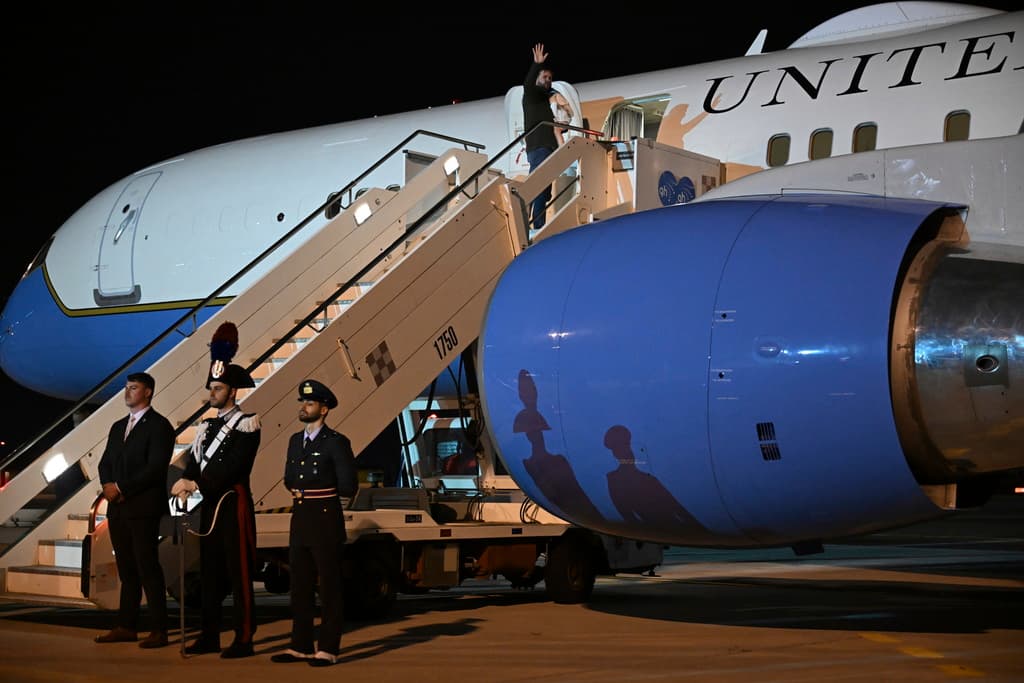
As tensions between New Delhi and Beijing intensify, Vice President Vance on Monday received a warm welcome from Prime Minister Modi of India, who seems more interested in tightening relations with America than with Communist China.
“China is out to get you,” the vice chairman, Mdhav Das Nalapat, of India’s largest independent university, Manipal Academy, tells the Sun. Mr. Vance’s three children on Monday received gifts of peacock feathers from Mr. Modi, and wife Usha Vance’s Indian roots were highlighted across the country. Yet the vice president’s trip is far more than “just a family visit,” Mr. Nalapat says.
Chairman Xi on Monday warned countries against siding with America in the escalating global tariff wars. Beijing “firmly opposes any party reaching a deal at the expense of China’s interests,” its commerce ministry said. “If this happens, China will not accept it and will resolutely take reciprocal countermeasures.”
Defying that threat, New Delhi announced a 12 percent tariff to curb cheap steel imports from Communist China. The measure must sting Beijing, as India is a founding member of an alliance that also includes Brazil, Russia, China, and South Africa. The world’s most populous country, though, seems eager to tighten relations with America even at the expense of cooling them with BRICS allies.
“The geopolitics is getting worse,” Mr. Nalapat says. “So Apple is setting up factories in other places, including India. Microsoft, all these companies, are setting up, and many of them are coming to India because we have abundant manpower, a lot of trained engineers, and all that. Nowhere else you can get that.”
Indians hope that Mr. Vance’s four-day visit to the country could hasten a trade agreement to facilitate such reshoring to India from China. The vice president’s office said both he and Mr. Modi “welcomed significant progress in the negotiations for a U.S.-India Bilateral Trade Agreement.” It “presents an opportunity to negotiate a new and modern trade agreement focused on promoting job creation and citizen well-being in both countries.”
The vice president and the premier discussed a “roadmap for close cooperation between India and the U.S., leveraging the strengths of Make America Great Again (MAGA) and Viksit Bharat 2047,” India’s embassy to Washington said in a statement that referred to Mr. Modi’s vision of transforming India into a developed country by that year. The leaders discussed “enhancing cooperation in energy, defense, strategic technologies, and other areas,” the embassy added
America is India’s largest trading partner, with annual bilateral trade estimated at $191 billion, and the two countries aim to expand it to $500 billion by the end of the decade. Last year, though, India had a $45.7 billion trade surplus with America. President Trump threatened a 26 percent tariff, though the White House later announced a 90-day pause on global tariffs — with the exception of Communist China.
“We understand the trade deficit issue, because we ourselves are facing it with China,” the executive editor of India’s Hindustan Times, Shishir Gupta, tells the Sun. “We want to have a trade deal as fast as possible, but, then, a lot of things have to be done within India” for a deal to be concluded, he adds.
Mr. Modi has eased Indian tariffs on American imports in recent months. New Delhi’s finance minister, Nirmala Sitharaman, is touring America and is scheduled to meet the treasury secretary at Washington this week. While Mr. Trump has in the past called India “tariff king,” the country is one of several large Asian economies — including Japan and South Korea — with which Washington is intensifying trade negotiations.
Representatives on both sides aim to complete a trade deal by fall. Negotiators are aiming to untangle India’s complex set of trade barriers on American imports and for India to also cut down its reliance on Chinese supply chains. The steel tariff announced at New Delhi Monday could signal a first shot in that process.
Mr. Xi, meanwhile, is on a tour of several neighboring countries, hoping to strengthen Beijing’s hold on Asian trade. “A single small boat may not survive a ferocious storm,” Mr. Xi said while in Vietnam, “only by working together can we sail steadily and far.”
For now, “China is embedded at every level of the global production hierarchy,” and America, Europe, South Korea, Japan, and India, are heavily dependent on it, a former Indian trade official, Ajay Srivastava, tells the Indian Express. Yet, as America and Communist China increasingly engage in a tariff tit-for-tat, can New Delhi position India as an alternative to Beijing?