
At 75, Norma Desmond of ‘Sunset Boulevard’ Is More Ready Than Ever for Her Close-Up

In honor of its 75th anniversary, Paramount Pictures has mounted a 4K Blu-ray edition of Billy Wilder’s ‘Sunset Boulevard’ and is re-releasing the movie in select theaters this summer.
Via Wikimedia Commons
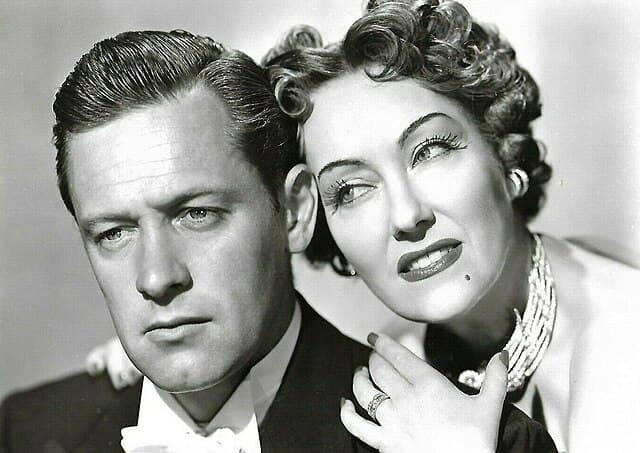
William Holden and Gloria Swanson in 'Sunset Boulevard.' Via Wikimedia Commons

The actress Gloria Swanson was interviewed by a British author and critic, John Russell Taylor, at London’s National Film Theater for the BBC in 1981. Swanson cut a striking figure, particularly when one considers the role for which she is likely best known, the over-the-hill starlet Norma Desmond in Billy Wilder’s “Sunset Boulevard” (1950). We should all be so attractive at age 82.

The elaborative nature of acting is different from the exigencies of life, but watching the real-life Swanson a good three decades after telling the world that she was ready for her close-up is a head-turner. This is particularly the case after listening to Swanson recount the time spent on the set of Wilder’s picture: “I used to sing all the way to the studio … it was extraordinary, it was such a loving experience.”

The discrepancy between behind-the-camera and on-the-screen couldn’t be more stark. Norma Desmond was a gargoyle, a neurasthenic variation on Dickens’s Miss Havisham ensconced in the Hollywood hills. Singing and loving are hard to square with the grotesqueries of “Sunset Boulevard,” but, then, that’s why it’s called acting.

In honor of its 75th anniversary, Paramount Pictures has mounted a 4K Blu-ray edition of “Sunset Boulevard” and is re-releasing the movie in select theaters this summer. It seems a good moment to moot the staying power of the picture and the character at its center. The wages of fame is a tried-and-true subject, but it has gained resonance over the course of decades and, especially, since the advent of the internet. The reach and ubiquity of celebrity has achieved alarming proportions. In many ways, the time for Norma Desmond’s close-up is now.

Via Wikimedia Commons

Wilder’s paean to the contingencies of fashion, age, and taste — scripted with longtime collaborator Charles Brackett with the assistance of D.M. Marshman Jr. — is an elusive creature, being, in equal parts, film noir, horror movie, and comedy. Andrew Lloyd Webber adapted it for the stage, Carol Burnett lampooned it on her CBS variety show and President Trump has screened it several times at the White House. The Desmond estate puts him in mind of Mar-a-Lago.

“Sunset Boulevard” could also be seen as a progenitor of the self-reflexive machinations of postmodernism. Wilder’s picture scuttled promiscuously between fiction and fact, what with Swanson playing a stylized version of herself — clips of Swanson films are shown as artifacts of Desmond’s career — and “real life” appearances by the director Cecil B. DeMille, gossip columnist Hedda Hopper, and actors Anna Q. Nilsson, H.B. Warner, and Buster Keaton. The latter’s single word of dialogue — “pass” — remains an indelibly sad moment.

The auteur responsible for “Five Graves to Cairo” (1943) and “Double Indemnity” (1944) had earned the right to satirize cinematic conventions, the most prominent of which is the beyond-the-grave narration of Joe Gillis (William Holden), a failed screenwriter and canny opportunist. Joe’s savvy is tested when he stumbles upon the premises of a mansion that is less California glitz than the house of Dracula. He is welcomed onto its premises by Desmond and her butler Max von Mayerling (Erich von Stroheim), who is also a former husband and onetime director. The environs are cloistered and rife with delusion. Joe agrees to stay on the premises as Norma’s script doctor and, eventually, becomes her lover.

“Sunset Boulevard” isn’t Wilder’s most cynical movie — that distinction belongs to either “Ace in the Hole” (1951) or “Kiss Me Stupid” (1964) — but the candle it shines on human behavior is, to put it mildly, jaundiced. Credit an inordinately clever script, Wilder’s directorial acumen, and cinematographer John F. Seitz’s gothic chiaroscuro for elevating what might have been an expert deployment of easy ironies into an entertainment that skirts profundity. How well has this rueful tale held up over 75 years? Very well, indeed.


The New York Sun

© 2025 The New York Sun Company, LLC. All rights reserved.

Use of this site constitutes acceptance of our Terms of Use and Privacy Policy. The material on this site is protected by copyright law and may not be reproduced, distributed, transmitted, cached or otherwise used.

The New York Sun

Sign in or  create a free account

or
By continuing you agree to our Privacy Policy and Terms of Use