‘Big Appliance’ Takes Colorado to Federal Court To Block Law Requiring Cigarette-Like Warnings on Gas Stoves
The group says the law ‘stigmatizes safe products’ and ‘undermines the principles of free speech.’
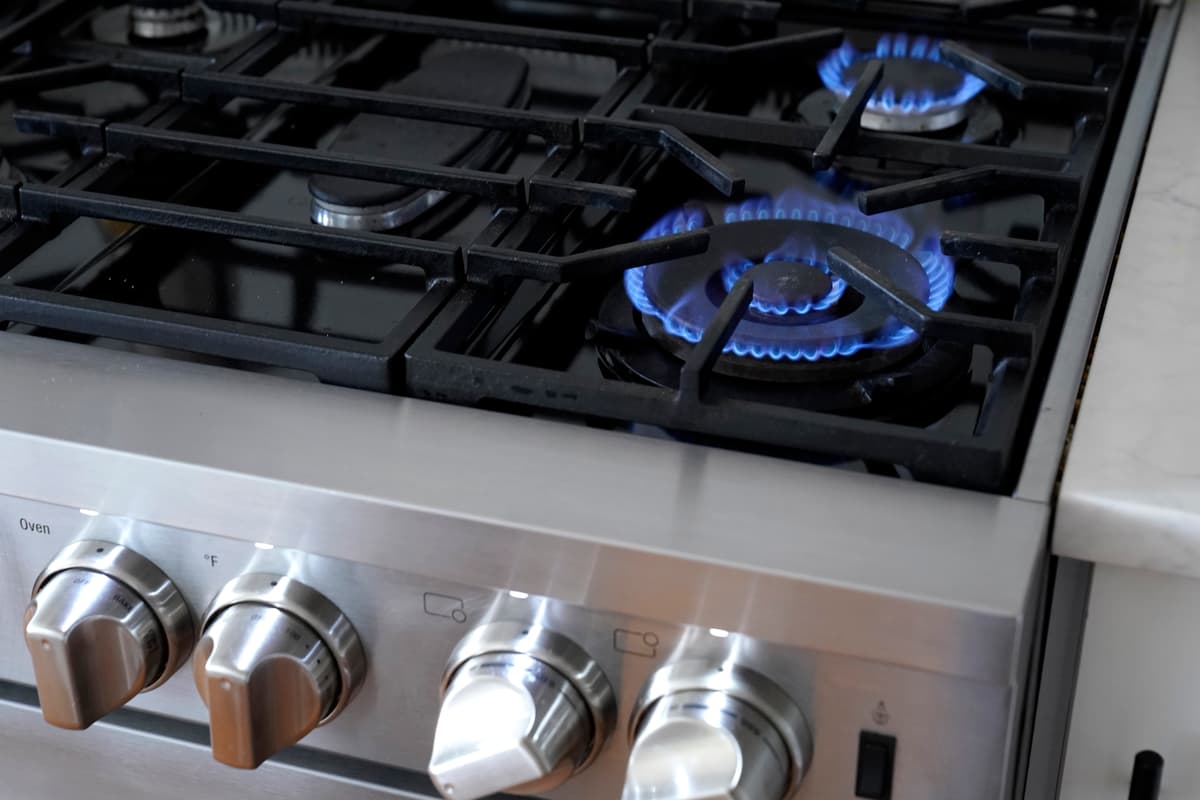

A major appliance trade group is throwing its weight around to stop Colorado from ‘compelling’ retailers to slap bright warning labels on gas stoves, saying the mandate is a violation of the First Amendment.
In May, Colorado’s governor, Jared Polis, signed HB25-1161 into law, the first of its kind, requiring retailers to place an adhesive yellow warning label on gas stoves to inform would-be buyers of the “air quality implications of having an indoor gas stove.” The labels are also required to direct consumers to a government website outlining the “health impacts” of the appliances.
The Association of Home Appliance Manufacturers, or AHAM, filed a federal lawsuit seeking to block the law, which took effect on August 6. In a press release, the association said the law “violates the First Amendment by singling out gas stoves, and compelling retailers and manufacturers to warn consumers of alleged ‘health risks’ and ‘health impacts’ that have not been proven.”
The group is asking for an injunction to block the law, which it says “stigmatizes safe products” and “undermines the principles of free speech.”
Democrats and left-wing activists have said that gas stoves are harmful to the environment and can have hazardous health impacts. A 2022 report published on the open-access site MDPI, which has faced criticism over its publishing practices and questions about how rigorously its journals are reviewed, said that emissions from gas stoves contribute to one in eight cases of childhood asthma.
However, the AHAM says that there is no consensus that gas stoves pose health risks. The group highlighted a study released by the Government Accountability Office in March 2025 to support its case.
“Gas stoves pose risks that include carbon monoxide and nitrogen dioxide emissions, as well as risks that are common to all stoves, including particulate matter emissions, fires, and burns,” the GAO report said.
The report said that gas stoves emit nitrogen dioxide, which “can affect health, depending on exposure levels and individual sensitivity. However, it found there is “no consensus on the health effects of nitrogen dioxide emissions directly attributable to gas stove cooking.”
The president of the AHAM, Kelly Mariotti, said in a statement about the group’s lawsuit, “We strongly support science-based practices that protect consumers. What we are opposing is a state government compelling private companies to communicate a message that lacks scientific consensus.”
“The First Amendment protects not only the right to speak, but also the right not to speak, particularly in a way that is misleading. If the labeling requirement remains in place, Coloradans may be persuaded to make decisions based on incomplete and unproven information,” she said.
The advocacy director for the American Lung Association in Colorado, Nick Torres, defended the law, telling Colorado Public Radio that it is a “good approach to capture the need for quality, evidence-based information consumers could trust at the point of sale.”
Several other states have tried to pass laws requiring warning labels for gas stoves. The proposals failed in Illinois and New York. California’s legislature approved a similar bill; however, Governor Newsom vetoed it due to concerns that the bill’s language would prevent the labels from being updated.
Lawmakers in Massachusetts are considering a bill that would require retailers to display warnings that say gas stoves “release nitrogen dioxide and carbon monoxide inside homes.”