
Blinken’s Mideast Agenda Becomes More Unlikely Even as He Visits the War-Torn Region

The growing gap between Israeli and American visions for the future of the Mideast is increasingly becoming visible.
AP/Mark Schiefelbein, pool
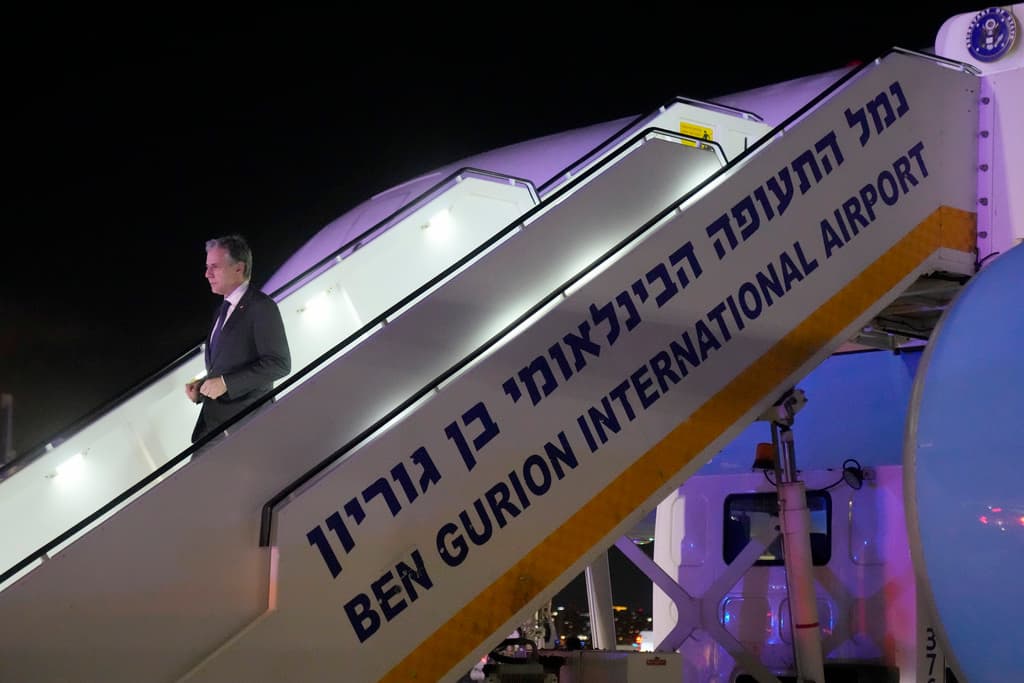
Secretary Blinken arrives at Ben Gurion International airport, Tel Aviv, February 6, 2024. AP/Mark Schiefelbein, pool

Stumbling blocks to Secretary Blinken’s agenda are mounting on his fifth Mideast trip since October 7, even as the growing gap between Israeli and American visions for the future of the Mideast increasingly becomes visible.

At Doha Tuesday, Mr. Blinken conducted a press conference alongside Qatar’s prime minister, Mohammed bin Abdulrahman Al Thani, indicating an alliance between the two countries. At Tel Aviv Wednesday, the visiting secretary faced reporters alone, following a separate press conference in which Prime Minister Netanyahu seemed to reject most of his guest’s demands. 

Prior to Mr. Blinken’s arrival, he asked for an unprecedented one-on-one sitdown with the chief of staff of the Israel Defense Force, Lieutenant General Herzi Halevi. Mr. Netanyahu rejected the request, opting instead to include the general in the secretary’s meeting with several government officials.    

Mr. Blinken told reporters Wednesday that his “foremost” goal was the release of 136 Israeli hostages. Additionally, he spoke of ensuring a “clear and credible pathway to a Palestinian state,” and an “Israel that is fully integrated in the region,” including a peace treaty within Saudi Arabia.  

Despite Mr. Blinken’s seemingly endless efforts to promote that ambitious agenda, his stated goals seem to have become more unlikely during his four-day trip to the region than before it.  

On Wednesday, Hamas issued its conditions for a hostage release. They read like a recipe for Israel’s surrender and a demand that the terror organization regain control over Gaza. As the Israeli defense minister, Yoav Gallant, told Mr. Blinken, Hamas intended for Israel to reject its conditions, according to Israel’s Channel 13. 

Yet, even as Mr. Blinken told reporters that “there are some clear non-starters” in the Hamas proposal, he insisted that it creates “space” for future negotiations.  

Hamas is calling for a four-and-a-half-month pause in the fighting and international assurances that Israel will then completely end the war and remove its soldiers from Gaza. Israel, it says, must also release 1,500 imprisoned terrorists, including 500 serving life sentences due to egregious or murderous acts. Hamas even demands that a Muslim authority at Jerusalem’s Al Aqsa mosque have sole responsibility for approving entry of Jews to the compound. 

“A surrender to Hamas’s delusional demands would not only lead to no release of hostages, it would invite the next massacre,” Mr. Netanyahu said in his solo press conference, adding, “We were supposed to negotiate through intermediaries, but from what I see, Hamas isn’t there.”

The premier said he told Mr. Blinken that Israel is “close to a total victory” in Gaza. Defeating Hamas, he insisted, would be a win “for the entire free world,” vowing that Israel would “not allow Iran’s dark forces to emerge victorious. Each one of our enemies is watching to see which side wins.” 

As Israeli troops are closing in on Hamas’s stronghold at Khan Younis, their next target is Rafah, on the Egyptian border. Mr. Blinken reportedly raised objections. Up to 1.4 million civilians moved to the Rafah region early in the war, he told reporters, and any military operation there “needs to put civilians first and foremost in its mind.”

Mr. Netanyahu, on the other hand, is adamant that victory is the foremost goal. The war cabinet “instructed our forces to move to Rafah next,” he said, adding that the IDF would fight there, as everywhere, “according to international law” and with special attention to humanitarian needs.  

Meanwhile, after Saudi officials indicated last week that they prize a defense treaty with America more than a Palestinian state, an official palace statement following Mr. Blinken’s meeting with Crown Prince Mohamed bin Salman Monday changed its tune. It made clear that no peace treaty would be possible before Israel ends the Gaza war and before a Palestinian state is created, with Jerusalem as its capital.  

Most Israelis fear that full Palestinian statehood now would reward Hamas and create a launchpad for renewed terror attacks. The Palestinian Authority has steadfastly rejected calls to denounce the October 7 atrocities. Public opinion polls in Gaza and the West Bank show almost universal Palestinian support for continued attacks. 

Mr. Blinken nevertheless insisted that a treaty with the Saudis would “entirely change the equation” in the region and “isolate groups like Hamas” and the Iranians. “So it’s up to the Israelis” to decide if they want to “end the endless cycle of destruction, despair, and misery,” he said.

Mr. Netanyahu was less impressed by the latest Saudi statement. “Everyone can state what they want, but ultimately the real test is whether we win the war,” he said. “Our relations with Arab states will look positive if we win, and look bad if we don’t.” 


The New York Sun

© 2025 The New York Sun Company, LLC. All rights reserved.

Use of this site constitutes acceptance of our Terms of Use and Privacy Policy. The material on this site is protected by copyright law and may not be reproduced, distributed, transmitted, cached or otherwise used.

The New York Sun

Sign in or  create a free account

or
By continuing you agree to our Privacy Policy and Terms of Use