

California Democrats Rush To Approve Redistricting Plan as GOP Legal Challenges Mount

Lawmakers say a special election to redraw congressional districts could cost $250 million.
AP/Tran Nguyen
Assembly Republican leader James Gallagher speaks in opposition to Democrats' plan to advance a partisan effort to redraw California congressional map on Monday in Sacramento. AP/Tran Nguyen

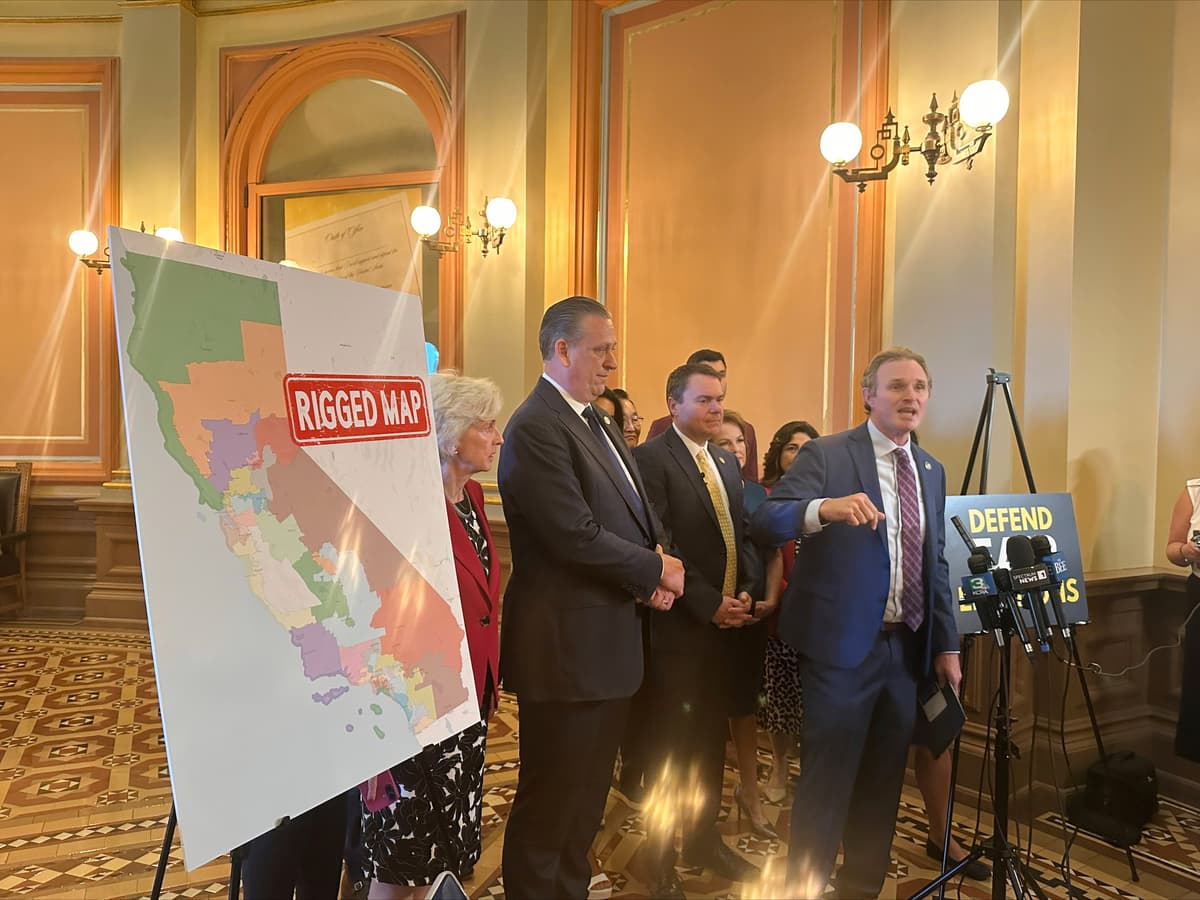
Calling the state the “last line of defense for our democracy,” California Democrats are rushing through Governor Gavin Newsom’s plan to redistrict the state and fend off Republican lawmakers who have filed an emergency petition with the state supreme court to block the process.

Mr. Newsom wants lawmakers to approve a plan for the state to spend up to $250 million on a special election for voters to approve new districts in an effort to increase the number of likely Democratic-controlled districts in the state by five.

The measure would only go into effect if Texas, or any other Republican-controlled state, redraws their lines before the 2026 midterm election. “If those states stand down, then so will California,” a California state senator, Christopher Caballdon, said.

California normally uses an independent redistricting commission to set the maps every decade after the national census. After the 2030 Census, the state’s independent redistricting commission will resume its job of drawing congressional maps, according to the legislation.

Four Republican lawmakers filed a suit with the state’s supreme court on Tuesday to ask it to step in and stop Democrats from moving forward with the plan.

The GOP complaint claims the legislature is “gutting and amending” unrelated bills into redistricting legislation to avoid the normal process that guarantees a review and deliberation on legislation. 

The suit came just as hearings got under way in committees in both the assembly and the senate on Tuesday to quickly move the process along.

The assembly hearing was raucous, with two Republican members trying to block movement of the legislation as much as possible. It started with Assemblyman David Tangipa immediately trying to get the meeting adjourned.

He repeatedly questioned the lack of time he had to read the bill. When one committee Democrat told him that he should be able to read the five-page bill in one day, Mr. Tangipa replied that he reads slowly.

Mr. Tangipa offered an amendment that would block any lawmaker from voting in favor of the redistricting plan from running for office in the newly formed districts. It was quickly rejected along party lines.

When members of the public were allowed 30 seconds each to voice support or opposition to the bill, a long line of opponents stepped forward.

One man received applause after saying, “As Greta Thunberg said, ‘How dare you?’ How dare every one of you guys for trying to pass this bill. Shame on all of you. Shame, shame, shame.”

After Mr. Tangipa refused to stop talking, the committee chairwoman ordered a vote to move the legislation out of committee. The measure passed five-to-two with Mr. Tangipa pausing his interruption to vote no. The committee then went into recess.

The senate hearing was much more subdued. “California will not bend the knee to authoritarian demands,” a state senator, Sabrina Cervantes, said in support of the bill.

The president of Planned Parenthood in California, Jodi Hicks, testified in favor of the measure, claiming that if Republicans remain in control of Congress a “nationwide abortion ban is a possibility.”

“It brings me no joy to see the maps that we passed fairly by the commission to be tossed aside for this new set of maps,” a former redistricting commissioner, Sara Sadhwani, said. “But I do believe this is a necessary step in a much bigger battle to shore up free and fair elections in our nation.”

Another former member of the redistricting commission spoke out against the plan. Connie Archbold Robinson noted that California voters have rejected gerrymandered districts three times.

“This legislation is being touted as the only way to resist authoritarianism,” Ms. Robinson said. “This is a false choice.”

The sole Republican on the committee, Steven Choi, said, “There are so many illegal and also unethical elements in this attempt.” He was the sole no vote against the legislation as the committee moved it forward on a four-to-one vote.


The New York Sun

© 2025 The New York Sun Company, LLC. All rights reserved.

Use of this site constitutes acceptance of our Terms of Use and Privacy Policy. The material on this site is protected by copyright law and may not be reproduced, distributed, transmitted, cached or otherwise used.

The New York Sun

Sign in or  create a free account

or
By continuing you agree to our Privacy Policy and Terms of Use