Catholic and American Brands Are Bolstered With the Accession of Pope Leo XIV
For the first time in the history of these two preeminent institutions, their chosen leaders share the same nationality.
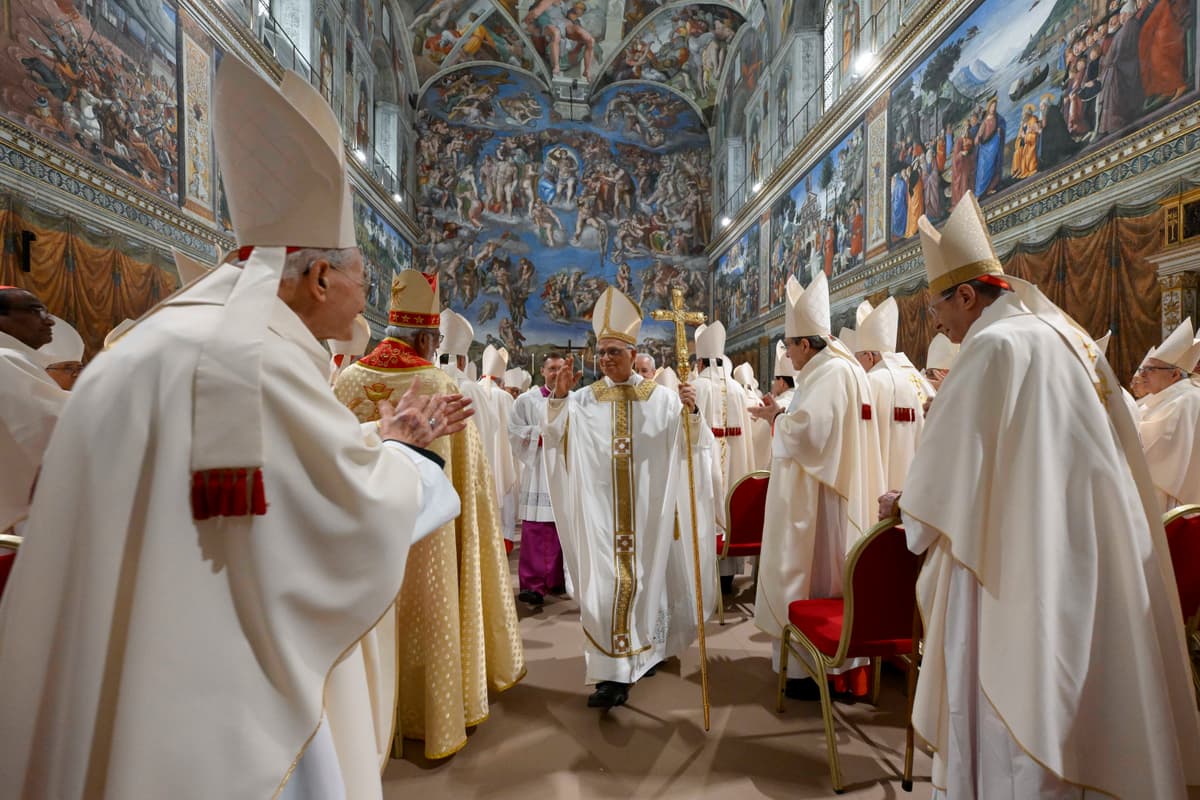

Not too much should be made of the fact that we now have the first pope whose native language is English since Adrian IV (Nicholas Breakspear), who died in 1159. The election of an American pope, albeit one who has spent much of his career in pastoral work combating the left in the struggle for the hearts and minds of Latin America, came just three days before the apparent achievement of the outline of a trade agreement between the United States and the People’s Republic of China, the world’s two largest economies.
This last event produces, like a Deus ex Machina, the collapse of the hysteria and snobbish mockery from foaming-at-the-mouth anti-Trumpers like Robert Reich and Sidney Blumenthal, who had been shrieking with joy, to intelligent groups like the editors of the Wall Street Journal, who should know better and were wringing their hands with alarm, that President Trump’s tariff initiative would be a disaster.
Leo XIV will face many vicissitudes, and the restructuring of international trade will require much more negotiation, but it is fair to say, if the banal parlance may be excused, that the Roman Catholic brand and the American brand are strong and to the extent that they are now more closely associated with each other, they are both stronger. The largest religious denomination in the world reaffirms that it is also the most vital, and the most powerful nation in the world is returning, as has been promised and as its citizens wish, to the full extent of its greatness. For the first time in the history of these two preeminent institutions, their chosen leaders share the same nationality.
English is the world’s largest language group and though, thanks to that implausible religious leader and sub-optimal spouse, King Henry VIII of England, the English-speaking world was more heavily influenced by the Reformation, and not necessarily the best aspects of the Reformation, than the other great Western cultures, our turn had certainly come.
It was clear after the death of Pope Paul VI, who inaugurated the practice of a pope traveling widely, and the brief pontificate of John Paul I, both in 1978, that it was time for the Roman Catholic Church to pursue its international mission by ceasing to be an Italian-dominated organization. Of course, the nationality of the pope prior to his elevation does not necessarily much change the character of the organization that he heads. A papal election does not necessarily have a great impact on his country of origin.
It did with John Paul II, a Pole with an admirable history of resistance to oppression by both Nazis and Communists and an impeccable record of supportiveness of Jews in what was historically one of Europe’s most antisemitic countries. The subsequent elevations of Cardinal Ratzinger of Germany as Pope Benedict XVI and of Cardinal Bergoglio of Argentina as Pope Francis had no discernible impact on their countries. (Argentina did have a radical political change but not one that much conformed to the views of Francis.)
The public does not know much about the secular views of Pope Leo XIV, but the fact that he is an American has generated a good deal of comment that he will administer the Holy See with comparative efficiency, as its financial condition requires. The name that he has chosen indicates sympathy for the disadvantaged stopping well short of the prolonged dalliance with the Latin American left that Francis conducted; and the fact that he emerged onto the balcony of St. Peter’s Basilica in the traditional attire of an elected pontiff, unlike his predecessor, has been taken as at least a gesture to traditionalists.
That he spoke Latin, Italian, and Spanish, but not his native tongue, from the balcony of the basilica immediately after his elevation has given comfort to those who imagined that he might be contemplating the Americanization of the Holy See. But there are two related takeaways from just a casual observation of the events of the last week.
The immense crowd that filled St. Peter’s Square and the Via de la Conciliazione, which leads into it, enthusiastic and conspicuously including a large number of younger people, confirms again the relevance and imperishability of the Roman Catholic Church. To its numerous and sometimes sensible critics, it is the bumble bee of human institutions that flies on, saecula saeculorum, in defiance of all laws of nature and logic.
Yet it remains the principal occupant of that irreducible zone of the human psyche that believes, suspects, or is at least open to the possibility that there is a divine intelligence in which lies the explanation for all that preceded known human history and all that is beyond us in space and in time. To declare and believe that there is absolutely nothing beyond the life and world that we know and that human life is a mere coincidence of no durable or moral significance — that we are a passing accident and that there are no spiritual forces anywhere — all this requires a greater act of faith and one that is harder to substantiate than almost any form of religious belief.
The shambles of governments in most democratic countries and practically all undemocratic countries is finally driving demonstrable sections of the populace to take more seriously than has been recently fashionable the contemplation of the legitimacy of faith.
The other conclusion from the events of the last week that does directly and positively reflect on and demonstrate the vitality of the United States is that the elderly but collectively extremely intelligent and well-informed College of Cardinals was not deterred by fashionable opinion from selecting as the 267th successor to St. Peter as head of the church that Jesus Christ, it is generally believed, asked him to found, a citizen of the most influential and controversial nationality in the world.
The United States is the country regarded with the most mortal antagonism by the international left, including the cadres of the extreme left whose ant-like movements have so disturbed the political and social life of the United States that the American people have revoked their elites and elevated a president dedicated to the restoration of the traditional formula for the growth and unheard of success in almost every field of the United States of America. This is an encouraging sign of the times.