

Charges Under Espionage Act Could Loom for Trump, Search Warrant Suggests
Ex-president could be facing decades behind bars if put in the dock for violating law on government secrets.
President Trump could be facing decades behind bars for violating the Espionage Act and other federal statutes relating to classified documents — a prospect put into sharp relief after Mr. Trump himself gave the okay to unseal the warrant that set off the raid on his compound at Mar-a-Lago.
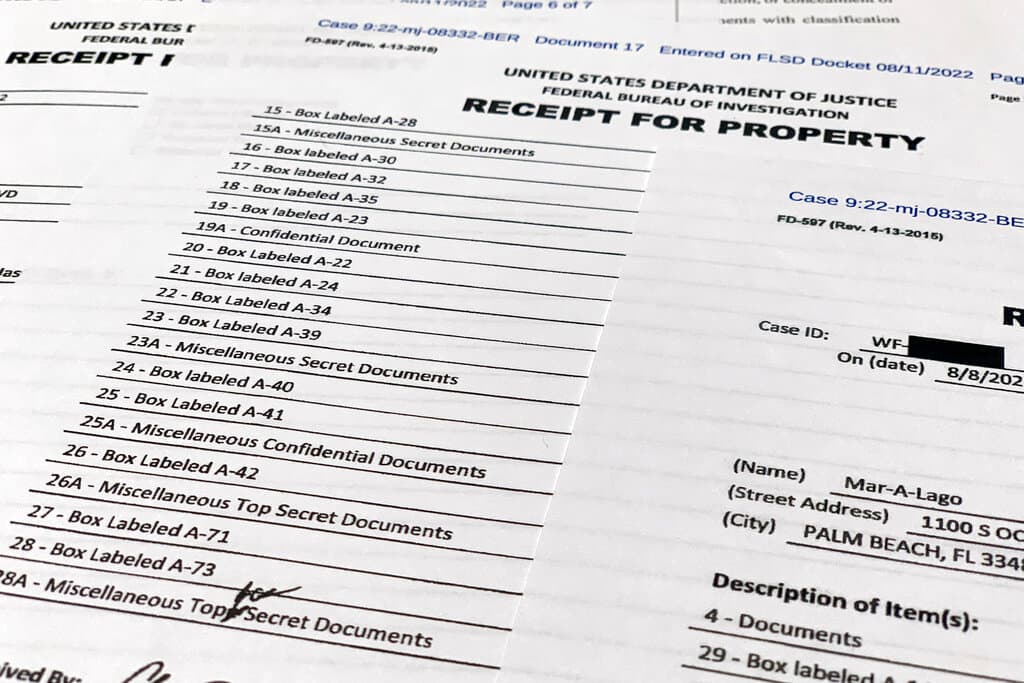
The possibility of jail time came into focus as the search warrant noted the legal case underlying the confiscation of documents, reportedly 11 sets of classified material. The Wall Street Journal notes that agents also “collected four sets of top secret documents, three sets of secret documents, and three sets of confidential documents.”
According to the Wall Street Journal, some of these materials, housed in “around 20 boxes of items, binders of photos, a handwritten note and the executive grant of clemency for Mr. Trump’s ally Roger Stone,” were “marked as top secret and meant to be only available in special government facilities.”
The materials also reportedly included information about the “President of France,” and the Washington Post reported earlier in the day that some may have related to nuclear material. This highly sensitive information is usually accessible only in Sensitive Compartmented Information Facilities.
Three statutes mentioned in the warrant lie at the core of DOJ’s developing case: Title 18 of the United States Code, Sections 793, 2071, and 1519. The first of these is known as the Espionage Act. It proscribes “Gathering, transmitting or losing defense information” to be used “to the injury of the United States, or to the advantage of any foreign nation.” The penalty is a fine or a prison term not more than ten years — per document.
Section 2071 of the statute interdicts someone who “conceals, removes, mutilates, obliterates, or destroys” official documents, and prescribes a prison term of “not more than three years” a record.
Section 1519 concerns “Whoever knowingly alters, destroys, mutilates, conceals, covers up, falsifies, or makes a false entry in any record, document, or tangible object with the intent to impede, obstruct, or influence the investigation or proper administration of any matter.” It carries a 20 year prison term.
On his Truth Social platform, Mr. Trump previewed what is likely to be a crucial argument should charges be filed: “It was all declassified.”
His attorneys will likely point to Department of Navy v. Egan, a 1987 Supreme Court case that noted the President’s authority “to classify and control access to information bearing on national security” and found that the authority “to protect such information falls on the President as head of the Executive Branch and Commander in Chief.”