Chief Justice Roberts Hides in Plain Sight as His Supreme Court Splits at the Seams
The head of the federal judiciary did not write a dissent or a concurrence in the entirety of the high court’s term.
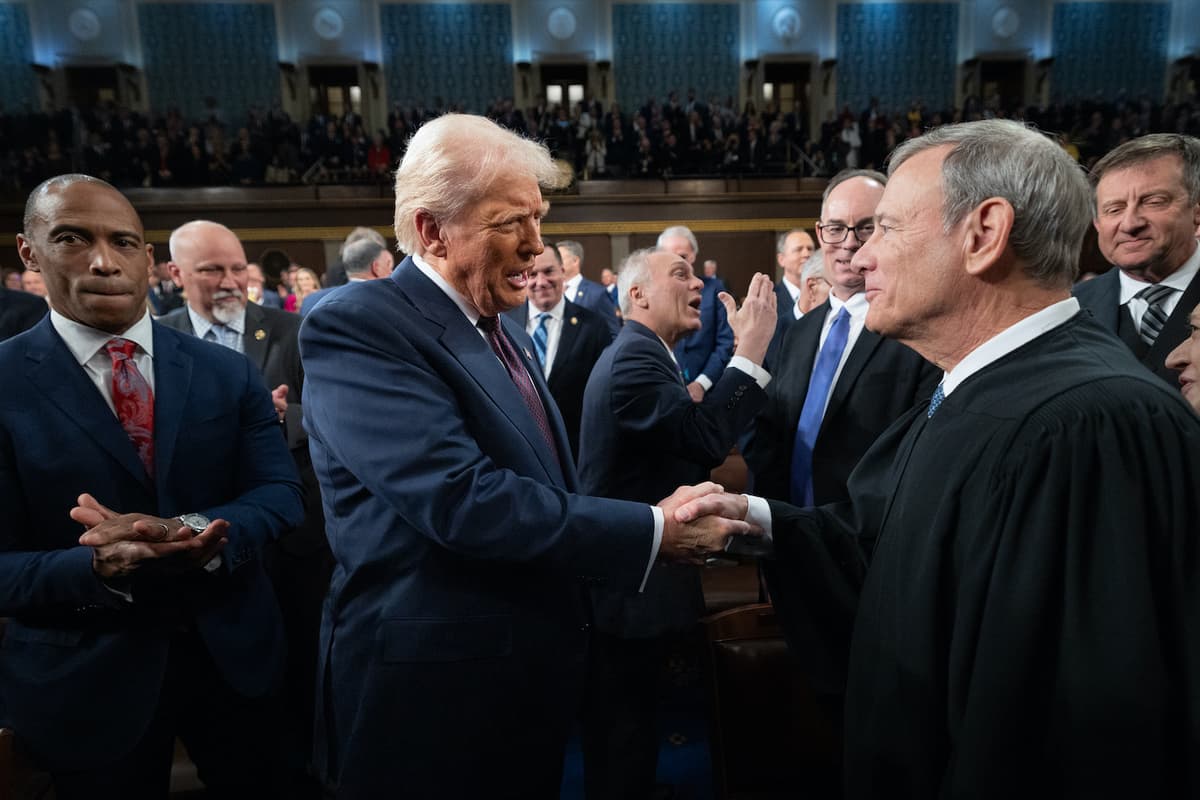
Chief Justice Roberts’s role on the Supreme Court he leads appears to be evolving after a term in which he did not author a single dissent or concurrence — despite a slate of hot-button cases.
The chief justice, according to data adduced by SCOTUSblog, was in the high court’s majority some 95 percent of the time, the highest such rate of any justice. The most frequent dissenter was Justice Ketanji Brown Jackson, who wrote 10 of them, several of which were characterized by heated rhetoric. The next most frequent dissenter was Justice Clarence Thomas, with nine dissents.
Chief Justice Roberts was not always so demure. In 2021, he authored a solo and blunt dissent in a First Amendment case. “The Court sees no problem with turning judges into advice columnists,” he seethed, arguing, “For those who want to know if their rights have been violated, the least dangerous branch will become the least expensive source of legal advice.”
That solo dissent, though, was the first for Chief Justice Roberts after 16 years on the high bench. Justice Jackson wrote three such solitary dissents in her first term and she has issued concurring opinions at the highest rate of any justice dating back to 1937. If Justice Jackson is increasingly willing to step out on her own, Chief Justice Roberts appears committed to hewing closely to the court’s majority.
He is chief justice not only of the Supreme Court: He is chief justice of the United States, leader of the entire federal judiciary, and it could be that Chief Justice Roberts understands that role, in respect of high court opinions, as hemming him in. He did, though, speak out after President Trump and congressional Republicans called for the impeachment of a federal district court judge, James Boasberg, for deciding against the administration on deportations.
Mr. Trump had called Judge Boasberg a “radical left lunatic” and a “troublemaker.” In a statement, Chief Justice Roberts declared, “For more than two centuries, it has been established that impeachment is not an appropriate response to disagreement concerning a judicial decision. The normal appellate review process exists for that purpose.”
That brushback pitch aside, Chief Justice Roberts has found himself in the majority in decisions that have delivered a robust understanding of executive power. In Trump v. United States, from last year, he wrote the opinion mandating that official presidential acts are presumptively immune from prosecution while unofficial ones lack that protection.
This term the chief joined Justice Amy Coney Barrett’s majority decision in Trump v. Casa, which, in a case about the abolition of birthright citizenship, curtailed the use of nationwide injunctions by federal district court judges. Chief Justice Roberts and Justice Barrett have emerged as something of a dynamic duo, and earlier in Mr. Trump’s term they joined with the court’s liberals to block an effort to freeze federal funds. They also linked up to rule that deportations under the Alien Enemies Act require at least some due process.
Casa is noteworthy not only for the details of its ruling but also for the acrimony that surfaced between Justice Barrett’s majority opinion and Justice Jackson’s dissent. The court’s junior justice accused her colleagues of creating a “zone of lawlessness within which the Executive has the prerogative to take or leave the law as it wishes” and posing an “existential threat to the rule of law.”
Justice Barrett’s opinion — endorsed by Chief Justice Roberts — recoiled from Justice Jackson’s “startling line of attack” and called her approach “tethered neither to … sources nor, frankly, to any doctrine whatsoever.” Justice Barrett adds, “We will not dwell on Justice Jackson’s argument. … We observe only this: Justice Jackson decries an imperial Executive while embracing an imperial Judiciary.”
After the ruling in Casa was handed down in June, Chief Justice Roberts, at a judicial conference at Charlotte, called threats against judges “totally unacceptable” and decried serious threats of violence and murder against judges just simply for doing their work. He also vowed, “Nothing is going to keep me in Washington” during the high court’s summer break.