
China Appears To Be Adding Australia to Its List of Harassment Targets
What China seems to be saying with its war games near Australia is: If you’re challenging our air space over the South China Sea, which belongs to us, then we can show the flag in what are plainly international waters near you.
Now it’s Australia’s turn: The Chinese, forever harassing the Philippines and Taiwan, are going for Australia too.
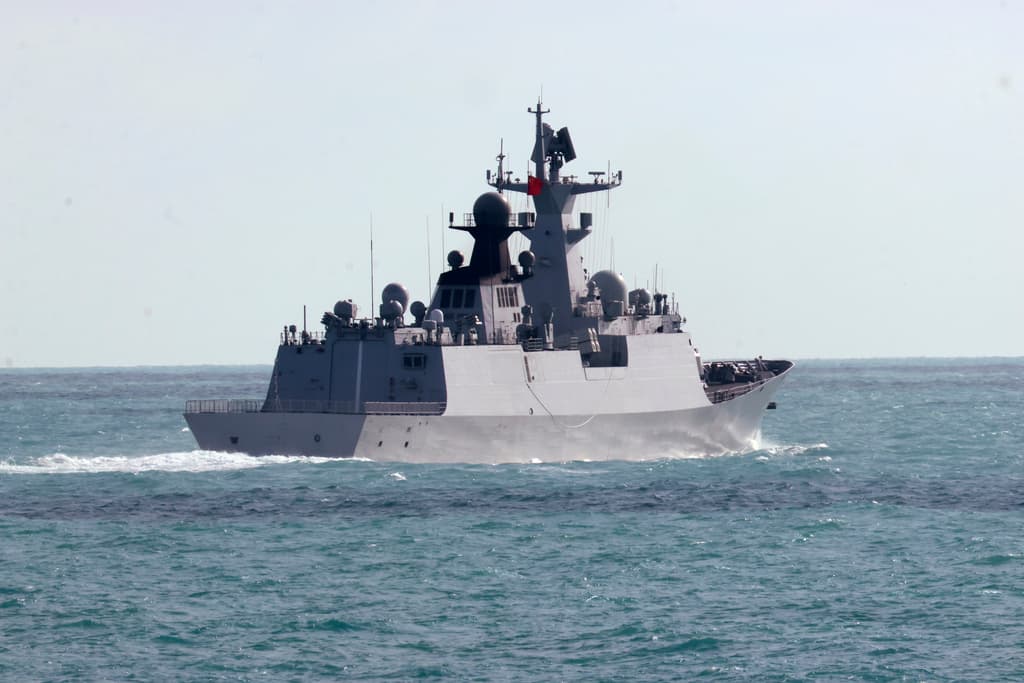
They’ve begun on an almost modest note. Out in the Tasman Sea about 150 miles off Australia’s southeast coast, three Chinese warships — a frigate, a cruiser, and a resupply vessel — have been having fun playing war games with one another
The Chinese were kind enough to warn Australian and New Zealand aircraft to stay away, advising that it was live ammunition they were firing. Then the Aussies confirmed what the Chinese were doing and advised pilots to fly around the danger zone or cancel flights. At least three planes between Australia and New Zealand had to shift their routes.
What was this exercise, 4,600 miles southeast of the Chinese mainland, all about? The answer appears to be that it was China’s almost tentative way of saying: If you’re challenging our air space over the South China Sea, which belongs to us, then we can show the flag in what are plainly international waters near you.
The vice president of the Australian and International Pilots Association, Steve Cornell, wondered why. The Sydney Morning Herald quoted Mr. Cornell, a pilot for Australia’s Qantas airline, as saying, “You would think that they could have parked somewhere less inconvenient whilst they flexed their muscles,” considering it’s “a big bit of ocean.”
But no, the Chinese claimed they firmly believed they’d followed all the rules. Or, as a spokesman for China’s foreign ministry put it, the exercise was done “in a safe, standard, and professional manner in accordance with relevant international law and international practice.”
Of course, the Chinese didn’t bother to inform Australian authorities before warning aircraft to fly away. “Very disconcerting,” Australia’s defense minister, Richard Marles, said, but the Australian prime minister, Anthony Albanese, had to admit the ships were well outside Australian territorial waters.
But why were the Chinese so far from the usual trouble spots in the South China Sea, where they’re constantly bullying Philippine fishing boats, and the straits between the mainland and the independent island province of Taiwan, which they also claim as theirs?
The answer appears to have been Chinese concern about a relatively new defense pact involving Australia, the United Kingdom, and the U.S. Under the pact, known by an acronym, Aukus, Australian warships have entered the South China Sea along with their allies. Also there’s the Quad, a non-military grouping in which top officials from Washington, Australia, Japan, and India exchange insights on regional issues — a lot of which concerns China.
In an exercise last April, Japanese ships joined vessels from Australia, America, and the Philippines in the South China Sea in response to “Chinese harassment of Philippine Navy resupply missions in the region,” according to the U.S. Naval Institute. The ships ventured near the Scarborough shoals, off the west coast of the northern Philippines island of Luzon, after Chinese coast guard vessels fired water cannon to drive away Philippine fishing boats trying to get to the shoals, assumed for years to have belonged to the Philippines.
Then, in May, there was “a dangerous maneuver in the Yellow Sea in which a Chinese fighter jet dropped flares in the flight path of an Australian navy helicopter,” according to an article by Corey Lee Bell and Elena Collinson in the Diplomat, a regional magazine. “Chinese state press throughout the year continued to voice criticism against AUKUS and the Quad, Australia’s engagement in joint military exercises in the South China Sea, and its procurement of Tomahawk missiles from the United States.”
Under the circumstances, China’s English-language state newspaper, Global Times, quoted a “Chinese military expert,” Fu Qianshao, as advising the Aussies to get used to “more and more far seas-capable vessels” from China “safeguarding normal trade and economic activities.” It did not seem by chance that his phraseology appeared to have mimicked American explanations for challenging the Chinese with air and sea patrols over and on the South China Sea.“There is no need to make a fuss,” Mr. Fu said, charging that an Australian military aircraft had “deliberately intruded into China’s territorial airspace of Xisha Qundao” — the Paracel Islands in the South China Sea, where the Chinese have constructed a full-service base complete with air strip and harbor.