

Chinese Communist War Plane Locks Radar Onto Japanese Aircraft in Airspace Near Free China
Rising animosity is seen between the communist regime in Beijing and Japan’s democratic government.
Russia and Communist China are upsetting America’s two northeast Asian allies, Japan and South Korea, by sending warplanes on flights intended to show off their strength in a potential war for the region.
In the most inflammatory incident, Japan charges that a Chinese warplane locked its radar onto Japanese planes flying near Taiwan. Japan’s defense minister said a Chinese J-15 fighter plane took off from the Chinese aircraft carrier Liaoning in waters off the southernmost Japanese prefecture of Okinawa and locked its radar on Japanese F-15s for three minutes and then 30 minutes.
The act of locking radar would precede firing on a target. The incident reflects rising animosity between the People’s Republic of China and Japan ever since Japan’s prime minister, Sanae Takaichi, equated a Chinese attack on Taiwan with an attack on Japan, implying that Japan would have to defend Taiwan as if it were Japanese territory.
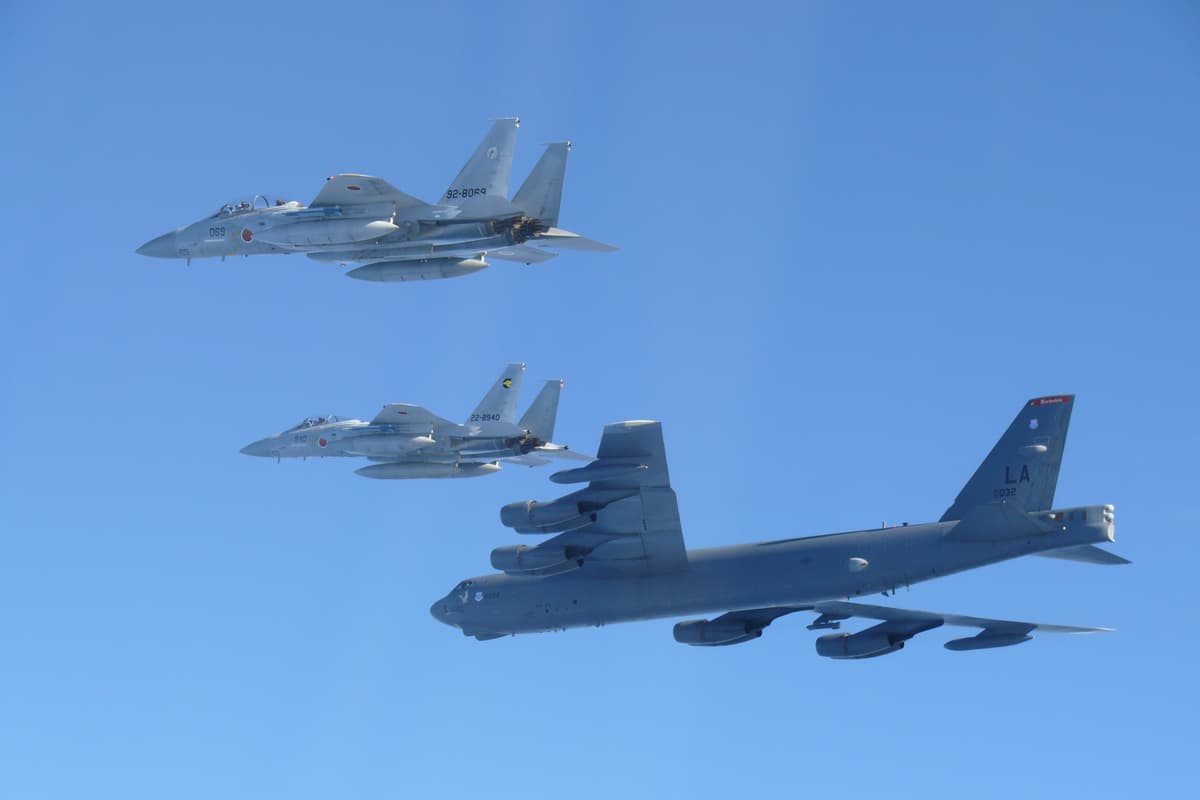
Tensions increased as Chinese H-6 bombers and Russian TV-95 bombers, described as “nuclear capable” since they can carry nuclear bombs, flew over the Sea of Japan and the East China Sea between the Chinese mainland and Taiwan. Japanese and American warplanes responded by flying joint patrols over the Sea of Japan.
The Chinese and Russian flights also upset South Korea by entering Korea’s “air defense identification zone” within which planes are supposed to identify themselves. Although the identification zone is not inside Korean air space, Seoul sees entry into the zone by Communist Chinese and Russian planes as an attempt at intimidation.
It was the lock-on by radar of Japanese planes that was most upsetting since it occurred near Taiwan. The implication was that the People’s Republic of China was ready to go to war if the Japanese insisted on defending the island democracy.
“Japan is pushing back against Chinese accusations and sharpening its messaging while stressing restraint as it continues to rail against a radar lock-on provocation targeting a Japanese fighter jet as a dangerous act,” said Japan’s Asahi Shimbun, one of Japan’s major national newspapers.
“Although military tensions between Japan and China had been rising around Japan for some time,” said Asahi, the incident, “has sent shock waves through the Defense Ministry and the SDF,” initials for “Self-Defense Forces, the euphemism for the Japanese armed forces.
The paper quoted a senior SDF official as calling the lock-on “a dangerous act that could lead to military conflict if one step is taken in the wrong direction.” For the pilot, said the official, “it must have been terrifying, like having a finger on the trigger of a gun pointed at them.” If fighter jets on both sides had locked their radar onto each other, he added, it would have constituted such a strong act of hostility that “the U.S. military might have retaliated.”
America has come out in support of its Japanese ally while attempting to play down the immediate threat. A State Department spokesman said that “China’s actions are not conducive to regional peace and stability” while “the U.S.-Japan Alliance is stronger and more united than ever.”
Communist China’s military newspaper accused Japanese planes of having “repeatedly approached and disrupted the training zones” of planes from the Chinese aircraft carrier, “posing a serious threat to flight safety. Asahi quoted Japan’s chief cabinet secretary, Minoru Kihara, as saying the Chinese claim that Japanese planes “seriously obstructed safe flight is unfounded.”
In Beijing, a Chinese spokesman said Japan’s allies should “not be hoodwinked by the Japanese side.” The joint Chinese-Russian patrol, he said, “showed their resolve and capability to address regional security challenges and safeguard peace and stability.”