
Chinese President Steals Show at APEC Gathering After Trump’s Exit

His deceptively conciliatory plea for fair play, free of pressures and prejudices, goes unchallenged in the absence of the leader of America, China’s arch-rival for influence in the Indo-Pacific region.
Andrew Harnik/Getty Images
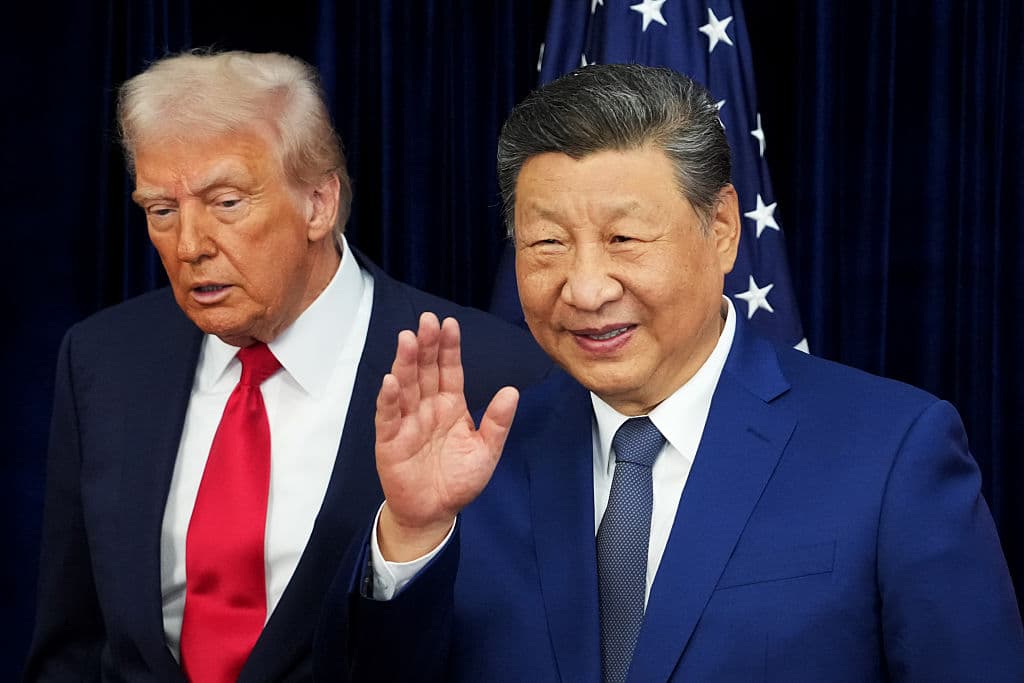
President Trump and President Xi Jinping ahead of a bilateral meeting at Gimhae Air Base on October 30, 2025, at Busan, South Korea. Andrew Harnik/Getty Images

GYEONGJU, South Korea — Communist China’s president, Xi Jinping, has stolen the show at the gathering of the Asia-Pacific Economic Cooperation group here, calling for the leaders of APEC’s 20 other economies to “promote open development where everyone shares opportunities and emerges a winner.”

That deceptively conciliatory plea for fair play, free of pressures and prejudices, went unchallenged in the absence of the leader of America, China’s arch-rival for influence in the Indo-Pacific region. President Trump, facing huge problems in Washington, flew off the day before, leaving two of his Cabinet secretaries to defend America’s interests.

One of them, the secretary of defense/war, Pete Hegseth, delivered a distinctly hawkish message to his Chinese counterpart, Admiral Dong Jun, advising him of “serious concerns” about “China’s activities in the South China Sea and Taiwan and toward U.S. allies and partners in the Indo-Pacific.”

Mr. Hegseth raised the topic at another regional gathering, that of top officials of the member states of the Association of Southeast Asian Nations at Kuala Lumpur.

His remarks gave the impression that Mr. Trump and he were playing good cop and bad cop after Mr. Trump waxed exuberant about his meeting Thursday at Busan with Mr. Xi one day before the opening here of the APEC conference. Messrs. Trump and Xi ignored security issues, settling for America to lower tariffs on Chinese products while China removed controls on the export of rare earth and the import of soybeans.

Mr. Xi at APEC rose to rhetorical heights, flattering the group’s leaders by telling them they are “spearheading the region’s rise to the forefront of global open development,” making the Asia-Pacific “the most dynamic part of the global economy.“ While “changes unseen in a century are accelerating across the world,”  he declaimed, “the rougher the seas, the more the APEC members must pull together.”

Talking up free trade as though he were the leader of a thoroughly capitalist, democratic nation, Mr. Xi called for “joint efforts to safeguard the multilateral trading system” in “an open regional economic environment” grounded in “the stability and smooth flow of industrial and supply chains,” China’s Xinhua news agency reported.

At Asean, Mr. Hegseth said that America “does not seek conflict” but would “stoutly defend its interests and ensure it has the capabilities in the region to do so.” America’s commitment to the “Free Chinese” island of Taiwan, for which America provides arms and training, is “unchanged,” he told Admiral Dong, despite Chinese air and naval exercises around the island, which it vows to place under Communist Chinese control.

In the absence of President Trump, it was up to the American Treasury secretary, Scott Bessent, to take up the cudgels for America.  His remarks, in an “informal dialogue” with APEC economic leaders, sounded like a polite response to what Mr. Xi had said several hours earlier.

“Under President Trump’s leadership, the United States is rebalancing its trade relationships to build a stronger foundation for global growth,” he said, ensuring “that each country operates on fair and reciprocal terms” in a global system “grounded in transparency, market access, and fair competition, and also one that supports growth across all APEC economies.”

On the sidelines, leaders at both APEC and Asean wondered about Mr. Trump’s order to the Pentagon to prepare to resume nuclear testing for the first time in more than 30 years. Mr. Trump did not elaborate but did say on Truth Social that he had approved South Korea’s proposal for one of Korea’s large shipbuilders, Hanwha, to build a nuclear submarine partly with American technology at the Philadelphia shipyard in line with resurrecting America’s decrepit shipbuilding industry.


The New York Sun

© 2025 The New York Sun Company, LLC. All rights reserved.

Use of this site constitutes acceptance of our Terms of Use and Privacy Policy. The material on this site is protected by copyright law and may not be reproduced, distributed, transmitted, cached or otherwise used.

The New York Sun

Sign in or  create a free account

or
By continuing you agree to our Privacy Policy and Terms of Use