Coalition of the Beleaguered? Israel Warms Up to Taiwan and Ukraine as It Rethinks Stances on Communist China and Russia
As traditional European allies of Israel increasingly sour on its Gaza policies, Jerusalem is warming up to potential allies that seem to suffer, like the Jewish state, the ire of big powers.

Israel, which in the past has been wary of confronting America’s top rivals, Communist China and Russia, is now warming up to Taiwan and Ukraine — much to Beijing and Moscow’s chagrin. Is a new coalition of the beleaguered in the offing?
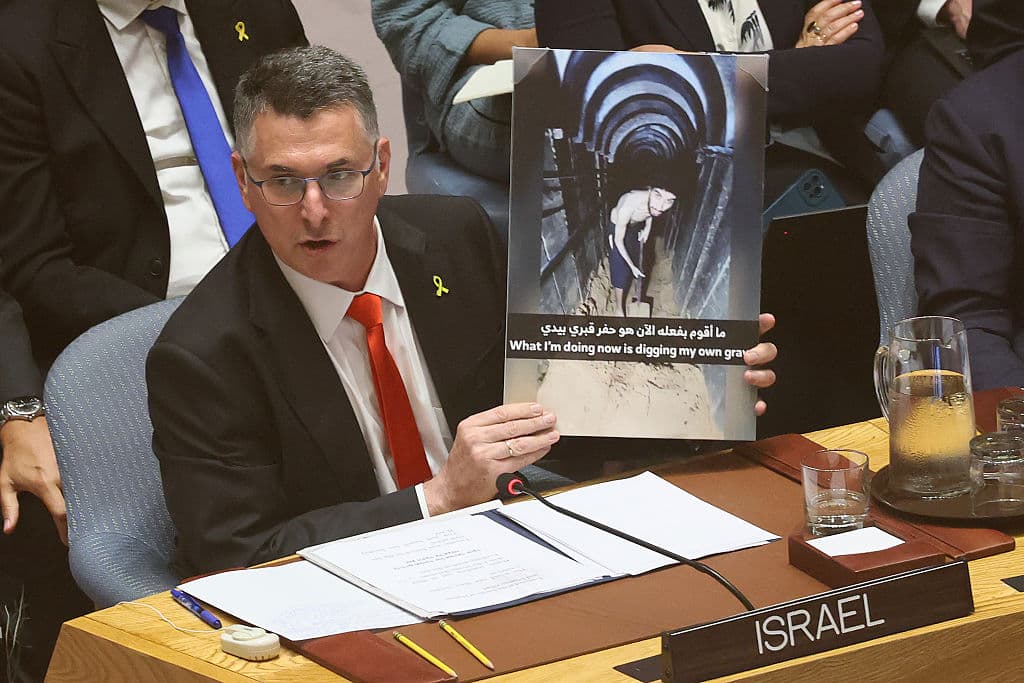
The Israeli foreign minister, Gideon Sa’ar, initiated a United Nations Security Council meeting Tuesday afternoon in hope of directing the world’s attention to hostage videos released over the weekend by Hamas and the Palestinian Islamic Jihad. Instead, while diplomats expressed shock over the emaciated abductees depicted in the videos, they dedicated the bulk of their remarks to condemning Israel’s Gaza policies.
Mr. Sa’ar, who closed the Tuesday session, was dismayed at what he called an “upside down” global approach to the Jewish state’s battle against the terrorists who launched the war on October 7, 2023. At the start of his remarks, the top Jerusalem diplomat singled out for ridicule a condemnation from Moscow’s UN ambassador.
“It was really funny to hear Russian Federation representative after three years and a half of a brutal invasion and brutal war in Ukraine and bombardments on civilian population in Kyiv and other places, speaking here the way he spoke,” Mr. Sa’ar said. “I also heard the Palestinian representative. I must say, the Palestinians learned propaganda from you, from the Soviet era.”
Kyiv noticed, with President Zelensky’s top adviser, Andriy Yermak, writing on X Wednesday: “Thank you, @gidonsaar, for your clarity and moral courage at the UN. Silence in the face of terror is complicity. Hamas and Russia use the same terrorist methods. There is no ‘context’ for barbarism.”
Following Russia’s 2022 invasion of Ukraine, Israel refrained from taking sides. Jerusalem, for one, needed President Putin’s consent to act freely over the skies of Syria, where a Moscow ally, Bashar Assad, held power. Now that Mr. Assad is out, Israel is more free to re-examine relations with Russia.
In late July Mr. Sa’ar became the highest-ranking Israeli official to visit Kyiv, where he signed cooperation deals. “Both our nations face difficult and challenging times,” the foreign minister told reporters. “We both face war and pain. We are both resilient nations.”
On the same day that Mr. Sa’ar was at Kyiv, 72 of the 120 Knesset members signed at Jerusalem an unprecedented petition. It called on the Republic of China to be admitted to international organizations, a goal long denied by Communist China.
That was “a historic step,” Taipei’s representative in Israel, Abby Lee, told the Sun on Thursday. “We thank this landmark bipartisan support from Israel in recognizing Taiwan’s contribution to global affairs,” and “look forward to deepening our cooperative relations in mutually beneficial areas to advance shared prosperity.”
Beijing was livid. “We urge certain members of the Knesset to stand on the right side of history and take actions that promote China-Israel relations and benefit the Israeli people, rather than the opposite,” the embassy of Communist China at Tel Aviv said in a statement. “We cannot but ask: Who is influencing these members of the Knesset, and what ulterior motives are they concealing?”
The petition, which was signed by legislators from both the ruling coalition and its political rivals, was initiated by a Knesset member of the opposition Yesh Atid party, Boaz Toporovsky, and Ohad Tal of the coalition’s Religious Zionist Party, who heads the Israel-U.S. relations caucus.
“After October 7 Taiwan was one of the first to stand by Israel and has continued to support us since,” Mr. Toporovsky said. “This is our opportunity to show our deep appreciation for Taiwan, to stand by its side, and to support our shared prosperity,” Mr. Tal added.
Beijing is a major supporter of the Islamic Republic of Iran, from which it purchases crude oil despite American sanctions. Last week the Department of the Treasury imposed its latest, most onerous sanctions against what is known as Communist China’s “dark fleet” of tankers evading detection by hauling discounted Iranian oil to Chinese ports.
Israel increasingly rejects Chinese investment bids, even as the two countries are already pursuing large joint projects. Following the Israeli strikes on Iran’s nuclear installations in June, and especially after America joined the bombing, Beijing is reportedly reconsidering its extensive Mideast relations. The Communist behemoth’s deepening ties with Tehran are also leading Jerusalem to rethink its Asia policies.
As traditional European allies of Israel increasingly sour on its Gaza policies, Jerusalem is warming up to potential allies that seem to suffer, like the Jewish state, the ire of big powers.