Communist China Tries To ‘Erase’ America’s Role in World War II Victory
Yet the legacy of Sino-American partnership is one to mark as Free China, now on Taiwan, launches a defense buildup amid Beijing’s threats.

The impending festivities at Beijing for the 80th anniversary of World War II’s end reflect Xi Jinping’s push to rewrite history as he upends the American-backed order forged after the global conflict. Yet the colossal celebration will gloss over the fact that, before the communist takeover, America and Free China were close allies. The legacy of Sino-American partnership is one to mark as Free China, now on Taiwan, launches a defense buildup amid Beijing’s threats.
It’s typical of Mr. Xi’s distortions that he and the communist regime have even the date wrong when it comes to the end of World War II, our Donald Kirk reports. September 3 is hailed as the day of Red China’s “victory” over “Japanese Aggression and the World Anti-Fascist War,” as the propaganda organ Global Times puts it. Yet Japan had already on August 15, 1945, following the atomic bombing of Hiroshima and Nagasaki, surrendered to America.
It underscores the “bitter battle of narratives between Beijing and Taipei,” Reuters reports, over the legacy of World War II. The Free Chinese government at Taipei — with ample justification — gripes that the communist regime is taking “credit for leading the fighting when most of it was done by forces of what was then the Republic of China.” Plus too, the $5 billion estimated cost of the parade is being flagged by Taiwan as a waste of money.
The anniversary parade on Wednesday reflects Mr. Xi’s strategy of “portraying the conflict as a triumph led by the Communist Party,” the Times reports, even if historians affirm that “it was the Chinese Nationalists,” led by Generalissimo Chiang Kai-shek, “who did most of the fighting.” Mr. Xi ignores, too, that during the war, and even at the time of the Japanese surrender, Mr. Kirk reports, “Mao Zedong’s Red Army was battling Chiang’s depleted forces.”
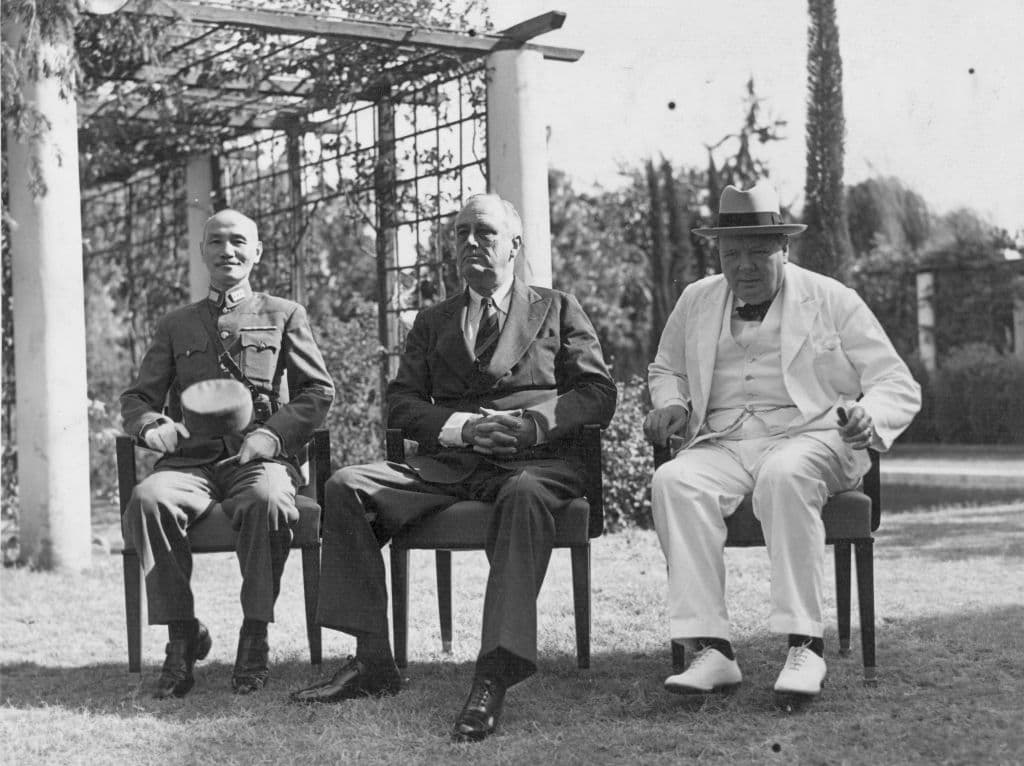
Chiang during World War II, along with Churchill, Stalin, and FDR, was part of the “Big Four” battling the Axis powers. America lavished billions of dollars to help arm Free China. Chiang, though, had not only Japan as an enemy, but Mao’s communists, too. The Red Army largely bided its time during the war, saving resources for its push after the flighting to topple Chiang’s regime. America’s failure to realize the stakes in the civil war led to Mao’s victory in 1949.
The shock of the communist takeover roiled American politics and raised the question of, “Who Lost China?” The blame was partly due to leftists in the Truman administration who imagined the communists were pro-democracy agrarian reformers. Chiang’s warnings were ignored by “young and naive American military officers in China,” and even senior officials at Washington, who bought the communists’ “propaganda,” historian Jay Taylor says.
No wonder, then, that Mao’s successor at Beijing wants “to erase,” as the Washington Post puts it, America’s role in China’s World War II victory over Japan. Regime-aligned “scholars, media outlets and think tanks have downplayed the significance of American assistance to China during World War II,” the Post adds, “casting the U.S. as a self-serving power then and now.” That’s an insult to the brave troops, including Americans, who fought under Chiang.
America’s error in failing to support Chiang against Mao was compounded by Nixon’s conciliatory visit to Beijing in 1972 and Carter’s opening of diplomatic ties with Red China in 1979. Chiang died in 1975. Our ally Taiwan saw its seat at the United Nations default to the communists. The vast expansion of trade with the mainland has triggered a yawning deficit and the loss of jobs here, threatening our security as China seeks global dominance.
The Republic of China “stands on the front line of the Indo-Pacific’s first island chain,” Taiwan’s foreign minister, Lin Chia-lung, writes in the Sun, and has plans for increasing “defense spending and boosting whole-of-society resilience.” The lessons of history suggest the urgency of backing Taiwan in its fight for freedom. The goals of the island democracy’s security push, Mr. Lin avers, are “defending democracy and freedom from authoritarian expansionism.”
_______________
This editorial was updated to clarify the venue of the Japanese surrender on August 15, 1945.