Parley on 80th Anniversary of Japan’s Surrender in World War II Could Set Stage for Summit Between Kim Jong-un and President Trump

Communist China’s Xi seeks to boost his alliances with Russia and North Korea.
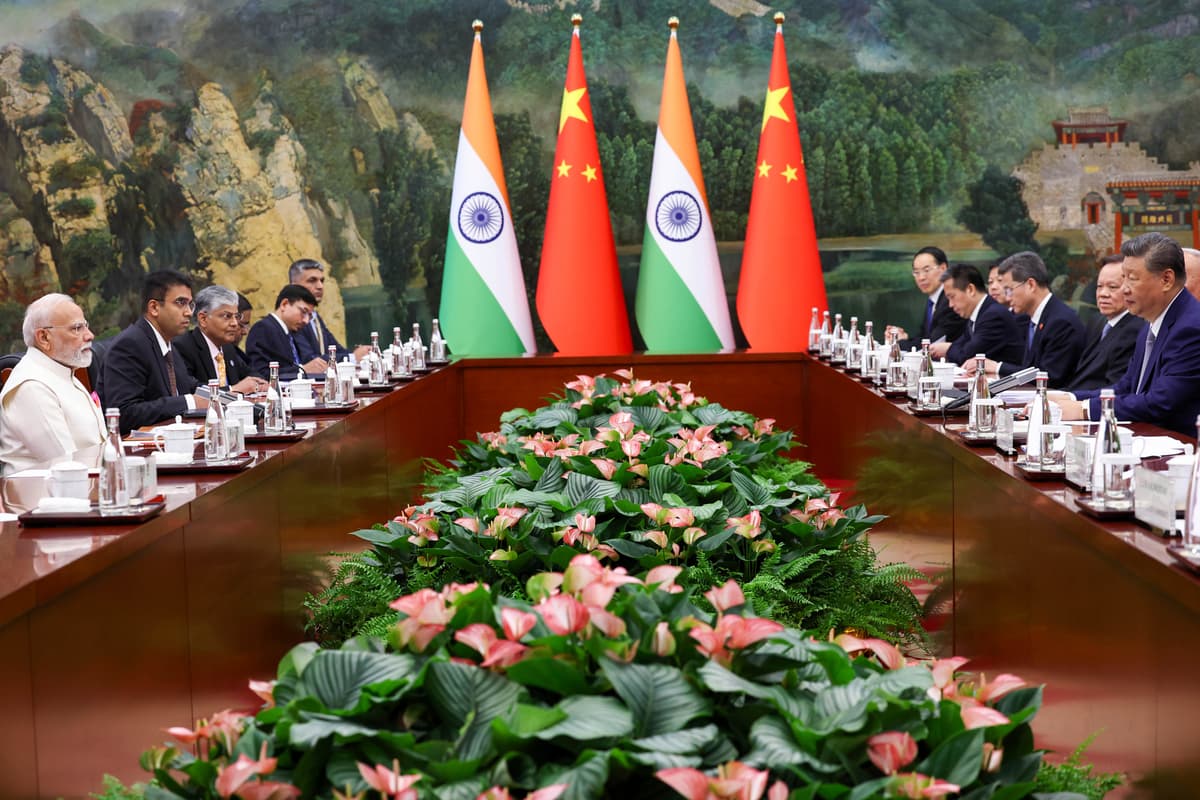
Indian Prime Minister's Office via AP
Prime Minister Narendra Modi of India, left, and President Xi Jinping of Communist China, right, meet on the sidelines of the Shanghai Cooperation Organization summit at Tianjin, China. Indian Prime Minister's Office via AP

Communist China’s president, Xi Jinping, on the 80th anniversary of Japan’s surrender in World War II, on Wednesday will host two of America’s most difficult foes, President Vladimir Putin of Russia and North Korea’s Kim Jong-un, among 26 heads of state converging at Beijing.

Mr. Xi is turning the anniversary into an occasion for strengthening alliances with Russia and North Korea. Both of the leaders will be accompanied by a retinue of ministers and advisers. Mr. Kim will arrive with his wife, Ri Sol-ju, on the same slow-moving armored train that took him to Beijing for his last visit.

Mr. Xi is showing off his might after making peace with India’s prime minister, Narendra Modi, at a confab of more than 20 world leaders at the port city of Tianjin. Proclaiming the end of the long-running conflict between Indian and Chinese soldiers along the Himalayan border, Mr. Xi said that from now on China and India should be “partners, not rivals.”

The leaders of the world’s two most populous countries — each about 1.4 billion — found common cause in commiserating over high tariffs propounded by President Trump that have blemished good-will between New Delhi and Washington while America confronts Chinese forces in the western Pacific and South China Sea.

Mr. Modi, upset by Mr. Trump slapping an additional 25 percent — on top of the 25 percent tariff that he had already imposed on imports from India — as punishment for India selling oil and natural gas to Russia, declared, “The interests of 2.8 billion people in both our countries are tied to our cooperation.” Mr. Modi, in a meeting at Tokyo with Japan’s prime minister, Shigeru Ishiba, also concerned about American tariffs, talked up the Quad Four, the informal grouping of India, Japan, America, and Australia.

Mr. Xi saw the conversation with Mr. Modi as an opportunity to undermine American-Indian relations. Despite flare-ups dating to a border war in 1962 in which China nipped off pieces of Indian territory in the Himalayas, he said the two had to “focus on development as their greatest common denominator.”

The gathering at Tianjin of what is known as the Shanghai Cooperation Organization, including leaders of other Asian countries with whom China wants to band together in its drive for supremacy over the region, was just the prelude to several days of interaction among global leaders and their ministers, aides, and advisers.

Mr. Putin was also at the Tianjin meeting, but Mr. Xi’s exercise in showing off China’s rising power reaches its apogee when North Korea’s leader joins Messrs. Xi and Putin on ceremonial display at the parade Wednesday.

On his first visit to China in six years. Mr. Kim will meet with both for conversations on what they can do for one another in a sharply defined standoff against South Korea, America, and Japan. North Korea has already sent about 15,000 troops to Russia along with hundreds of thousands of artillery shells and other weaponry, and it depends on China for almost all its oil and half its food.

In all the celebration of the Chinese “victory” over Japan, however, Mr. Xi and his extensive state propaganda machine will give no credit to the anti-Communist “Nationalist” Chinese leader, Chiang Kai-shek, who led Chinese forces against the Japanese with crucial American support.

Hailing September 3,1945, as the date of “victory in the Chinese People’s War of Resistance against Japanese Aggression and the World Anti-Fascist War,” China’s propaganda newspaper, Global Times, neglected to mention that Mao Zedong’s Red Army was battling Chiang’s depleted forces.

Nor did it explain that General Douglas MacArthur had formally accepted the Japanese surrender the day before on the USS Missouri and that Emperor Hirohito had actually surrendered on August 15 after the American atom-bombings of Hiroshima and Nagasaki.

South Korea’s Yonhap News quoted the president of the University of North Korean Studies at Seoul, Yang Moo-jinn, as saying Mr. Kim’s visit may be “part of efforts to mend frayed ties with Beijing.” Mr. Xi is believed not to have been happy about Mr. Kim’s tight relations with Mr. Putin, notably his deal to support the Russian war in Ukraine.

Mr. Yang even saw the celebration as a chance to promote dialogue between Messrs. Kim and Trump, who has said he would welcome another summit. “Mr. Kim’s presence,” Mr. Yang said, “may serve as the country’s starting point for multilateral dialogue and as a catalyst for a North Korea-U.S. summit.”


The New York Sun

© 2025 The New York Sun Company, LLC. All rights reserved.

Use of this site constitutes acceptance of our Terms of Use and Privacy Policy. The material on this site is protected by copyright law and may not be reproduced, distributed, transmitted, cached or otherwise used.

The New York Sun

Sign in or  create a free account

or
By continuing you agree to our Privacy Policy and Terms of Use