
Coronavirus Vaccine Supercharges Immune System Against Cancerous Tumors, New Study Suggests

Vaccinated lung cancer patients lived nearly twice as long as those who had not received the vaccine.
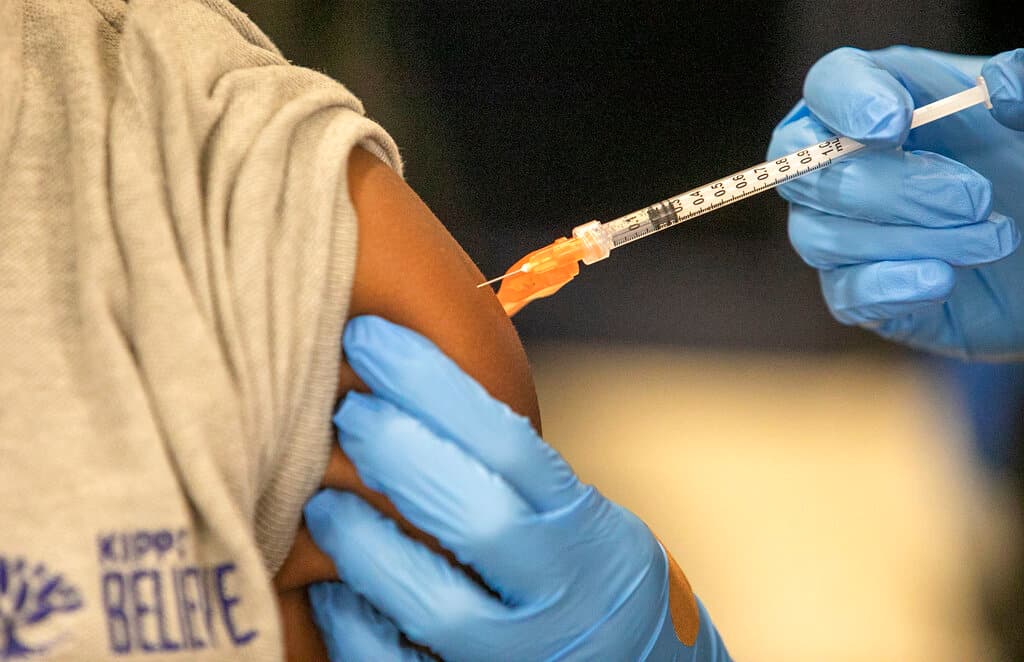
AP/Ted Jackson, file
Medical personnel vaccinate students at a school in New Orleans. AP/Ted Jackson, file

Covid-19 vaccines may do far more than prevent severe coronavirus infections — a new study suggests they could supercharge the body’s immune system against cancer, nearly doubling the median survival times in some patients.

A new study from the University of Texas MD Anderson Center, done in conjunction with the University of Florida, reviewed the records of more than 1,000 patients undergoing immunotherapy for advanced non-small-cell lung cancer and melanoma, comparing those who had received the vaccines with those who did not. 

Patients who received Covid-19 vaccines within 100 days of beginning cancer immunotherapy lived a median of 37.3 months, nearly 17 months longer than their unvaccinated counterparts who survived 20.6 months. The survival benefit extended to patients with metastatic melanoma as well, according to the study, published in the journal Nature.

“This data is incredibly exciting, but it needs to be confirmed in a Phase III clinical trial,” a radiation oncologist and lead author of the study, Adam Grippen, said to The Washington Post, adding that planning for those trials are already underway with new patients being enrolled by the end of 2025.

Messenger RNA vaccines, more commonly known as mRNA, work by delivering genetic instructions that teach cells to produce a harmless viral protein that can prime the immune system without any actual infection. 

The mRNA platform enabled scientists to develop Covid-19 vaccines in under a year after the virus emerged — a process that typically takes 10 to 15 years. The unprecedented timeline was supported by Operation Warp Speed, the Trump administration’s initiative to accelerate pandemic response.

The mRNA vaccine technology, however, is far from new. Scientists spent more than two decades researching mRNA vaccines as potential treatments for influenza and cancer.

The findings offer hope for a universal, off-the-shelf cancer vaccine, but arrive as mRNA vaccine research faces mounting challenges and skepticism from some corners of the Trump administration.

In August, the Health and Human Services secretary, Robert F. Kennedy Jr., halted nearly $500 million in mRNA vaccine funding, claiming “the data show[s] these vaccines fail to protect effectively against upper respiratory infections like Covid and flu.” 

The scientific community has forcefully rejected that assertion.

“It’s going to deter innovations,” professor at the University of California College of the Law at San Francisco, Dorit Reiss said to the Post at the time. “Why invest in new technologies if the government can not only refuse to fund them, but if it’s going to cancel already promised contracts?”


The New York Sun

© 2025 The New York Sun Company, LLC. All rights reserved.

Use of this site constitutes acceptance of our Terms of Use and Privacy Policy. The material on this site is protected by copyright law and may not be reproduced, distributed, transmitted, cached or otherwise used.

The New York Sun

Sign in or  create a free account

or
By continuing you agree to our Privacy Policy and Terms of Use