Federal Appeals Court To Hear Arguments in Case That Could Determine Fate of ‘Liberation Day’ Tariffs

The future of one of the president’s signature policies hangs in the balance as his ‘reciprocal tariffs’ are supposed to take effect on August 1.

AP/Mark Schiefelbein
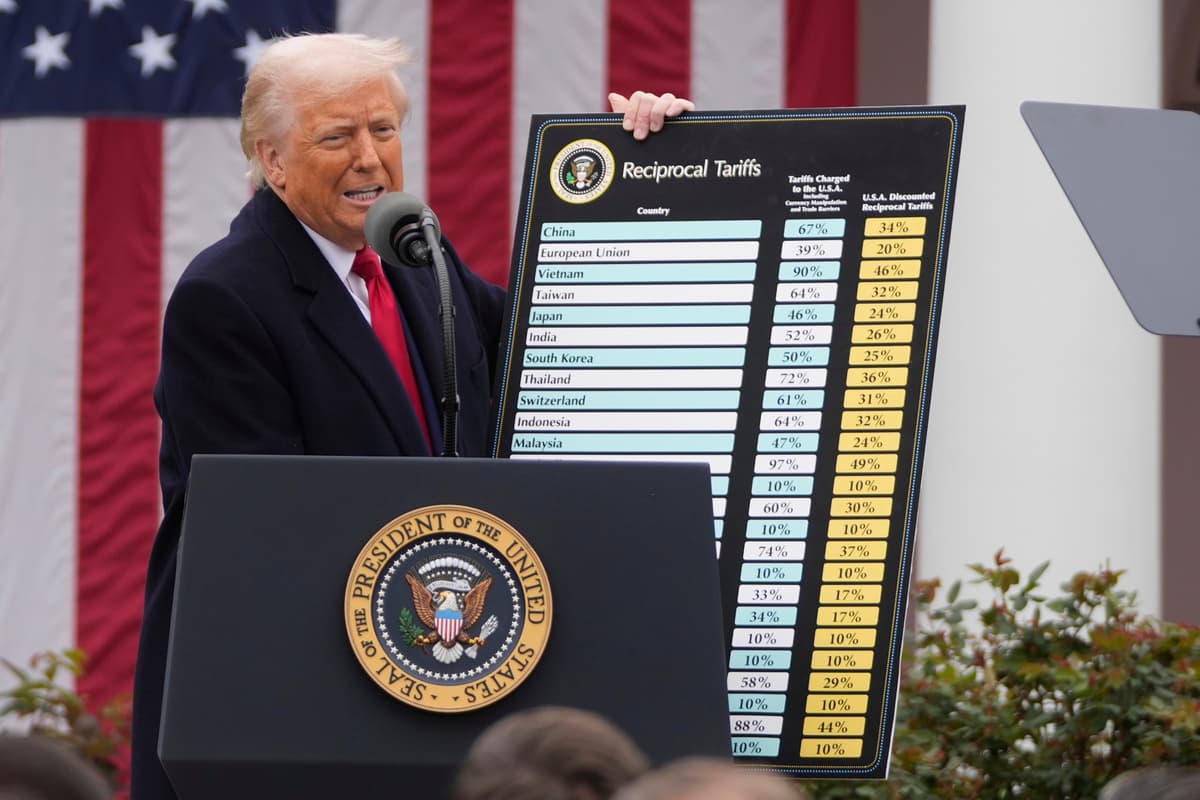
President Trump speaks during an event to announce new tariffs in the Rose Garden at the White House on April 2, 2025, in Washington. AP/Mark Schiefelbein

The future of one of the core pillars of President Trump’s economic policy hangs in the balance as a federal appeals court hears oral arguments Thursday to decide whether he can use an emergency authority to unilaterally impose so-called reciprocal tariffs.

In February, Mr. Trump said he would impose tariffs on China, Canada, and Mexico, calling the flow of fentanyl into America a national emergency that can only be tackled via the import taxes. In April, he announced his “Liberation Day” 10 percent global baseline tariffs, saying trade deficits also are a national emergency. Those tariffs are set to take effect on August 1.

The U.S. Court of Appeals for the Federal Circuit, which has jurisdiction over international trade matters, will hear arguments as it weighs whether the president has the authority under the International Emergency Economic Powers Act of 1977 to impose the tariffs. 

The Constitution gives Congress the power to impose tariffs. However, lawmakers can and have delegated some tariff authority to the president in recent years. 

One of the questions surrounding the 1977 law, which gives the president the ability to impose economic sanctions to respond to “unusual and extraordinary” threats to America’s “national security, foreign policy, or economy,” is whether it gives the president the ability to impose tariffs. 

Mr. Trump is the first president to try to use the International Emergency Economic Powers Act to impose tariffs. 

In a filing, the Department of Justice argued that lawmakers “meant for the president to use his IEEPA powers as a tool to create leverage, just as Congress and the president have long done in other international-trade contexts.”

The administration has also argued that there is “no basis” for a “meaningful judicial review of President Trump’s findings” that there is an “extraordinary and unusual threat” necessitating the tariffs. 

However, in May, a three-judge panel on the U.S. Court of International Trade ruled that the IEEPA does not give the president “unbounded” authority to impose tariffs. 

“An unlimited delegation of tariff authority would constitute an improper abdication of legislative power to another branch of government,” the court said. “Regardless of whether the court views the president’s actions through the nondelegation doctrine, through the major questions doctrine, or simply with separation of powers in mind, any interpretation of IEEPA that delegates unlimited tariff authority is unconstitutional.”

The Trump administration appealed the ruling to the Federal Circuit, which put the lower court’s ruling on hold.

Twelve Democrat-run states and five small businesses involved in the case argue that the IEEPA gives the president no authority to impose tariffs. Instead, they say the law only refers to measures such as embargoes and similar sanctions. 

Several conservative think tanks, including Advancing American Freedom, filed amicus briefs in the case arguing that Mr. Trump’s interpretation violates the nondelegation doctrine, which states that Congress cannot delegate its legislative authority to another branch of government. A libertarian think tank, the Cato Institute, wrote in an amicus brief that the IEEPA gives the president the authority to adjust tariff rates once they are passed by Congress. However, it said the law does not give the president the authority to impose them unilaterally without congressional authorization.

Meanwhile, the American Enterprise Institute argued in its brief that trade imbalances do not constitute an emergency, and that tariffs would not be an effective measure to counter them anyway. 

It is expected that whichever side loses at the Federal Circuit will appeal to the Supreme Court. 

One argument that might add to the drama surrounding the decision is that the Trump administration argues that even if the court rules against the tariffs, they should not be blocked nationally due to the Supreme Court’s decision limiting nationwide injunctions. 

If the court rules in Mr. Trump’s favor, it could give him broad authority to use emergency powers to implement his economic agenda. 

In his second term, Mr. Trump has frequently sought to claim emergency powers to swiftly carry out his agenda. In the spring, the federal government sought to use the 1798 Alien Enemies Act to bypass the standard review process and quickly deport Venezuelan illegal immigrants who the administration claimed were members of a gang. However, the Supreme Court blocked the administration from using the law because of concerns that the migrants were not receiving due process. 

In June, a federal appeals court gave the president a win when it said he could use emergency powers to federalize the National Guard in California to protect federal property and personnel at Los Angeles during immigration raids.


The New York Sun

© 2025 The New York Sun Company, LLC. All rights reserved.

Use of this site constitutes acceptance of our Terms of Use and Privacy Policy. The material on this site is protected by copyright law and may not be reproduced, distributed, transmitted, cached or otherwise used.

The New York Sun

Sign in or  create a free account

or
By continuing you agree to our Privacy Policy and Terms of Use