

Democrats Score Major Victory in Utah as Judge Orders Use of New Congressional Map With Deep-Blue District

The court order nearly guarantees that Democrats will win a House seat in the state next year.
Kristin Murphy/The Deseret News via AP
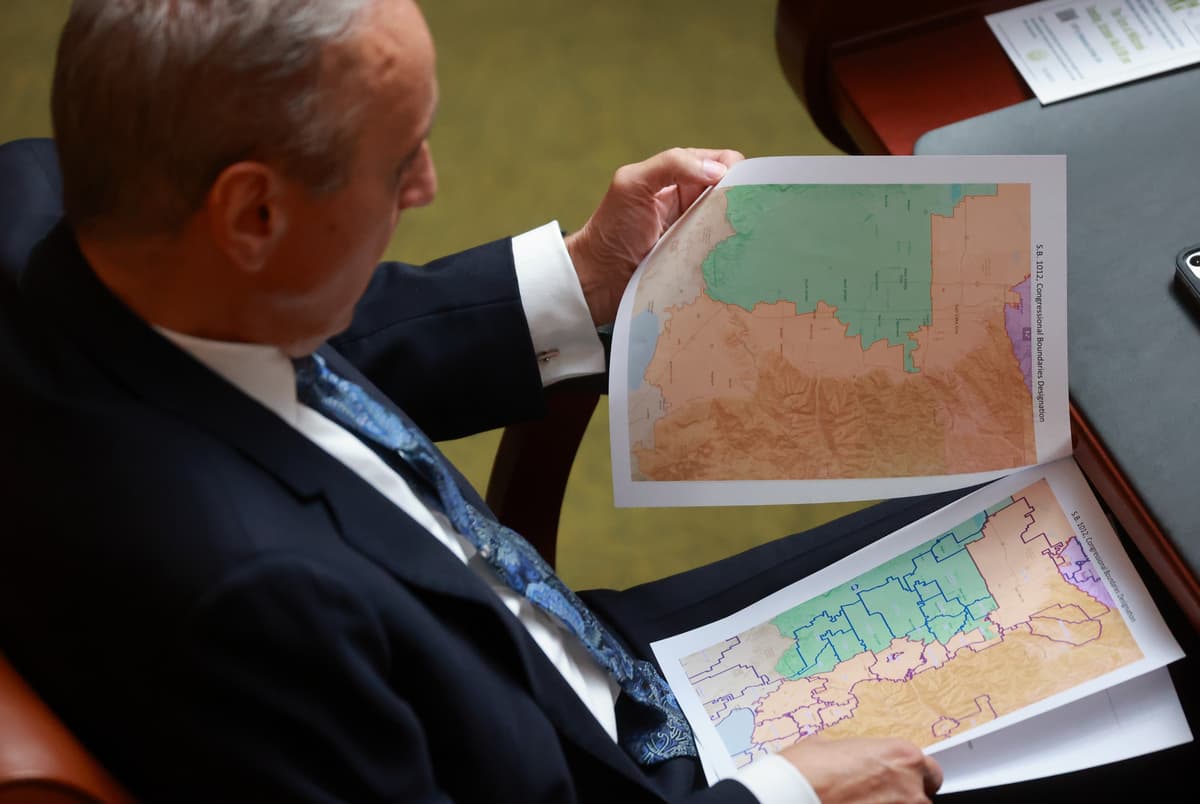
A Republican member of the Utah legislature, Cory Maloy, holds a packet of potential redistricting maps during a special session at Salt Lake City on October 6, 2025. Kristin Murphy/The Deseret News via AP

Democrats in Utah have scored a win in the seemingly never-ending redistricting wars, after a judge ordered the state to adopt a new congressional map that creates a solidly blue seat in the state.

A previous map would have given Democrats a chance at picking up a seat, but that now seems assured. The new dark blue district centered at Salt Lake County guarantees that Utah will help blunt the effect of redistricting efforts in red states.  

The redistricting fight started this summer, when Governor Greg Abbott of Texas, with the help of the Justice Department, put forward a new congressional map for his state which is expected to eliminate five Democratic seats. California Democrats countered with a similar redrawing, which in turn prompted Republican-led states like Missouri, Ohio, and North Carolina to redistrict ahead of the 2026 midterms. 

The Utah case did not come about through the legislature, however. A lawsuit challenging the Utah congressional map arose when plaintiffs claimed that the legislature was drawing maps with partisan intent, despite voters having approved an independent redistricting commission which was meant to protect against partisan gerrymandering. 

Voters approved the advisory redistricting commission in a ballot initiative in 2018 but the legislature has declined to use the maps recommended by the commission since then. The Utah supreme court has said trying to weaken the commission violates the initiative. 

Judge Dianna Gibson ruled that the current congressional map — in which all four of Utah’s districts are represented by Republicans — violates the independent redistricting law. Her remedy was that the Republican-led legislature submit a proposed map for her consideration. Plaintiffs also submitted two map proposals, with Judge Gibson herself to choose among the various maps. 

In an order issued late Monday, she rejected the legislature’s Map C, which would have created a single district that Vice President Kamala Harris would have won last year, though by a narrow margin. Judge Gibson instead picked one drawn by plaintiffs which creates a district centered at Salt Lake County. Ms. Harris would have won this new district by nearly 25 points. ​​

“Map C fails in many ways to comply with Proposition 4,” Judge Gibson wrote in her order, according to FOX13 Salt Lake City. Proposition Four was the ballot initiative that created the independent commission barring the use of maps which were gerrymandered for partisan purposes. 

“First, Map C was drawn with partisan political data on display. Map C does not abide by Proposition 4’s traditional redistricting criteria ‘to the greatest extent practicable,’” the judge wrote, adding that the legislature’s proposed map “unduly favors Republicans and disfavors Democrats.”

The new map chosen by Judge Gibson will almost certainly be used next year because the state’s supreme court has signaled they will not hear any appeals in the case. Last year, after hearing an appeal on a ruling from Judge Gibson, the court wrote unanimously that the legislature could not ignore the independent redistricting commission.

“We hold that when Utahns exercise their right to reform the government through a citizen initiative, their exercise of these rights is protected from government infringement,” the five justices, all of whom were appointed by Republican governors, wrote at the time. 

“This means that government-reform initiatives are constitutionally protected from unfettered legislative amendment, repeal, or replacement,” they added. “Although the Legislature has authority to amend or repeal statutes, it is well settled that legislative action cannot unduly infringe or restrain the exercise of constitutional rights.”

Attention now turns to the only two states still likely to redraw congressional maps before the 2026 midterms — Indiana, where the GOP could pick up two seats, and Virginia, where Democrats are planning to eliminate at least two Republican-held seats, though Governor-elect Abigail Spanberger and the Democratic legislature could flip as many as four seats for their party.


The New York Sun

© 2025 The New York Sun Company, LLC. All rights reserved.

Use of this site constitutes acceptance of our Terms of Use and Privacy Policy. The material on this site is protected by copyright law and may not be reproduced, distributed, transmitted, cached or otherwise used.

The New York Sun

Sign in or  create a free account

or
By continuing you agree to our Privacy Policy and Terms of Use