Described as ‘Life Affirming,’ Gabe Polsky’s ‘The Man Who Saves the World?’ Is Also an Odd Film
Polsky milks one man’s far-ranging idiosyncrasies for a film that embodies a 21st-century variant on noblesse oblige by reviving the 19th-century notion of the noble savage.


Gabe Polsky’s “The Man Who Saves the World?” is an odd film on several counts, detailing, as it does, the efforts of a lone individual on his quest to set the cosmos aright. It’s worth noting that three of the picture’s executive producers are affiliated, largely if not exclusively, with comedy.
Danny McBride and David Gordon Green are responsible for, among much else, the HBO series “Eastbound & Down” and “The Righteous Gemstones.” Peter Farrelly garnered an Oscar for Best Director of “Green Book” (2018), but he’s likely best known for a spate of rude comedies on which he collaborated with his brother Bobby, including “Dumb and Dumber” (1994) and “There’s Something About Mary” (1998).
Mr. Farrelly has gone on record as describing “The Man Who Saves the World?” as “life affirming.” Mr. Polsky hopes that it will prompt viewers to wonder whether “maybe, just maybe, the world is opening up to something new.” But these observations are on paper. The director’s onscreen conclusion is, I think, more telling: “It’s really easy to doubt and judge … how we see this story reveals everything about who we are.”
In other words, cast your skepticism to the wind lest we have to suffer a fool like you. Given Mr. Polsky’s demeanor — he appears in “The Man Who Saves the World?” as low-key and humble, a naif by choice — you wouldn’t think him capable of doling out condescension as back-handed as all that. But, then, one might need a rationale for having spent months, perhaps years, taking note of the quixotic adventures of Patrick McCollum.
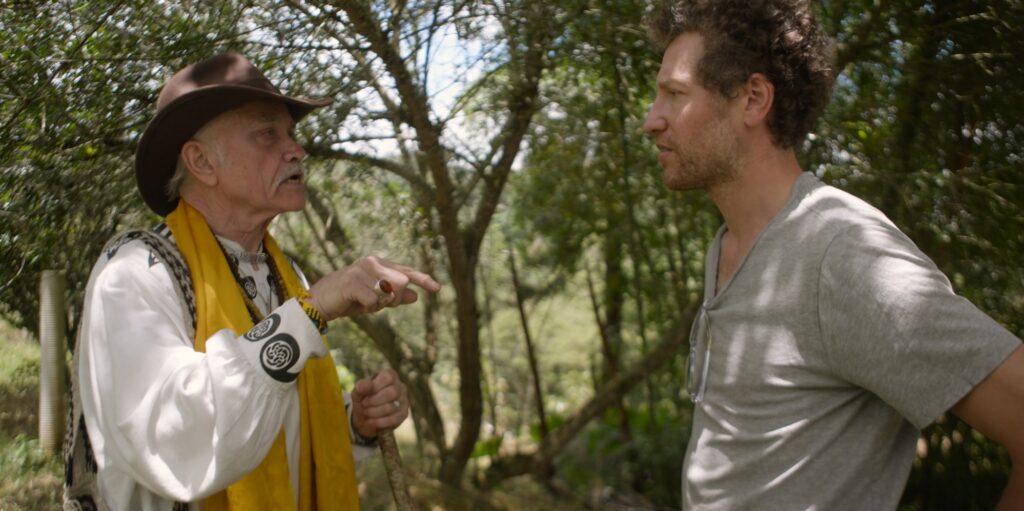
The last time we heard from Mr. Polsky was “Butcher’s Crossing” (2022), a horse opera of impressive metaphorical grit. This time around, he’s put on a documentarian’s hat to pick up the trail of Mr. McCollum, racking up frequent flyer points following the sacred activist and interfaith chaplain to various world locales. Toward the end of the film, Mr. Polsky posits that he has served as Sancho Panza to Mr. McCollum’s Don Quixote.
The implication is that Messrs. McCollum and Polsky are inseparable partners, buddy-buddies in body and spirit. Still, Mr. Polsky must know something about Cervantes’s epic novel, “Don Quixote.” A few minutes before likening himself to Sancho Panza, he raises Mr. McCollum’s ire by implying that the activist’s long and complicated quest to save the Amazonian rainforest may be so much tilting at windmills. A patching up between the two men takes place, but just barely.
Mr. McCollum is a member of a grand tradition of American eccentrics, a man who has a can-do attitude in the face of significant odds. He’s at the center of a prophecy that has pegged him as the catalyst for, as the film’s title has it, saving the world. In order to do so, our hero must see to the reuniting of indigenous peoples of South America.
This quest is of a piece with Mr. McCollum’s other exploits, including jewelry design, welding, kung fu, explosives, deep sea diving, sorcery, circus carney, chaplain to the Menendez brothers, and friend to the recently deceased Dian Fossey. Mr. McCollum is fluent in “magical languages” that allow him to communicate with flora. They have, apparently, some stories to tell.
Mr. McCollum is an affable man of modest means with a loving wife, a bad back, a cluttered household, and a second home out in the desert with a stairway that ascends to nowhere. Whatever one might think of his mission or the otherworldly portents to which he subscribes, there’s no doubting an abiding sense of purpose.
Mr. Polsky is another matter, having milked one man’s far-ranging idiosyncrasies for a film that embodies a 21st-century variant on noblesse oblige by reviving the 19th-century notion of the noble savage. On those points, “The Man Who Saves the World?” isn’t funny at all.

