Despite Trump Warning for Companies To ‘Eat’ Tariffs, Prices Are Going Up — And It’s Just the Beginning

Last month, wholesale prices rose at the fastest pace in three years, suggesting that retailers simply can’t continue to ‘eat the tariffs.’

AP/Noah Berger
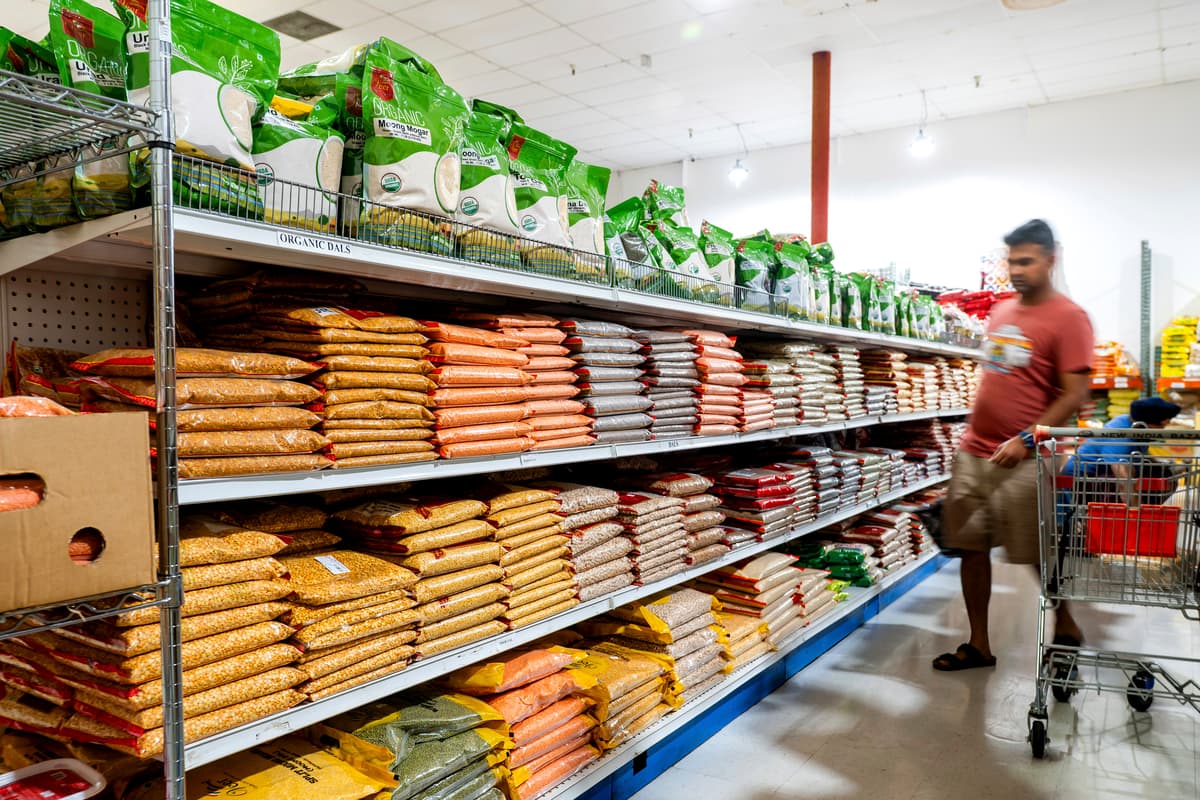
A customer shops a grain aisle at New India Bazar, where most merchandise is imported from India and Canada. AP/Noah Berger

President Trump’s April announcement of steep tariffs on imports set off a tidal wave of worry in America, but the pain never arrived. That’s all about to end.

In May, Walmart said it would soon have to raise prices to offset the import taxes, but Mr. Trump told the world’s largest retailer to “eat” the additional cost.

“Walmart should STOP trying to blame Tariffs as the reason for raising prices throughout the chain,” Mr. Trump wrote on Truth Social. “Between Walmart and China they should, as is said, ‘EAT THE TARIFFS,’ and not charge valued customers ANYTHING. I’ll be watching, and so will your customers!!!”

That worked for a while, but now, months later, companies are finally saying enough is enough and raising prices.

On Wednesday, Sony announced that PlayStation 5 game consoles will cost $50 more in the United States starting Thursday. The company didn’t explicitly cite tariffs as the reason for the higher price, but implied that they were to blame.

“Similar to many global businesses, we continue to navigate a challenging economic environment. As a result, we’ve made the difficult decision to increase the recommended retail price for PlayStation 5 consoles in the U.S. starting on August 21,” Sony said in a statement.

Fujifilm has blamed tariffs for increases on virtually all of its cameras and lenses, with prices jumping up to $800 on some high-end products.

Home Depot is also set to jack prices up after holding the line to maintain prices on imported products. The home-improvement retailer, which has more than 2,300 stores across North America, said prices will increase due to significantly higher tariffs than it expected in May.

“Obviously tariff rates are significantly higher today than they were when we spoke in May. So as you’d expect there’ll be some modest price movement in some categories but it won’t be broad based,” the executive vice president of merchandising at Home Depot, Billy Bastek, said during an earnings call.

Last month, wholesale prices rose at the fastest pace in three years, suggesting that retailers simply can’t continue to “eat the tariffs.” Companies are “coming to the point where their margins are getting squeezed and they need to start passing that onto consumers,” the president of the Federal Reserve Bank of Cleveland, Beth Hammack, told CBS News earlier this month.

American businesses ate more than half of the tariff costs through June, a recent analysis from Goldman Sachs economists found. Consumers, on the other hand, absorbed just 22 percent. The Goldman economists say that’s about to end, and consumers’ share will rise to 67 percent over the coming months.

But it’s not just tariffs that are driving up costs. Perhaps the worst news comes with every trip to the grocery store. The U.S. Bureau of Labor Statistics reported a 38 percent surge in the wholesale price of vegetables in July. Economists put some blame on tariffs, but also cite weather and supply chain issues.

In a twist, another of Mr. Trump’s pet projects could also be driving up prices. With the Trump administration’s immigration crackdown, farms are short on workers, leading to lost crops. “A lot of the product is being lost because there’s nobody to work. So the product that has been picked has been raised maybe 35 to 40 percent,” one California produce store owner said.

Beef and veal prices are also soaring, up 11.3 percent in July compared to last year, according to the most recent consumer price index report. That increase is nearly four times that of any other food during the same period.

Plus, there are signs that it’s all just the beginning. “Nearly 1 in 3 (30.9%) U.S. businesses expect they’ll charge higher prices in six months,” one recent study found. “Just 4.3% expect lower prices.”

“Tariffs are likely playing a significant role in these concerns, but so is the overall sense of uncertainty that remains in the American economy,” LendingTree’s chief consumer finance analyst, Matt Schulz, said. “There are so many unknowns that it’s nearly impossible to predict what the next few weeks will look like, much less six months from now. However, this report makes it clear many businesses see continued rising prices ahead.”

But fast-food fans will soon be getting a break. Starting next month, McDonald’s and its franchisees will reduce combo meal prices to about 15 percent below the cost of purchasing the items individually, according to the Wall Street Journal.

The Extra Value Meal will also return for $5 for breakfast meals and the famed Big Mac meal — which soared to an eye-popping $18 at one rest stop in Connecticut over the summer — will settle back down to a more manageable $8 on average.


The New York Sun

© 2025 The New York Sun Company, LLC. All rights reserved.

Use of this site constitutes acceptance of our Terms of Use and Privacy Policy. The material on this site is protected by copyright law and may not be reproduced, distributed, transmitted, cached or otherwise used.

The New York Sun

Sign in or  create a free account

or
By continuing you agree to our Privacy Policy and Terms of Use