

Director Lucile Hadžihalilović Has Crafted an Outstanding Film, ‘The Ice Tower’

Quiet and purposefully elusive, ‘The Ice Tower’ is often suspenseful, sometimes unseemly, and ingrained with a foreboding that is both childlike in its naivete and adult in its longueurs.
Via Yellow Veil
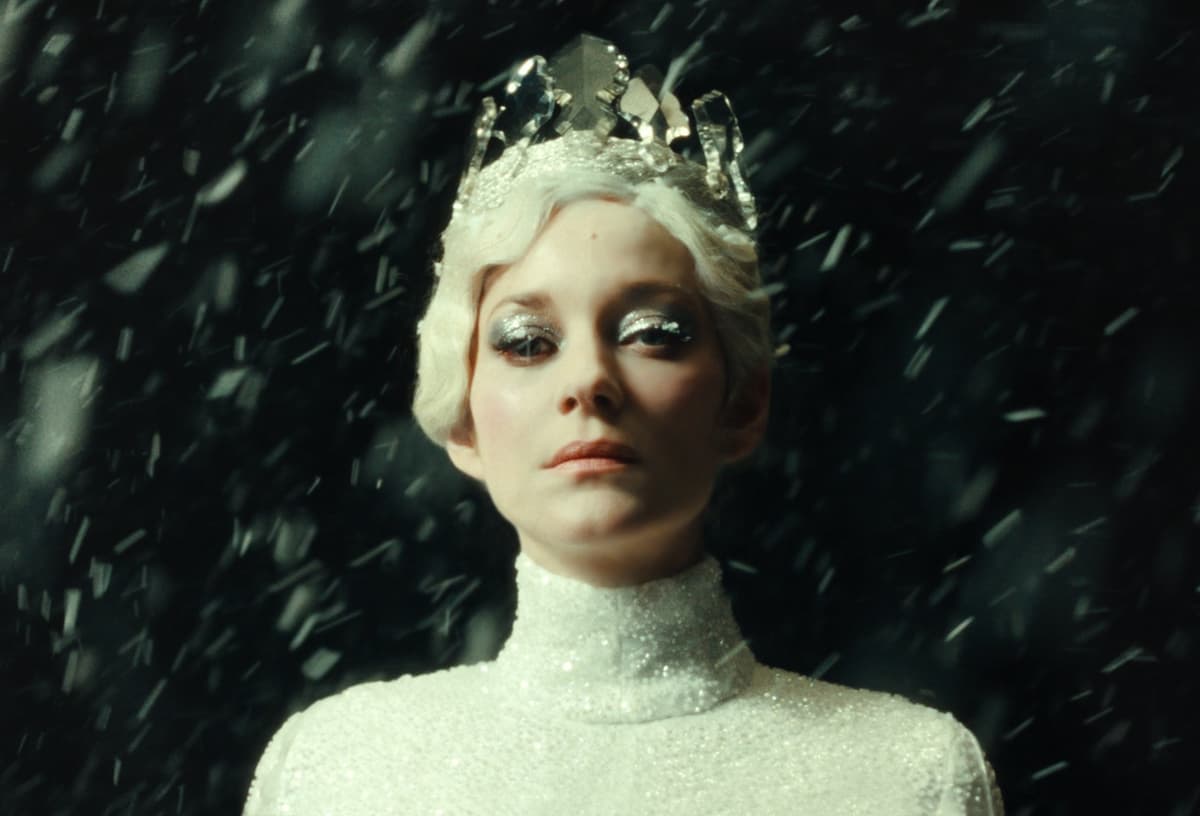
Marion Cottilard in 'The Ice Tower.' Via Yellow Veil

Hans Christian Andersen’s “The Snow Queen” is a fairy tale told in six parts, each section of which becomes increasingly Byzantine in its narrative turns. The story concerns a boy and a girl who traverse a world in which the devil has sown chaos. Talking animals figure into the adventures of Kay and Gerda, as do singing rose bushes and magic mirrors. As for the title character: She makes a brief but potent appearance.

The Snow Queen is ravishing to behold and adorned in finery not unlike her disposition — that is to say, “ice-shining, glittering ice.” Kay falls into the Snow Queen’s clutches, and begins to yield to her feminine charms. The villainess is circumspect enough to caution her willing ward about being kissed to death. An unstinting Gerda ultimately saves Kay from his own devices, and the pair end up basking under the grace of a warm summer sun.

The director Lucile Hadžihalilović was 5 years old the first time her mother sat down to read her Andersen’s fable and the Snow Queen — that “inaccessible and mysterious, simultaneously attractive and terrifying” figure — left a mark. Ms. Hadžihalilović’s new feature, “The Ice Tower,” doesn’t tell the story, but it does traverse similar thematic terrain, especially the notion that innocence is rare and faith, hardwon. Oh, and there’s a kiss that is, if not fatal, then decidedly uncomfortable.

“The Ice Tower” is an outstanding film, often suspenseful, sometimes unseemly, and ingrained with a foreboding that is both childlike in its naivete and adult in its longueurs. The screenplay, co-written by Ms.  Hadzihalilovic, Geoff Cox, and Alanté Kavaïté, favors mood over logic and gesture over dialogue. It’s a quiet, purposefully elusive movie, shuttling promiscuously between actual events and dreamlike reveries. Cautionary tales and cinematic spectacle converge only to have their whimsies called into question.

Clara Pacini in ‘The Ice Tower.’ Via Yellow Veil

This is a film about children abandoned by circumstance and the fantasies proffered by art. The time is the 1970s; the setting, a French mountain retreat. Our 15-year-old heroine, Jeanne (Clara Pacini), is chafing under the restraints of a foster home to which she’s been consigned after the death of her mother. Jeanne runs away, hitches a ride into town, and finds herself at a local ice rink. She becomes entranced with a skater, Bianca (Valentina Vezzoso) — as do the rest of us. Ms. Hadžihalilović’s loving emphasis on the woman’s skill and physiognomy makes sure of that. 

Jeanne and Bianca cross paths a second time, and the former gains possession of the latter’s purse, taking advantage of its spare francs and forms of identification. Desperate for a place to hunker down for the night, Jeanne stumbles into an empty set for a movie production of “The Snow Queen.” She becomes entranced by the actress in the lead role, Cristina Van Der Berg (Marion Cottilard). The star is flighty, demanding, and churlish. We learn about Cristina’s behavior on the down-low, primarily through Jeanne’s eyes. Voyeurism is a key component of this movie’s unsettling tone. Mses. Pacini and Cotillard are as winsome and magnetic as the occasion calls for.

Cristina takes a shine to Jeanne, notwithstanding — or, maybe, because of — her myriad duplicities. When the young woman is hired as an extra, Cristina sees to it that her involvement in the film becomes more substantial. Jeanne follows along in a puppy dog-like manner, seeking emotional solace that is clearly not forthcoming. All the while Ms. Hadžihalilović increasingly fudges the temporal and logistical flow of the story. Hard-and-fast distinctions are rendered muzzy. 

Ms. Hadžihalilović’s movie is at once elaborately contrived in its plot points and wholly organic in how they are given dramatic emphasis. The director’s methodology won’t be to all tastes, favoring, as it does, the gradual, the intimate, and the mystical. But she knows the strength of collaboration, and yokes stunning work from cinematographer Jonathan Ricquebourg, production designer Julia Irribarria, and, especially, Ken Yasumoto, whose sound design is alternately sneaking and brash. 

The best films waylay their readiest criticisms. “The Ice Tower” is one of them.


The New York Sun

© 2025 The New York Sun Company, LLC. All rights reserved.

Use of this site constitutes acceptance of our Terms of Use and Privacy Policy. The material on this site is protected by copyright law and may not be reproduced, distributed, transmitted, cached or otherwise used.

The New York Sun

Sign in or  create a free account

or
By continuing you agree to our Privacy Policy and Terms of Use