
Dispute Over ‘LGBTQ-Inclusive’ Childrens’ Storybooks Highlights Importance of School Choice

Even secular parents should find the idea of strangers teaching their prepubescent children about sexuality and gender dysphoria at such a young age and in such a frivolous manner unacceptable.

Justin Sullivan/Getty Images
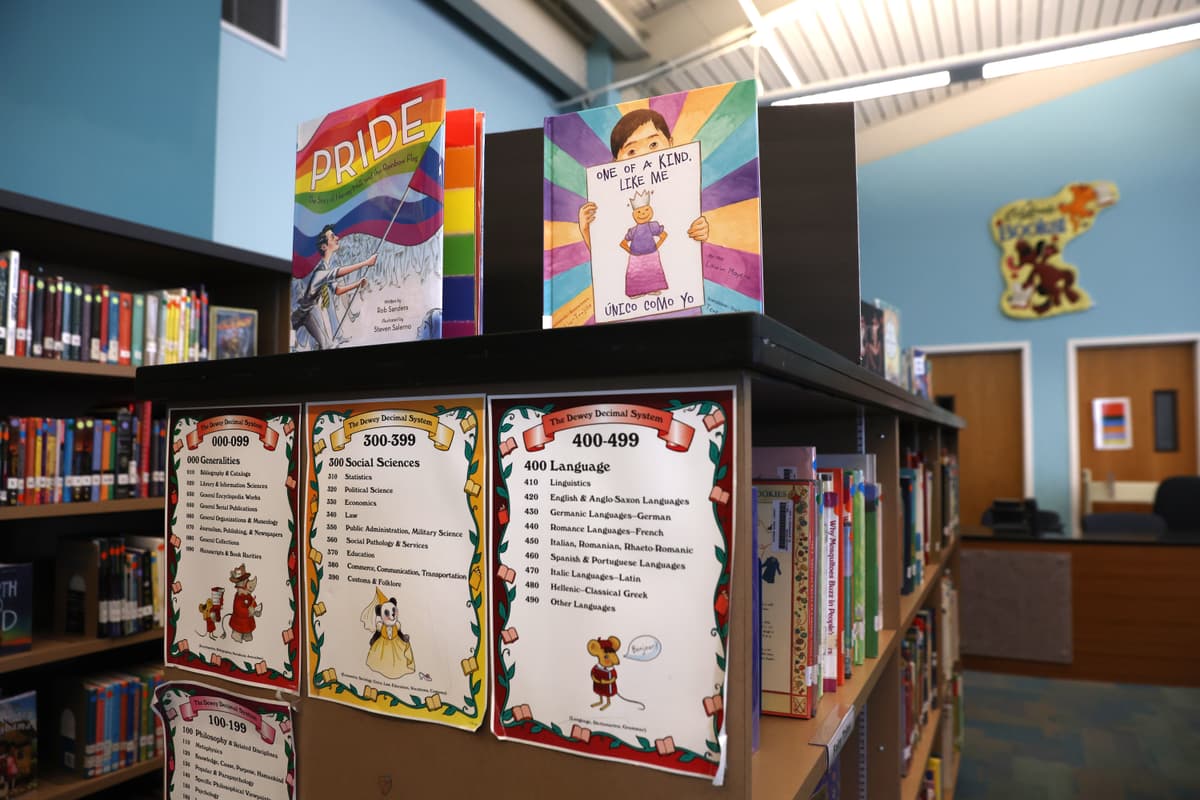
LGBT-themed books in an elementary school library. Justin Sullivan/Getty Images

During oral arguments in the case of Mahmoud v. Taylor, Justice Ketanji Brown Jackson unintentionally made a practical and convincing case for universal school choice.

A few years back, the Montgomery County, Maryland, school board instituted an “LGBTQ-inclusive” curriculum that included storybooks for children as young as prekindergarten. The books are ostensibly part of the English curriculum because, apparently, they feature words and sentences.

Yet the rationale for the program, according to the school system itself, is to “disrupt” the “binary” thinking of skeptical children. Which sounds very much like indoctrination.

For instance, one of the “think aloud moments” for children reading “Born Ready,” the tale of a confused girl, is “noticing how happy Penelope is when his mom hears him and commits to sharing with their loved ones that he is a boy.”

“Pride Puppy!” is about a cute little dog who wanders into the Pride parade and meets friendly drag queens and leather-clad participants. “Love, Violet” and “Prince & Knight” are about same-sex attraction.

Even secular parents should find the idea of strangers teaching their prepubescent children about sexuality and gender dysphoria at such a young age and in such a frivolous manner unacceptable. As most conscientious parents understand, children do not “know themselves best.”

One of the most vital duties of parenting is guiding children through the confusion of adolescence and teaching them morality. It is not consecrating every harebrained notion that pops into their precious, underdeveloped brains.

In any event, a group of religious parents led by a Muslim family in Maryland who believe the messages in the books conflict with their beliefs sued the county — not to stop the classes, but for the right to opt out of them. Yet, Montgomery County refused to allow them to do it, maintaining that the opt-out requests would be so numerous they would disrupt the class.

This might sound crazy, but if enough parents oppose a non-academic curriculum that it would be endangered, shouldn’t a public school do their best to accommodate taxpayers, rather than the opposite? Of course, in the progressive mindset the individual is subservient to the state, not vice versa.

So, Mahmoud is now in front of the court. During oral arguments, which seemed to be going relatively well for parents, Justice Jackson conceded that she was “struggling to see how it burdens a parent’s religious exercise if the school teaches something the parent disagrees with.” After all, they have a “choice,” she noted. “You don’t have to send your kid to that school. You can put them in another situation.”

Theoretically speaking, this makes complete sense. You can surrender your impressionable young child to hokum about gender transformation that conflicts with your faith or you can leave the school entirely and, presumably, send your children to a private institution or homeschool them.

The problem here is that Maryland is one of the worst states for parental choice. Justice Jackson, who spent years on the board of a Christian academy in Maryland, should know this. Other than a tiny voucher program, there is nowhere to go. Maryland doesn’t have open enrollment policies that, at a bare minimum, allow parents to change schools within the district.

Whichever school happens to be closest, no matter how poorly it performs or how ill-fitted it is for your child’s needs, is where they must go. Children might be the most valuable thing in your life, but a Maryland parent is afforded more choices on where to buy a television than where they educate their children.

Maryland barely has any charter schools. Parents who want to homeschool, which is challenging enough, must wrestle with needless regulatory burdens to teach their own children.

Anti-reform activists argue that school choice would result in an exodus of parents — and funding — undermining public schools’ ability to function. This is called a marketplace. If you can’t attract parents, it’s probably because your service is substandard.

Anti-reform activists also argue that voucher programs are for rich people when the reality is that they are mostly for the middle and working classes, who are unable to escape these propagandizing institutions. Montgomery County is one of the wealthiest in the country, so perhaps parents there have a better chance of escaping than most.

Irrespective of who school reform would help, it is an exceedingly small favor to ask schools to allow parents to opt out of classes that teach “inclusivity” — a euphemism for a radical cultural agenda. The fact that schools refuse to meet this request only illustrates the radicalism of these institutions.

Yet, fortunately, Justice Jackson has the answer on how to fix it.

Creators.com


The New York Sun

© 2025 The New York Sun Company, LLC. All rights reserved.

Use of this site constitutes acceptance of our Terms of Use and Privacy Policy. The material on this site is protected by copyright law and may not be reproduced, distributed, transmitted, cached or otherwise used.

The New York Sun

Sign in or  create a free account

or
By continuing you agree to our Privacy Policy and Terms of Use