Doubts Emerge Over Vance Claim That Airstrikes on Drug Smuggling Vessels ‘Highest and Best Use’ of America’s Military
What about, say, Bunker Hill, Antietam, Belleau Wood, Omaha Beach, and Inchon?
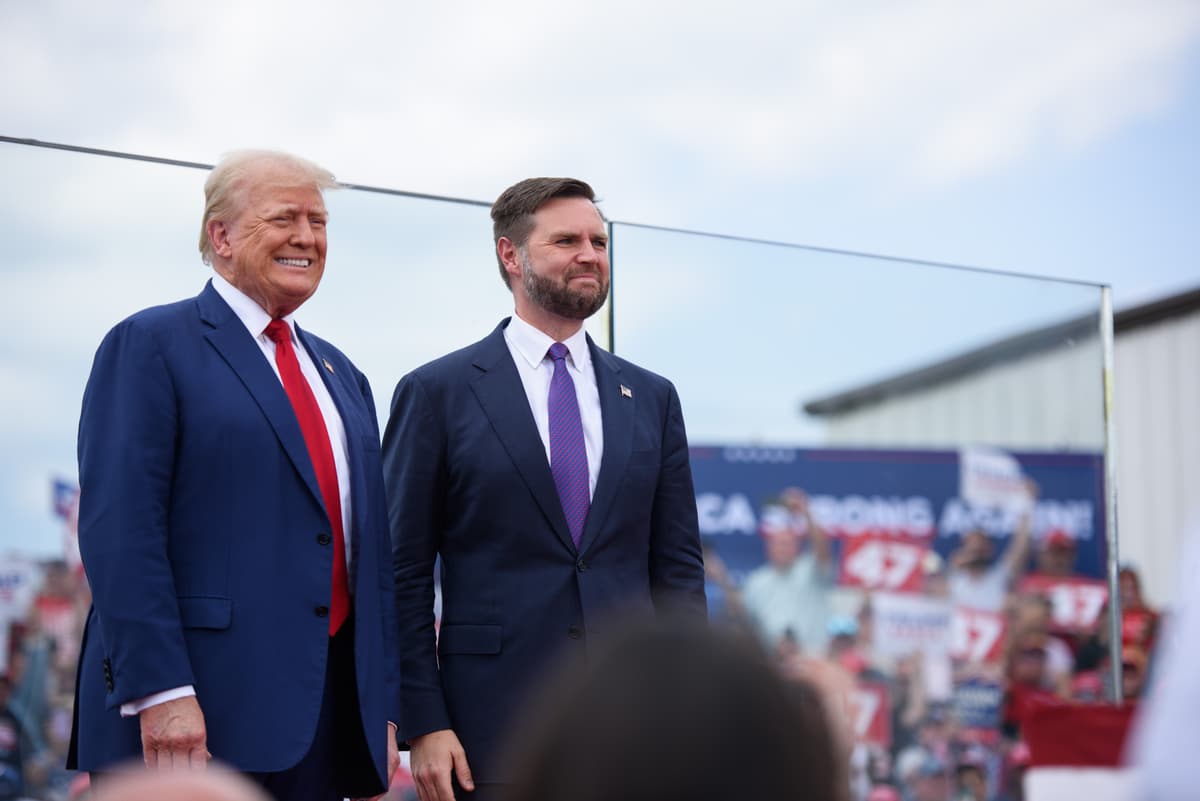

Last year, when JD Vance was campaigning to become what nature designed him to be, Donald Trump’s vice president, Mr. Vance gave credence to rumors about kitten-cooking Haitians: Immigrants were eating the pets of Springfield, Ohio. Given the scarcity of evidence, he defended these “stories” — his term — as instructive.
Which they were. They taught us about him.
As did his response when the president recently ordered the airstrike on a boat leaving Venezuela, killing, the president says, 11 drug smugglers. The president says there have been two other missile strikes on boats near Venezuela. Mr. Vance says: “Killing cartel members who poison our fellow citizens is the highest and best use of our military.” Higher and better, then, than Bunker Hill, Antietam, Belleau Wood, Omaha Beach, and Inchon.
Well. Assume that the dead were cartel members. Assume the boats were carrying drugs. Assume the drugs were destined for Americans who would poison themselves. And assume that this story ages better than did the story of the August 1964 Tonkin Gulf incident.
North Vietnamese torpedo boats supposedly launched two attacks on American destroyers. Congress promptly passed a resolution conferring on President Lyndon Johnson broad authority to “take all necessary measures” to defeat aggression in Indochina. There were about 20,000 U.S. troops then. Max Hastings’s “Vietnam: An Epic Tragedy, 1945-1975” discloses:
The first Tonkin Gulf attack was trivial. A Navy captain cabled “ENTIRE ACTION LEAVES MANY DOUBTS” and “NEVER POSITIVELY IDENTIFIED A BOAT AS SUCH.” An admiral warned the Pentagon that “many reported contacts and torpedoes fired appeared doubtful.” The second attack was fictitious. Mr. Hastings says that Johnson (“The details didn’t much matter to him”), waging his 1964 election campaign, was eager to seem strong.
Mr. Hastings: “Thereafter it was almost inevitable that the administration would lie and lie again to conceal the multiple blunders and deceits already perpetrated and to justify air strikes on North Vietnam.” Johnson would have been indignant if “anticlimactic facts had pricked the bubble of his carefully crafted indignation.”
That was then. This is now:
The Supreme Court will soon consider Mr. Trump’s claim that a statute that does not mention tariffs gives him the power to impose tariffs as high as he chooses, on any country he chooses, for any reason he chooses, for as long as he chooses. About this claim, congressional Republicans are supine, because of fear or adoration. Congressional Democrats are dumbfounded by the president’s exercise of powers their party was complicit in Congress forfeiting.
So, unsurprisingly, there is tepid congressional questioning of the president’s actions as judge, jury, and executioner in the waters off Venezuela. His behavior is predictable.
Given his capacious notion of presidential powers, in domestic and foreign affairs. And given Mr. Vance’s disdain for Americans “weeping over the lack of due process” for people swept from American streets and workplaces into “Alligator Alcatraz” and similar confinements because they are suspected members of criminal gangs. And given the president’s penchant for declaring this and that (e.g., a trade deficit) to be an “emergency.” And given that he learned opportunistic verbal extravagance (e.g., an “invasion” at the southern border) from progressives who tried to disqualify him from the 2024 election because the afternoon riot of January 6, 2021, supposedly qualified as an “insurrection” under the 14th Amendment. Given all this, expect more of this.
A law professor at the University of California at Berkley, John Yoo, is not squeamish about controversial uses of power: As deputy assistant attorney general under President George W. Bush, Mr. Yoo provided legal justifications for post-9/11 “enhanced interrogation” methods against captured Al Qaeda combatants. He says, however:
“There has to be a line between crime and war. We can’t just consider anything that harms the country to be a matter for the military. Because that could potentially include every crime.”
Yet who will draw that line? Who will enforce it? If you say Congress, you have not been paying attention.
Before Tonkin Gulf there was Havana Harbor. In 1898, America embraced war and imperialism because, well, “Remember the Maine.” The American battleship supposedly was blown up by a Spanish mine. Its sinking has long since been ascribed to an accidental internal explosion. Events sprint; understanding saunters.
And some tough guys think understanding is for weaklings. When an online critic of the missile strikes near Venezuela called them a “war crime,” Mr. Vance’s rejoinder was rich in tough-guy testosterone but thin on arguments: “I don’t give a s— what you call it.” Mr. Vance is, by mind and manner, where he belongs.
The Washington Post

