Easing Trump’s Tariff War on India Could Strengthen Anti-Beijing Alliances Across Asia
‘We’ve been at war with China since 1962. Don’t you realize you are as well?’ one Indian military official says.
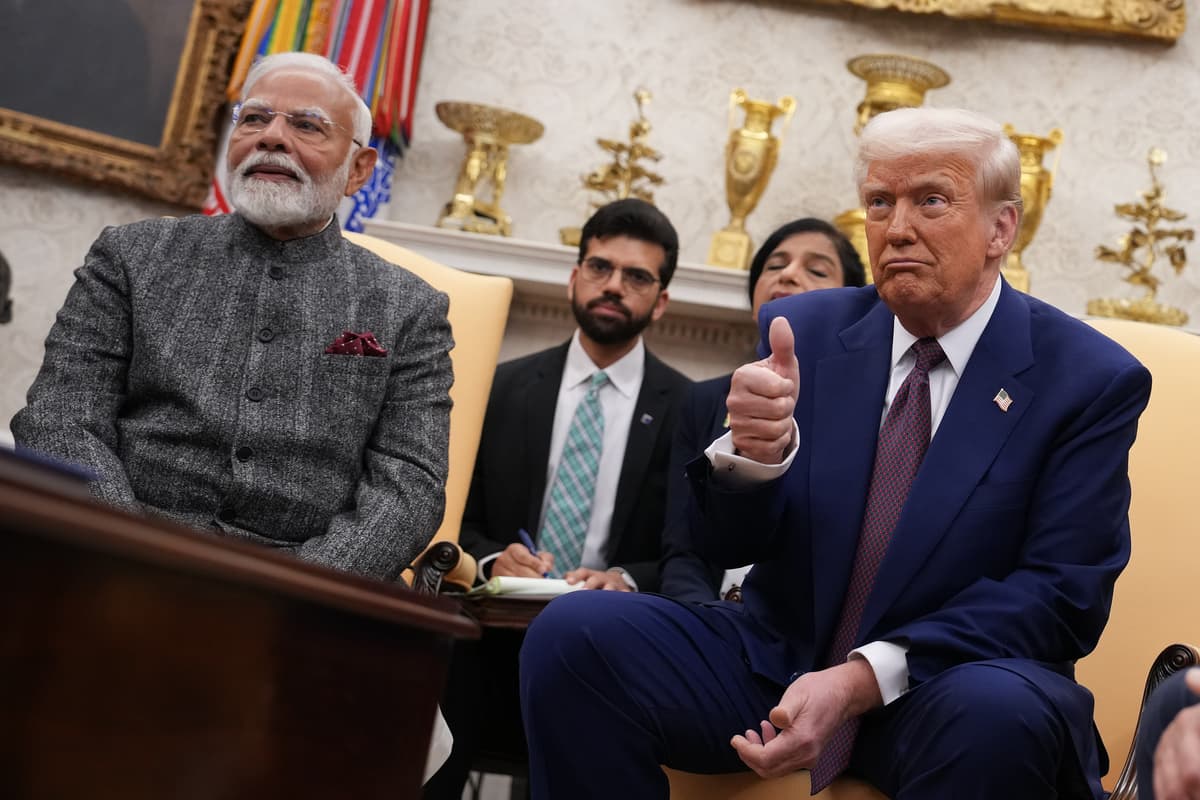

President Trump frequently highlights his affection for the prime minister of India, Narendra Modi, and the two leaders could possibly meet over the weekend. Yet is America ready to end a dispute with India that has weakened an Asian coalition to block Communist China’s global aspirations?
The world’s most populous country, boasting a fast-growing economy, India could be a strong ally for Washington while Beijing flexes its muscles in an ever-escalating competition with America. Yet Mr. Trump, in an attempt to sabotage New Delhi’s relation with Moscow, is levying on India one of the world’s highest trade barriers — a 50 percent tariff.
Widespread anger at Mr. Trump in India might begin to ease now, with the president hinting this week at the possibility of a deal. Indian press outlets report that a trade agreement that would reduce the tariff rate to 20 percent or less could be completed as early as this weekend.
Messrs. Trump and Modi might meet at Kuala Lumpur, Malaysia, where both are expected to attend a summit of the Association of Southeast Asian Nations. It could also be an opportunity for Mr. Trump to consolidate Asian alliances and block Beijing’s global dominance aspirations.
“You have to remember that India is an extremely important ally and friend, particularly when it comes to the larger issue of a fight with an aggressive China that is out to destroy us,” an Asia watcher at the Center for Security Policy, Grant Newsham, tells the Sun. Formerly a colonel of the U.S. Marines, he says Indian counterparts often chided him: “We’ve been at war with China since 1962. Don’t you realize you are as well?”
Mr. Trump, though, has been consumed with pressuring Moscow over the Ukraine war, which led him to levy a 25 percent tariff on India for consuming Russian oil on top of a 25 percent tariff over trade restrictions. In the process, did the president ignore an important ally in the confrontation with America’s most formidable competitor?
“I don’t think Washington ever lost sight of India’s importance for America’s interests,” a former senior Western diplomat at Delhi tells the Sun. “The Americans assumed that India was in their pocket, as it wouldn’t get too close to China, and since Russia has little to offer beyond oil. The Indians then felt slighted, and now Washington realizes it’s gone too far, so Trump is making amends.”
With India celebrating the festival of light, Diwali, hopes are rising for an easing of tensions. Some of the Trump administration’s most senior officials of Indian descent, including the director of national intelligence, Tulsi Gabbard, and the director of the FBI, Kash Patel, attended a White House candle lighting event Tuesday.
The president used the occasion to call Mr. Modi. “He’s a great person, and he’s become a great friend of mine over the years,” Mr. Trump told the Diwali celebrants. We “had a great conversation, we talked about trade.”
After idolizing Mr. Trump during his first term, Indians have soured on his tariffs, as well as his prominent meetings with Pakistani officials. The Delhi press has also taken Mr. Trump to task for claiming his diplomacy — as opposed to India’s military success in Operation Sindoor — ended a war in May with Pakistan.
The Tuesday phone call, and the hope of a deal to settle trade disputes, could change things. In India, comments made by some of Mr. Trump’s top aides, including trade adviser Peter Navarro and Treasury Secretary Scott Bessent, created anger “because Indians thought they were being just too arrogant,” the executive editor at Hindustan Times, Shishir Gupta, tells the Sun. Yet, after Mr. Trump “started to talk to the prime minister directly, I don’t think there is an issue.”
Mr. Trump said on Tuesday that Mr. Modi promised he was “not going to buy much oil from Russia. He wants to see that war end,” and therefore India is “not going to be buying too much oil. So, they’ve got it way back, and they’re continuing to cut it way back.”
Last week, in contrast, Mr. Trump said that the Indian premier assured him he would completely end Russian oil purchases, which account for nearly 35 percent of India’s crude imports. Delhi denied such a promise was made. Now Mr. Trump is only talking of a gradual reduction in India’s purchasing of Russian oil.
“We can work on that, because India can compensate by buying oil from other countries,” Mr. Gupta says.
“Thank you, President Trump, for your phone call and warm Diwali greetings,” Mr. Modi wrote on X Wednesday. “On this festival of lights, may our two great democracies continue to illuminate the world with hope and stand united against terrorism in all its forms.”
When the two leaders talk directly, “if there is an issue on which a political vision is required, which cannot be taken by the bureaucracy, the two can do that,” Mr. Gupta says. “So it’s not a bad sign. It shows that there is a bonafide engagement.”