
Energy-Hungry AI Data Centers, Trump Renewables Policy Leave Consumers Picking Up the Tab for Higher Electricity Costs

Demand for power is expected to increase by as much as 60 percent by 2030 as suppliers patch aging infrastructure to feed an exponential AI server surge.

AP Photo/Robert F. Bukaty
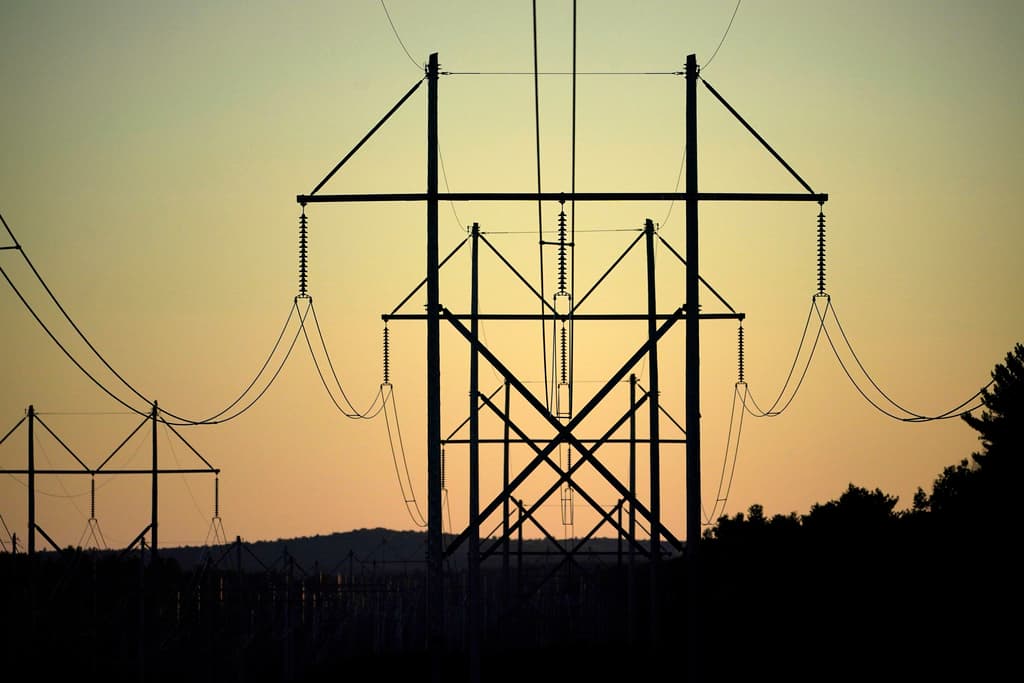
Power utility lines at Pownal, Maine. AP Photo/Robert F. Bukaty

Consumers are feeling the pinch of dramatic increases in electricity prices across every state in America this year as household demand competes with energy-hungry AI data centers, the cost of aging electrical grids, and fewer tax incentives for companies investing in alternative sources like wind and solar.

Across the country, the sticker shock faced by American households is driving debate over who is to blame.

“The more that solar PV and wind have been added to California’s electrical grid, the higher that residential electricity prices have gotten, even when you adjust for inflation. I’m not saying that’s the only reason for this correlation, but it’s definitely a part of the problem,” a meteorologist and climate blogger, Chris Martz, wrote.

“High electricity prices around the country flow directly from Trump’s decisions to gut or outright ban new electricity projects based on wind and solar, which he does to make the fossil fuels industry happy. Electricity bills are spiking around the country—twice as fast as the rate of inflation,” an attorney and Columbia University lecturer, Scott Horton, wrote

Energy suppliers say per kilowatt-hour revenues rose 6.6 percent in the residential sector in June compared to a year earlier. Revenues per kilowatt-hour went up in 45 states and the District of Columbia, with Maine, D.C., and New Jersey seeing the largest percent increases, all more than 21 percent, according to the U.S. Energy Information Administration.

While the Consumer Price Index for electricity actually decreased 0.1 percent in July versus June, the 12-month index is up 5.5 percent — twice the rate of the overall index. 

In America, electricity demand is expected to grow 25 percent by 2030 and 78 percent by 2050 from 2023 levels, while peak electricity demand — where the largest number of users are consuming electricity at once — is expected to grow 14 percent by 2030 and 54 percent through 2050, energy solutions provider ICF said in its June report.

“It seems like rising demand is not being met with supply rising as quickly as it’s being asked for,” the director of electricity modeling, Brendan Pierpont, for a climate policy think tank, Energy Innovation, tells The New York Sun.

Energy management company Schneider Electric attributes the increased demand to the proliferation of data centers, most of which will rely on the country’s power grid. The number of AI data centers built to house powerful servers used to train and run AI models doubled between 2021 and 2024. According to the Deloitte Research Center for Energy and Industrials, that number could increase thirtyfold by 2035, requiring 123 gigawatts of power — the equivalent of yearly power use by nearly 137 million American homes — each year. 

“The AI Revolution is so massive that electricity prices are moving in a literal straight line higher. Energy is the new limiting factor to AI growth,” an X post from a global growth markets newsletter, Kobeissi Letter, reads.

While data center expansion spans the nation, the 13 states across the Midwest and mid-Atlantic regions are home to the most data center capacity. The region of 67 million people saw average monthly power bills increase faster than the national average, spiking $30-$40 per month beginning in June.

“If you look at the Mid-Atlantic region, which is served by a market operator called PJM, we can see that they have had a kind of slow process of interconnecting new resources and processing requests for new power plants to come online, and that just hasn’t kept pace with this rise in data centers,” Mr. Pierpont says. “But those are market prices that are paid by everyone. All consumers across the region.”

Data centers are not the only factor driving up power bills across the country. Earlier this summer, President Trump signed a new law that ended tax incentives for wind and solar projects in favor of generating electricity from natural gas plants, which often have higher operating costs.

“We saw an energy crisis in Europe drive natural gas prices here in the U.S. up by a factor of four times overnight,” Mr. Pierpont says.

As demand increases, it is taxing an already aging infrastructure. A 2022 report from the Department of Energy estimates that America will need to increase its transmission systems by as much as 60 percent by 2030 and eventually triple them by 2050. Nearly 70 percent of transmission lines in America are more than 25 years old and inching closer to their 50-year lifespan and will need to be replaced over the next three decades.

“We have a pretty old electricity system. A lot of it was built in the 1940s or so,” Mr. Pierpont added. “The bill on deferred maintenance and replacing parts of the system that have aged out is starting to come due in a kind of tough cost environment.”


The New York Sun

© 2025 The New York Sun Company, LLC. All rights reserved.

Use of this site constitutes acceptance of our Terms of Use and Privacy Policy. The material on this site is protected by copyright law and may not be reproduced, distributed, transmitted, cached or otherwise used.

The New York Sun

Sign in or  create a free account

or
By continuing you agree to our Privacy Policy and Terms of Use