
‘Death of Captain Waskow’ Epitomizes Ernie Pyle’s Unmatched Coverage of the Soldiers Who Fell for America

This Memorial Day, take a moment for Henry Waskow, a man in his mid-20s from Belton, Texas killed in World War II by an ‘indiscriminate fragment of shell’ on an Italian mountainside.
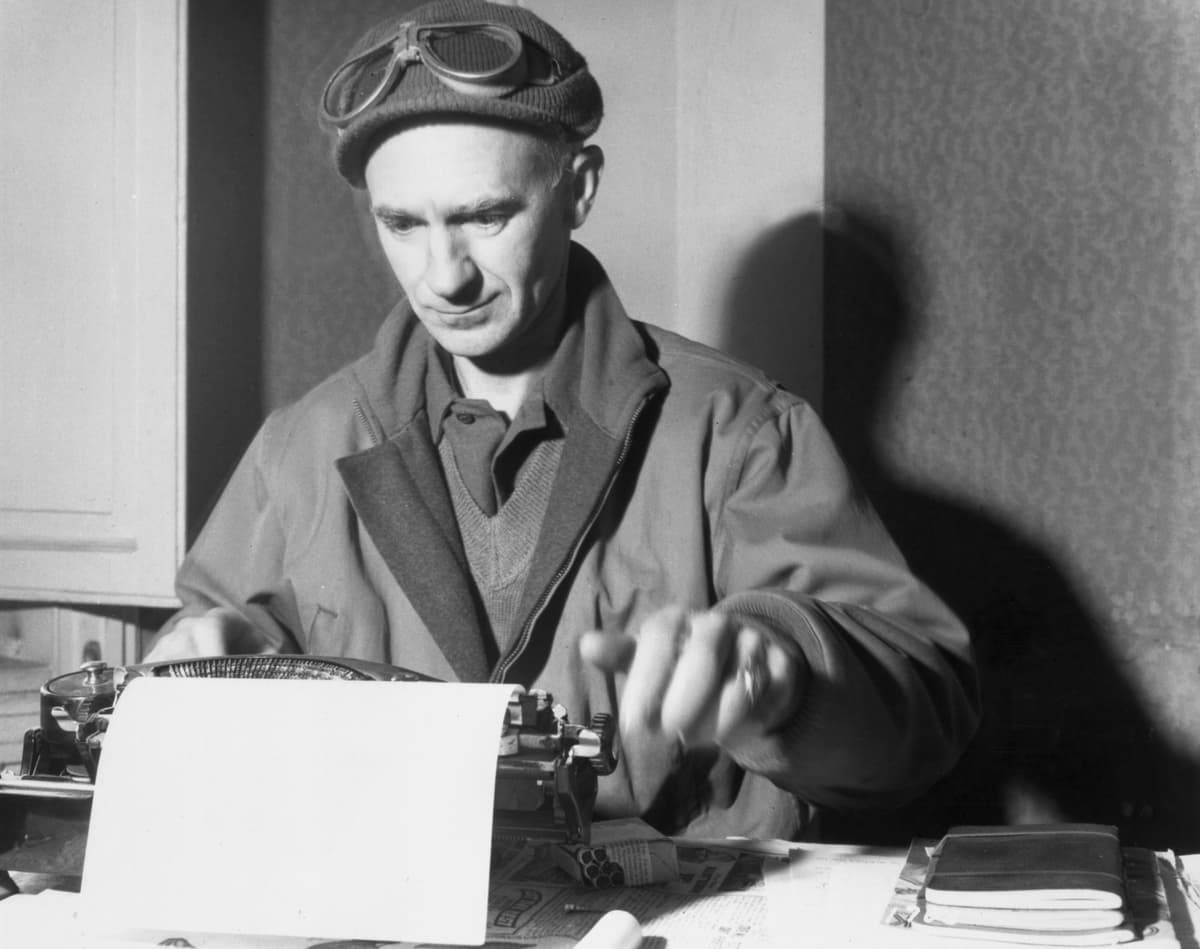
Hulton Archive/Getty Images
Journalist Ernie Pyle circa 1945. Hulton Archive/Getty Images

Most journalism is, at most, the “first rough draft of history.” Occasionally, however, there is some journalism — even of the most perishable kind: a column — that attains an immortality because of its simple sufficiency. It leaves nothing to be said, the words having perfectly suited a moment.

One such was the most famous piece by a columnist who soared to a place in the nation’s consciousness unmatched before or since from obscurity. On this Memorial Day, take a moment for Ernie Pyle’s “The Death of Captain Waskow,” a man in his mid-20s from Belton, Texas. The dispatch was datelined “AT THE FRONT LINES IN ITALY, January 10, 1944.”

Pyle was born with what was to be the war-torn 20th century, in 1900, in Dana, Indiana. He was a middle-aged Middle American travel writer until Hitler tried bringing Britain to its knees by bombing. The Blitz brought the war, as reported by Edward R. Murrow of CBS radio, to the United States, and brought Pyle to the European theater of a war he would not survive.

A member of the 3rd U.S. Infantry Regiment also known as The Old Guard, places flags in front of each headstone at Arlington National Cemetery.
A member of the 3rd U.S. Infantry Regiment also known as The Old Guard, places flags in front of each headstone at Arlington National Cemetery. AP/Andrew Harnik

War, as reported by him from what he called the “worm’s eye view,” was war as the common soldiers experienced it: discomfort, weariness, mud, filthiness, loneliness and stretches of boredom punctuated by episodes of death. Death somehow simultaneously random and routine. David Chrisinger, in his 2023 book “The Soldier’s Truth: Ernie Pyle and the Story of World War II,” tells the story of the man who wrote this:

“I was at the foot of the mule trail the night they brought Capt. Waskow’s body down. The moon was nearly full at the time, and you could see far up the trail, and even part way across the valley below. Soldiers made shadows in the moonlight as they walked.

“Dead men had been coming down the mountain all evening, lashed onto the backs of mules. They came lying belly-down across the wooden pack-saddles, their heads hanging down on the left side of the mule, their stiffened legs sticking out awkwardly from the other side, bobbing up and down as the mule walked.”

Pyle’s language was spare. His sentences were almost without cadences, like tired men not marching, just walking. You could call his style Hemingwayesque. Except Ernest Hemingway, also in the European theater, cultivated a watch-me-transform-literature antistyle: ostentatious simplicity.

Pyle would have scoffed at the notion that he had a style. His granular reporting, replete with the names and street addresses of the GIs he talked to, appeared in 400 daily newspapers and another 300 weekly publications. He appeared on the cover of Time magazine. He avoided the insult of fancy writing about the gray, grim everydayness of the infantryman’s war.

Henry T. Waskow, writes Chrisinger, worked his way up to captain from the lowest enlisted ranks, an extraordinarily beloved officer but also an “ordinary man.” Moments before his death he had a craving for toast: “When we get back to the States, I’m going to get me one of those smart-aleck toasters where you put the bread in and it pops up.”

Mr. Chrisinger: “It all happened so quickly. … An indiscriminate fragment of shell, red hot and sharp as a scalpel, had sliced a hole in his chest, killing him instantly.” Considering the hundreds of young Americans killed fighting for this unremembered spot, “the death of one ordinary man on a lonely mountainside was, for Ernie, an example of war on a miniature, intimate scale.”

On April 18, 1945, Pyle, 44, was killed by Japanese gunfire on an island near Okinawa. He is buried in the National Memorial Cemetery of the Pacific, at Honolulu.

On Christmas Eve 2019, Mr. Chrisinger visited the Sicily-Rome American Cemetery in Nettuno, Italy, south of Rome on the coast of the Tyrrhenian Sea. He was there to see Plot G, Row 6, Grave 33, where Waskow rests, 5,700 miles from Belton, Texas. He is among the best-known of the more than 7,000 Americans buried there.

The cemetery guide told Mr. Chrisinger that Waskow’s grave is sought out by many of the thousands of Americans who still come to the cemetery each year. Fewer and fewer each year, surely, as the connections of the dead with the living become fewer, until none will come.

The guide said, “There are 30 sets of brothers and three sets of twins buried here.” Referring to all those in the cemetery, he said: “Most of these boys have never had a visitor.” Visit them in your mind this Memorial Day.

The Washington Post


The New York Sun

© 2025 The New York Sun Company, LLC. All rights reserved.

Use of this site constitutes acceptance of our Terms of Use and Privacy Policy. The material on this site is protected by copyright law and may not be reproduced, distributed, transmitted, cached or otherwise used.

The New York Sun

Sign in or  create a free account

or
By continuing you agree to our Privacy Policy and Terms of Use