Europe May Live To Regret Its Foolhardy Effort To Turn Israel Into an Isolated ‘Sparta’

With NATO members spending millions of dollars to protect against cheap Russian drones, Israel soon will be able to sell them laser systems that can intercept flying objects for $2.

Paula Bronstein/Getty Images
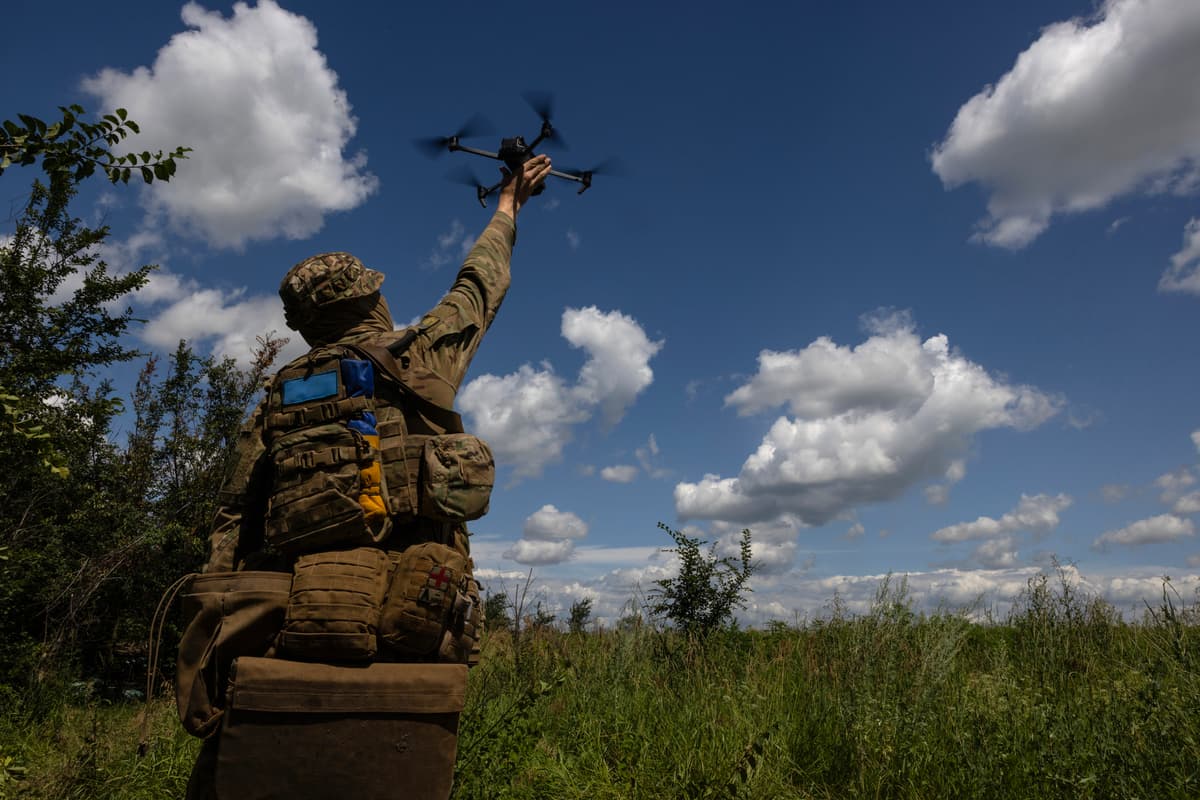
A Ukrainian drone operator lands his drone after a surveillance flight near Bakhmut in the Donetsk Region of Ukraine on July 16, 2023. Paula Bronstein/Getty Images

A new European Union plan to suspend a free trade agreement with Israel is yet to be implemented, but even if it does, can the continent afford to isolate the Jewish state and turn it into a “super Sparta”?

The term was coined by Prime Minister Benjamin Netanyahu Monday in a chat with finance ministry officials. After selloffs in the Tel Aviv stock market, Mr. Netanyahu convened a press conference Tuesday to praise Israel’s ability to export innovative products, rather than be a Sparta-like closed “autarkic” economy. 

Will economically challenged European countries aiming to punish Israel end up hurting themselves instead? The Jewish state could help Europe fend off Russia’s assault. As Europeans vow to increase defense spending, they might extensively rely on Israel’s battle-tested arms industry.

Yet, the EU policy chief, Kaja Kallas, ignored that fact as she unveiled a plan to suspend the Union’s free trade agreement with Israel. If approved by 15 of the Union’s 27 members, the plan would impose onerous new tariffs on Israeli exports.

While for now such a majority seems unlikely, it reflects a growing European unease over Israel’s conduct in Gaza. Punishing Israel economically was first proposed last week by the European Commission president, Ursula von der Leyen. Her turn to foe from friend increases Israel’s sense of Sparta-like isolation.  

At Rome on Wednesday, Pope Leo XIV expressed “profound closeness” to Gazans. “Before Almighty God, who commanded ‘Thou shalt not kill,’ and throughout human history, every person always has an inviolable dignity, to be respected and upheld,” the Pontiff wrote to his 1.1 million X followers.     

On Tuesday, a Geneva-based United Nations Human Rights Council commission declared Israel guilty of “genocide.” The anti-Israel commission’s three members resigned in June, reportedly fearing American sanctions. As their resignation only takes effect in November, they are now “getting their last bite of the apple,” the director of UN Watch, Hillel Neuer, tells the Sun.  

Mostly, though, Israelis are concerned about the threat of European trade sanctions. A third of all Israeli exports go to Europe, adding up to nearly $6 billion in 2024. The foreign minister, Gideon Sa’ar, is reportedly phoning colleagues to convince them to vote against what he called on X Wednesday the EU’s “morally and politically distorted” proposal. 

Reuters is reporting that for now the proposal lacks the necessary support of 65 percent of all EU countries. Germany, which boasts Europe’s largest economy, is yet to clarify its position. “Moves against Israel will harm Europe’s own interests,” Mr. Saar writes. “Steps against Israel will be answered accordingly, and we hope we will not be required to take them.”

Is that an empty threat?

Last week 19 Russian drones invaded Poland, a member of the North Atlantic Treaty Organization. Days later, Romania was similarly invaded. The drones were harmless, but will they next be laden with explosives? Russia might have discovered the asymmetry of modern warfare, where millions of dollars are needed to intercept a $100 drone. 

Last month, though, the chairman of Rafael, Israel’s top arms manufacturer, Yuval Steinitz, disclosed that the Israel Defense Force used a laser system to down dozens of drones as it battled Hezbollah and in the 12-day Iran war in June, and did so “with exceptional success rates.”

Led by America, several countries have tested laser-based weapons for decades, Mr. Steinitz said in a lecture at Tel Aviv University. All attempts to make these weapons operational, including by Israel, have failed, he said — “until Rafael achieved a breakthrough five years ago that enabled us to create the world’s first effective laser weapon.” 

In three months, he said, Rafael will deliver to the IDF laser-based systems for intercepting short- and medium-range missiles. In five years, lasers could neutralize Iranian and Yemeni long-range missiles. Unlike “Iron Dome” systems, which need constant replenishment, a laser system needs no resupply, and an interception costs no more than $2 a shot. 

In no more than a decade, according to Mr. Steinitz, laser weapons will completely change war theaters. “Nothing hostile will fly in the air,” he says. “No planes, no drones, no cruise missiles, no shells, no bombs. Because lasers will completely clear the skies of anything that can be identified and detected.”

As yet, Israel dominates the laser field, and arms might be just one area that Europe might be hard-pressed to forgo. Even under siege, and perhaps because of it, Israel excels in artificial intelligence, pharmaceuticals, agricultural products, and other innovations. 

Several countries are now threatening to pull out of the Eurovision pop song contest if Israel, which has previously won top prizes, is allowed to participate. In economics, though, market forces might trump such virtue signaling.


The New York Sun

© 2025 The New York Sun Company, LLC. All rights reserved.

Use of this site constitutes acceptance of our Terms of Use and Privacy Policy. The material on this site is protected by copyright law and may not be reproduced, distributed, transmitted, cached or otherwise used.

The New York Sun

Sign in or  create a free account

or
By continuing you agree to our Privacy Policy and Terms of Use