Exclusive: Legal Scholar Says ‘Erroneous’ Judge Trampled on Trump’s Rights in Hush Money Case, Urges Appeals Court To Dismiss Convictions
The judge with whom the president locked horns could be vulnerable to reversal.
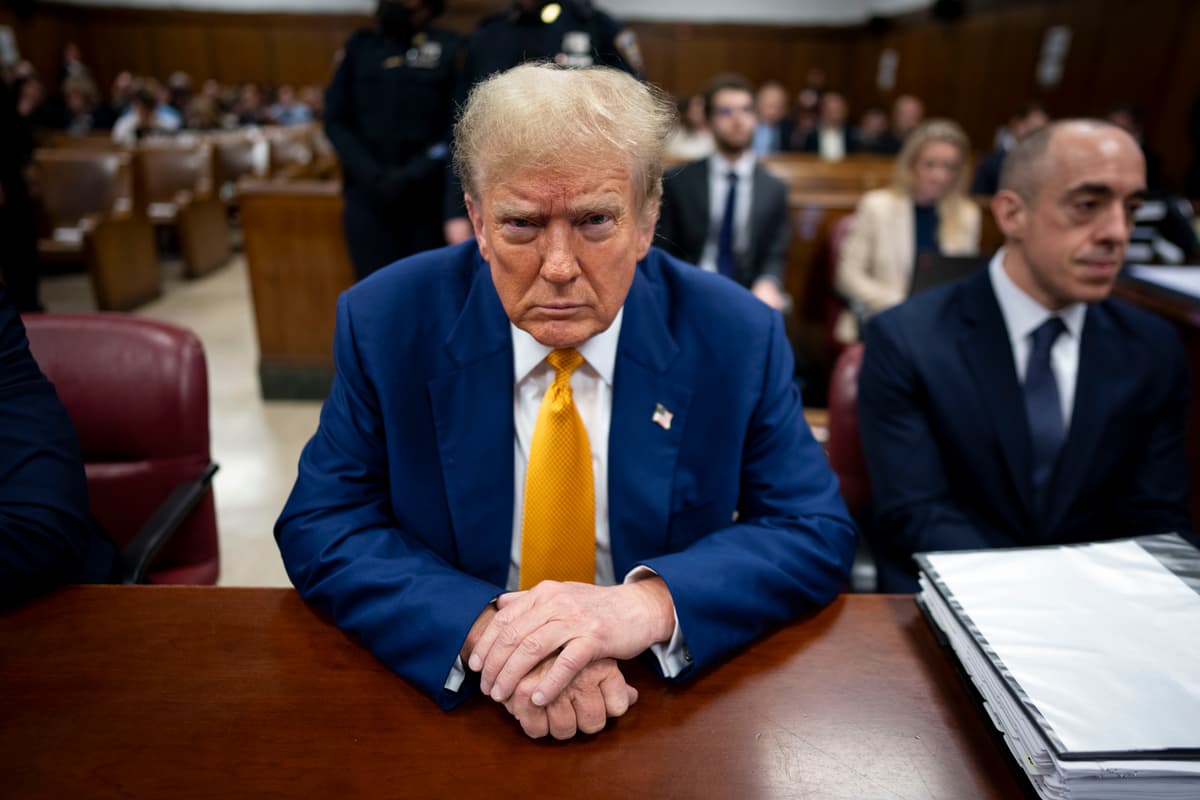
A powerful legal argument is emerging for why President Trump’s status as a convicted felon ought to share the fate of the Dodo — that his constitutional rights were violated by a New York judge, Juan Merchan, in the Stormy Daniels hush money case.
The case for a reversal comes from a legal scholar, Seth Barrrett Tillman, and the Landmark Legal Foundation. Their amicus brief to the New York Supreme Court Appellate Division, First Department — the body that will hear Trump’s appeal —argues that the court should overturn Mr. Trump’s 34 felony convictions. The case involves payments to Stormy Daniels, whose real name is Stephanie Clifford, over an alleged sexual encounter at Lake Tahoe in 2006.
While falsification of business records in New York is usually a misdemeanor, the Manhattan district attorney, Alvin Bragg, contended — and Judge Merchan concurred — that if that falsification was done in the service of a second crime, the violation became felonious. Furthermore, Mr. Bragg contended that he didn’t need to tell the defense which “second crime” he was alleging. Judge Merchan complied, telling the jury that they need not agree on the nature of that second crime, only that one existed. The Manhattan jury took those marching orders and brought in a conviction.
Judge Merchan’s instructions to the jury dictated that “although you must conclude unanimously that the defendant conspired to promote or prevent the election of any person to a public office by unlawful means, you need not be unanimous as to what those unlawful means were.”
Unanimity was not always a requirement to convict. Nowhere in the Constitution is the requirement found that all jurors must agree on a verdict. In 1898, the Supreme Court held in federal cases that a defendant possessed the “constitutional right to demand that his liberty should not be taken from him except by the joint action of the court and the unanimous verdict of a jury of twelve persons.”
State criminal trials, though, were not bound by a unanimity requirement, which suggests that it was not understood to be mandated by the parchment. It was only in 2020, in the case of Ramos v. Louisiana, that all criminal trials — state as well as federal — required unanimity to convict. The Nine found that obligation to be contained in the Sixth and Fourteenth Amendments.
The majority opinion in Ramos, written by Justice Neil Gorsuch cited racial animus as animating attachment to non-unanimous juries. The Coloradan writes that “Courts in both Louisiana and Oregon have frankly acknowledged that race was a motivating factor in the adoption of their states’ respective non-unanimity rules.” Justice Gorsuch traces the unanimity requirement to the Constitution’s command that juries be “impartial.”
The Sixth Amendment also demands that defendants be “informed of the nature and cause of the accusation” against them. The unspecified nature of the second crime Mr. Trump is alleged to have committed could be seen as betraying the promise of that constitutional command.
Mr. Tillman insists that Mr. Trump’s “constitutional right to a unanimous verdict was infringed” by Judge Merchan’s “erroneous jury instruction,” which ordered that the “jurors did not need to reach a unanimous agreement as to what were the ‘unlawful means’” to which the payments were devoted. Mr. Tillman writes that the instructions violated “the most basic conceptions of traditional American jury rights and due process.”
That is because, in Mr. Tillman’s reckoning, “where a statute adopts other criminal law or legal violations as a predicate, for that predicate to be established, the jury must be unanimous in regard to that separate predicate … even if the defendant has not actually been separately charged with that statutory criminal predicate or otherwise held liable under it.”
Courts have denounced as “fatally ambiguous” the arrangement endorsed by Judge Merchan because, as an Indiana tribunal put it, “it is impossible to determine whether the jury unanimously found that the government committed one particular offense.” In this case, the possibilities for a second crime committed by Mr. Trump include campaign finance violations or tax fraud related to the $130,000 in hush money he paid Ms. Clifford, via his erstwhile attorney, Michael Cohen.
One trial handbook maintains that “instruction that the jurors must unanimously agree on a single theory is required when any one of several alternative actions would subject the defendant to criminal liability” and the “actions are conceptually different.” Mr. Tillman argues that Judge Merchan’s “instructions squarely departed from settled practice.” That is because, Mr. Tillman adds, Supreme Court precedent mandates that any fact that “increases the penalty to which a defendant is exposed must be unanimously decided by a jury beyond a reasonable doubt.”
Justice Neil Gorsuch, in a Supreme Court opinion last year, wrote that “By requiring the Executive Branch to prove its charges to a unanimous jury beyond a reasonable doubt, the Fifth and Sixth Amendments seek to mitigate the risk of prosecutorial overreach … those amendments similarly seek to constrain the Judicial Branch, ensuring that the punishments courts issue are not the result of a judicial ‘inquisition’ but are premised on laws adopted by the people’s elected representatives.”
Mr. Trump’s own appellate brief argues that “permitting the jury to convict President Trump without unanimously agreeing on the ‘unlawful means’ at issue also violated the Due Process Clauses of both the U.S. and New York Constitutions.” The 47th president cites the Supreme Court for the proposition that the “Constitution itself limits a State’s power to define crimes in ways that would permit juries to convict while disagreeing about means.”
Mr. Trump cites other reasons for reversal of the verdict as well, including contending that Judge Merchan should have recused himself from hearing the case because of small donations the jurist made to Democratic candidates — including then-Candidate Biden — in the 2020 election. Judge Merchan’s adult daughter, Loren, also has provided consulting services for Democrats, including Vice President Harris’s campaign.
Mr. Trump was particularly focused on the question of Ms. Merchan’s partisan activities, which were legion. Judge Merchan gagged Mr. Trump, fined him, and threatened to imprison him if he would not stop raising the subject of Judge Merchan’s partisan daughter. Through it all, Judge Merchan refused to recuse himself.
Mr. Trump said repeatedly that Judge Merchan “hates” him.
For Mr. Bragg, winning a felony conviction alone was victory enough. When sentencing finally came around, in early January of this year, circumstances had changed dramatically since the spring of 2023 when he was arraigned on the charges. Judge Merchan gave Mr. Trump, at the time the president-elect, a “constructive discharge” — effectively no penalty beyond the stain of a felony conviction. It’s this stain that Mr. Trump wants out.
Mr. Tillman was also a champion of the formerly long shot- position that Special Counsel Jack Smith was unlawfully appointed by Attorney General Merrick Garland. Judge Aileen Cannon eventually came around to that position, disqualifying Mr. Smith and dismissing the Mar-a-Lago charges against Mr. Trump and his two co-defendants.
New York appellate courts are no strangers, when Mr. Trump is involved, to reversing trial court decisions. In August the $500 million civil fraud penalty imposed on Mr. Trump by Judge Arthur Engoron was wiped away by the same tribunal that will now hear the appeal in the hush money case. The court ruled that the sum violated the Constitution’s prohibition on “excessive fines.”
Now Mr. Tillman, on a telephone call from Ireland, where he teaches, tells the Sun that many of the liberal legal sages who usually line up against Mr. Trump are demurring from predicting that Judge Merchan’s instructions will hold up. Mr. Tillman reasons that “it is not because they have come around to Mr. Trump’s position. It is because they expect the verdict to be overturned.”